China's First Humanoid-Robot Listing
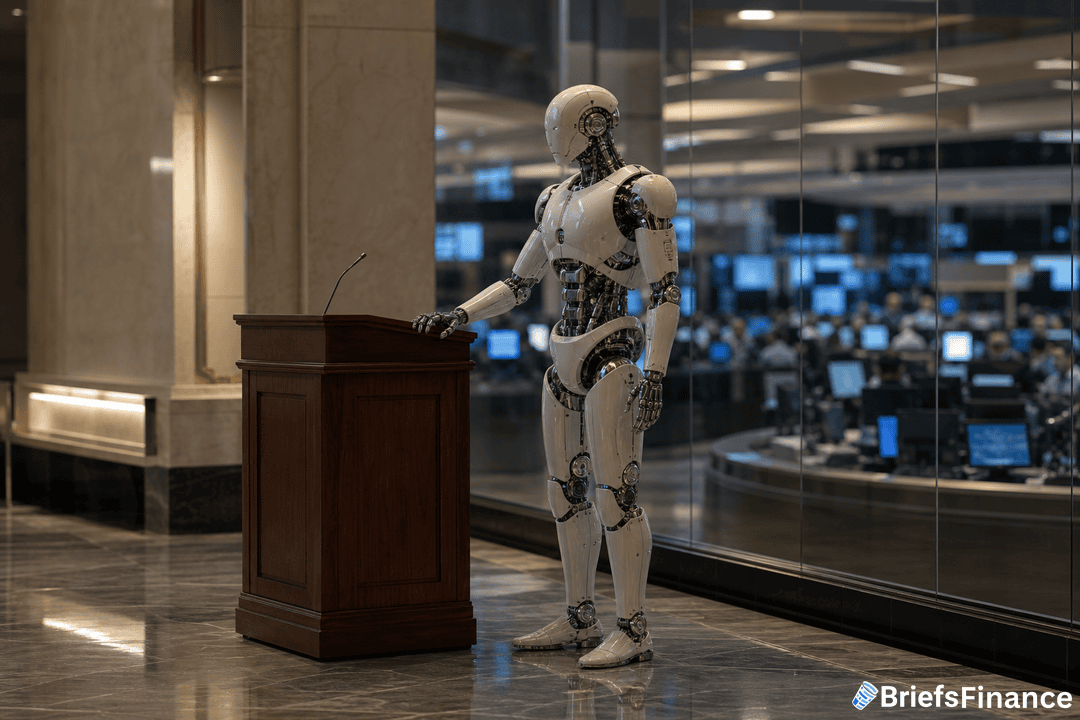
If you watched China's Spring Festival Gala, you have already seen these robots - those were the machines that danced on the national stage during the annual celebration. Now you can buy a piece of the company that made them.
Unitree Robotics starts trading on Shanghai's exchange Wednesday, August 18.
The deal was a hit before the first trade. The offering comprised 40.4 million shares priced at 150.8 yuan each, giving the Hangzhou company a value of about 61 billion yuan.
Part of the frenzy has to do with price. Regulators keep IPO prices conservative, requiring issuers to benchmark against peers in China and abroad, and they have discouraged rich valuations to protect retail investors.
Crypto contracts tied to Unitree have also surged ahead of the debut, with futures indicating a rise of more than 300% on the first day.
The Bull Case: A Mass-Production Turning Point
The frenzy is about more than one company. It is about a shift in the AI story.
Investors are moving from AI models that talk to AI that does physical things. That is what people mean by "embodied AI," and Beijing has made humanoid robots a strategic priority right alongside semiconductors.
The best financial decisions come from understanding the whole picture. Join Market Briefs free and get the full brief each morning.
JPMorgan's case for the sector rests on faster commercialization, localized supply chains, and rising policy support.
JPMorgan expects China to make up more than half of global demand.
Unitree stands to benefit if that growth happens. The company says it shipped more than 5,500 humanoid robots in 2025, more than any other maker, and its four-legged robots have sold more than 33,000 units in total.
The financials tell the same story: revenue hit 1.7 billion yuan in 2025, up from 393 million yuan the year before, while profit after tax came to 278 million yuan and gross margin stayed above 60%.
The company's origins trace back to 2016, when founder Wang Xingxing started building quadruped robots from his dorm room at Shanghai Jiao Tong University. That early focus on legged locomotion gave Unitree a head start in actuators and balance control, two of the hardest engineering challenges in robotics. Its transition from four-legged to two-legged machines has been closely watched by industry observers who see the company as a bellwether for China's broader robotics ambitions.
A Rich Price and a Long Road Ahead
There is a tension at the heart of this deal. Unitree's IPO pricing works out to 35.89 times sales, while Hong Kong-listed rivals Dobot and UBTech go for about 20 times sales.
Bo Ben, CEO of Lam Harmo Capital Co., says that lead is already priced in. "At the IPO price, Unitree's valuation already implies fairly optimistic expectations," he said.
"The long-term test is whether Unitree can turn its hardware lead into advances in AI capabilities," he added. The focus has shifted, with investors paying more attention to the software and environment-modeling systems that control robots than to the hardware specs alone.
Unitree plans to put about 4.2 billion yuan of the IPO cash into embodied-AI models, humanoid-robot R&D, and new products. Big-name backers signed on, with strategic investors taking about 20% of the offering.
They include DeepSeek, a Tencent-affiliated vehicle, and investment arms of state-owned China National Petroleum Corp., China Southern Power Grid Co., and China Telecom Corp.
DeepSeek received a 2.31% stake that it cannot sell for three years, and Unitree can use its AI expertise for robot models. Tencent-linked investors also subscribed and agreed to cooperate on robotics AI models and deployment scenarios.
A smooth debut could open the door for other Chinese robotics candidates, like Leju Robotics and Deep Robotics. Local media say Shanghai AgiBot Innovation Technology has already started preparing a Hong Kong listing.
For investors, the bigger question is whether the hype survives contact with reality. Pilot projects are growing and shipment forecasts are strong, but many industry players warn that adoption will be slow.
Broad use still needs better AI models and more training data from the real world. That is the test for Unitree, and for anyone sizing up the humanoid-robot sector.
The robots are impressive, and the stock is priced as if a lot will go right. The gap between those two things is where the opportunity and the risk live.
Markets move every day, and most of it never reaches you in time. Get the free Market Briefs daily newsletter and stay ahead of it.