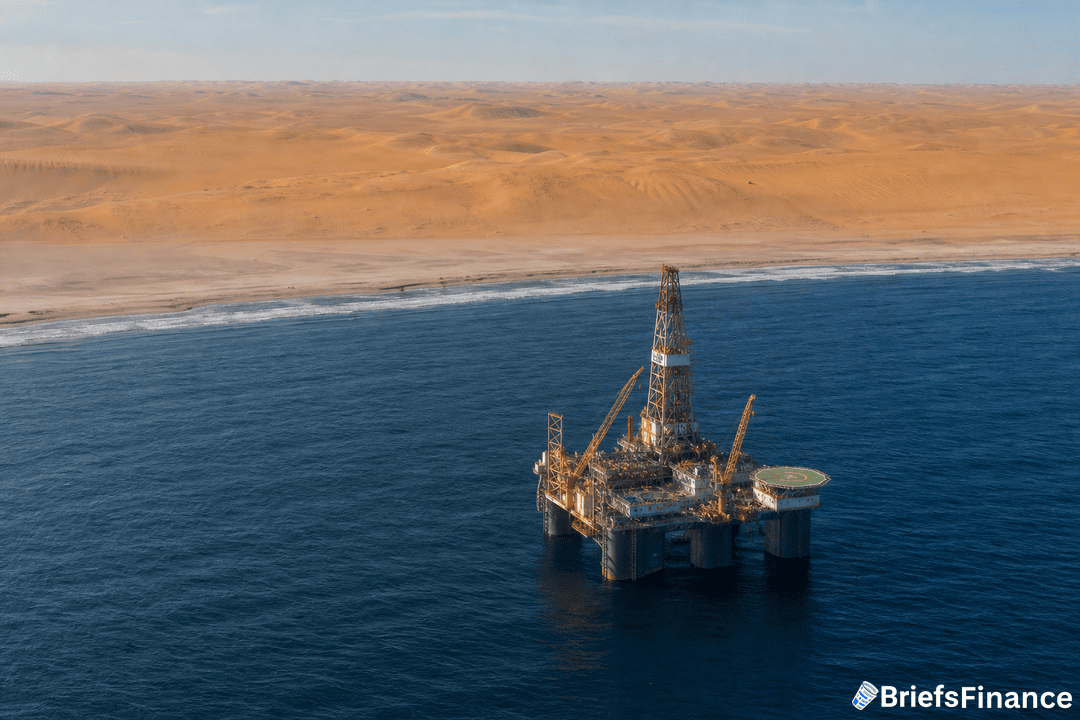
A Bet on a Second Try
Finding oil is an expensive gamble. Companies can map an area, drill a well, and still walk away empty-handed. Chevron's initial well in Namibia came up dry.
But Chevron is not packing up. It plans to drill another well in license 90 later this year. On Tuesday, Equinor said it is purchasing a 17.4% interest in the license from Harmattan Energy, a Chevron affiliate that operates the block.
That illustrates the lengthy timeline and the patience needed for such ventures. There is a real chance the next well misses too. But if it hits, Equinor has a cheap seat that can help fill its energy pipeline.
What Big Oil Sees in This Neighborhood
The Orange Basin has become one of the most crowded exploration areas on the continent. TotalEnergies, QatarEnergy, BP, and Eni are all exploring, along with smaller independents.
Just like drilling for oil, building wealth takes patience and consistency, so get the free Always Be Buying eBook.
Chevron is not betting the whole project on a single well. The new partnership lets a few companies share the upfront cost and the risk, while no single player has to absorb all the downside if the next attempt is empty.
The stakes are high. For Chevron, a second dry well would be a costly setback, but a successful discovery could open a new frontier. For Equinor, the entry is a relatively small bet that could pay off handsomely if the well hits. The basin's geology is complex, and each well provides new data that helps refine the understanding of the subsurface.
The basin has already humbled some players. Shell had to accept a $400 million loss on its wells in Namibia, as the company could not see a way to make them profitable. Still, Shell is back this year with another drilling campaign, this time with QatarEnergy and Namcor. Whatever it may have written off, it still sees a chance.
There is a path to profitability if drilling and extraction costs are low enough, but that is a big if. That is exactly the harsh financial math Chevron and Equinor are now facing.
Equinor's Broader Strategy
This move also sheds light on Equinor's broader strategy. The company is expanding beyond its home base and boosting its oil and gas output. It has been making acquisitions. This summer, Equinor took full control of a BP oil project, and separately paid $940 million for a stake in a U.S. natural gas power plant.
One reason is the same as buying into license 90: Equinor is willing to spread its bets across energy and geography. It wants more sources of cash and fewer single points of failure. But not all bets will pay off; most are still tied to a single well.
What This Means for Investors
The more you look at an oil company story, the more license 90 could matter. You don't need to know every detail. But if you hold shares in any of these companies, you are indirectly exposed to this kind of exploration risk.
Every barrel of oil starts somewhere. The barrels that one day come from license 90 will be produced by companies that dared to drill when others wouldn't. That is the bet Chevron and Equinor are making.
Investors in Chevron and Equinor won't see an immediate change. The long, unglamorous work is still ahead. But when a company brings in a partner, it's a sign they believe the risk is worth taking.
When one well comes up empty, smart investors keep trying, and your money can too with the free Always Be Buying eBook.