Free NewsletterPro Login

Warning: Undefined variable $stocks in /var/www/briefs.co/htdocs/wp-content/plugins/oxygen/component-framework/components/classes/code-block.class.php(133) : eval()'d code on line 448

Warning: foreach() argument must be of type array|object, null given in /var/www/briefs.co/htdocs/wp-content/plugins/oxygen/component-framework/components/classes/code-block.class.php(133) : eval()'d code on line 448

Warning: Undefined variable $funds in /var/www/briefs.co/htdocs/wp-content/plugins/oxygen/component-framework/components/classes/code-block.class.php(133) : eval()'d code on line 472

Warning: foreach() argument must be of type array|object, null given in /var/www/briefs.co/htdocs/wp-content/plugins/oxygen/component-framework/components/classes/code-block.class.php(133) : eval()'d code on line 472
/* the link was here */

EV Demand Perks Up As Tesla And Rivian Beat Q3 Forecasts

Published Oct 3, 2026
Share:
Summary:
  • Tesla sold 486,532 EVs in Q3, topping roughly 464,000 expected; Rivian delivered 19,248 versus about 17,600 forecast.
  • Hyundai and Ford say dealers want more EVs; Hyundai's Randy Parker links the pickup to gas prices and the war.
  • EV share is hovering near 6% this year, down from an all-time high near 11% last Q3; dealer EV supply fell to 78 days in August from about 180 days in early 2026.

Q3 Sales Surprises, With Dealers Asking For More

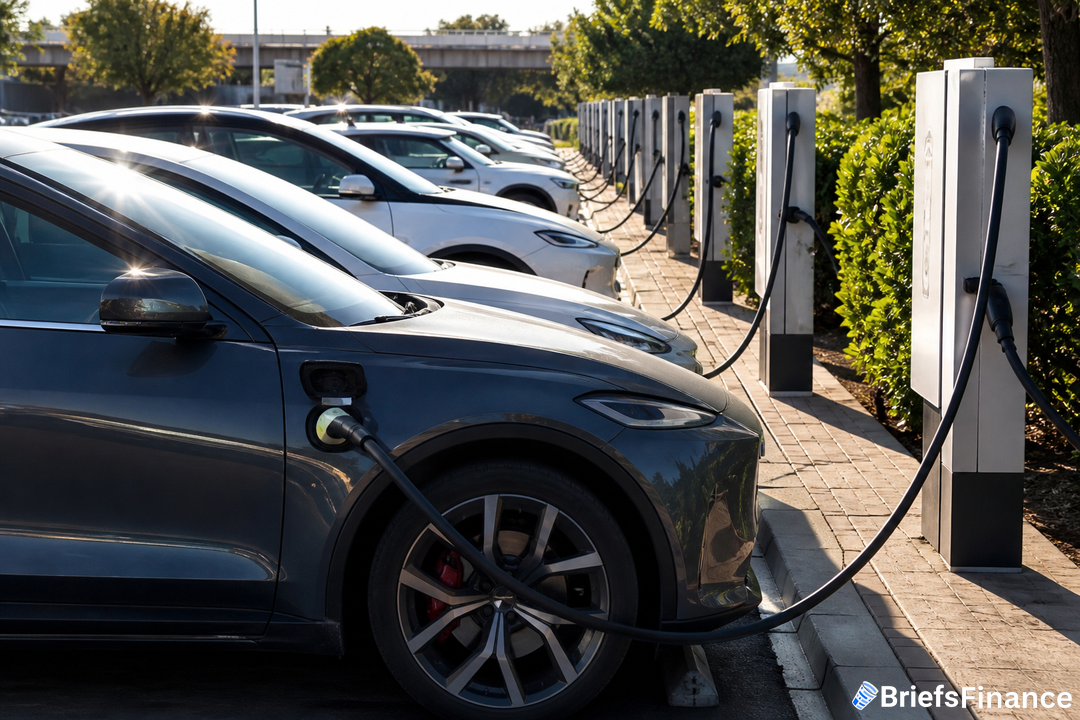
EVs just notched a few wins. Tesla moved 486,532 vehicles in the third quarter, beating the roughly 464,000 analysts penciled in, even as it slipped 2.1% from last year's rush-fueled record. Rivian delivered 19,248, ahead of about 17,600 expected. In a note, JPMorgan's Rajat Gupta said the results likely benefited from the first full quarter of R2 shipments, calling it a "strong sequential step-up." The midsize SUV aims at a broader audience at around $50,000, well below the larger R1 lineup.

Momentum is showing up beyond the headliners too, with lower-volume EVs from Toyota and General Motors' Cadillac brand gaining some traction. That, plus Tesla and Rivian's beats, has some watchers seeing early signs of an EV demand reset.

Dealers are feeling it on the ground. Leaders at Hyundai and Ford say stores are asking for more battery-powered inventory as shoppers circle back.

After A Surge, A Slump, And Now A Settle

The market looks like it's finding a new baseline after last year's whiplash tied to the end of federal EV purchase subsidies. A Republican-backed measure signed by President Donald Trump scrapped the $7,500 federal EV tax credit a year ago as part of his effort to unwind what he calls an "EV mandate." The pending expiration pulled demand forward, pushing EV market share to a record near 11% in last year's third quarter, then left dealers with too many unsold cars once the rush faded.

So where are we now? Cox Automotive says EVs have stabilized near a 6% share of the US market this year. Lots have thinned out too, with EV inventories dropping from about a 180-day supply in early 2026 to 78 days in August, roughly in line with gasoline models.

The same speed bumps still slow broader adoption: patchy charging networks, higher upfront prices, fewer choices, and range anxiety. Even with elevated fuel costs making plugs more appealing, many automakers are still posting weaker EV sales versus a year ago. Shoppers are gravitating to gas-electric hybrids and snapping up used EVs that are often priced like comparable gas cars.

Quarterly delivery numbers tell you more about real EV demand than any forecast does. Market Briefs breaks down the data free every morning.

What Automakers And Dealers Are Seeing Now

Hyundai pivoted toward hybrids when EV sales cooled and is not planning to raise EV production even as dealers ask for more, according to Randy Parker, CEO of Hyundai's North America business. "Because of the war, because of gas prices, we've also seen a rise and a recovery in EV sales," he said. "I've got more and more dealers now asking for EV product." On Thursday he added, "Always better to have one or two vehicles too few than have one too many," noting the market remains volatile for the same reasons and could shift again quickly.

Ford has overhauled its money-losing EV unit, canceling multiple models and disclosing $19.5 billion in charges. Even there, dealers are asking for more electrics. On Friday, Ford's US sales chief Rob Kaffl noted that a dealer had contacted him that morning to get assistance for two buyers looking for a particular Mach-e, the Mustang-inspired electric SUV in Ford's lineup. "We're seeing a lot of returning Mach-e customers who want to get back into another EV," he said, while adding that "the demand on Mach-e continues to be strong."

What It Means For Your Portfolio

The floor under EV demand looks firmer than it did a few quarters ago. Tesla cleared a tough year-ago comparison and still beat estimates, while Rivian outpaced forecasts with help from the R2 landing at a lower price point. Earlier this year, a team at TD Cowen headed by Itay Michaeli forecast that the US market could recover in 2027 or 2028 as newer vehicle generations and additional self-driving capabilities hit the road. "We are still in the early stages of this looming EV comeback," Michaeli said in an interview Friday. "EV market coverage, by our estimation, will grow substantially in the next couple of years by existing players."

For your money, three things to watch: slimmer inventories that can support cleaner sell-through, more upbeat dealer chatter that often leads orders, and quarterly beats that can sway sentiment even as hybrids and used EVs keep winning budget shoppers.

Tesla, Rivian, and the rest of the EV trade reprice on numbers like these. Get the free Market Briefs daily newsletter and keep up.

Disclosure

Recent News

1 2 3 … 92

Get Market Briefs delivered to your inbox every morning for free!

No fluff. No noise. No politics. Just finance news you can read in 5 minutes.

Blogs

October 2, 2026
Fed Interest Rates May Rise Again in 2026 - and the Newest Culprit Is AI
  • Fed Governor Barr told a meeting our head of investing research attended that higher rates are likely in 2026, lower inflation may not come soon, and AI is now pushing prices up.
  • The same week, President Trump asked the biggest AI companies to police themselves under an accord that's morally but not legally binding, because the White House sees AI as a race with China.
  • Higher rates put downward pressure on asset prices and squeeze borrowers, but the way through hasn't changed: own investments, buy on a schedule, and treat downturns as discounts.
Read More
October 1, 2026
Housing Market 2026: Why Office Buildings Are Cracking Before Houses Do
  • Office buildings are selling for 80% to 95% off because their five-year loans are resetting at much higher rates while half-empty floors have gutted the income those buildings are valued on.
  • Housing is under pressure, not cracking: a $400,000 mortgage costs $975 more a month than at 3%, but six of every seven mortgages are still under 6% and those owners are staying put.
  • Whether pressure turns into cracks is a race between unaffordability and the economy, and either way Jaspreet's rule is to treat your house as a liability and buy only what you can afford.
Read More
September 30, 2026
Dividend Investing vs. Growth Investing: Why the Slower Portfolio Can End Up Bigger
  • "What stock should I buy?" is the wrong first question. Growth, income, or wealth preservation comes first, and the goal changes which stocks even make sense.
  • At $500 a month for 30 years, 13% growth builds about $1.75 million. 10% growth plus a reinvested 4% dividend builds a little more than $2.2 million and pays a little more than $80,000 a year.
  • Income investors have US dividend ETFs, REITs, and international dividend funds to study. Growth investors have the Nasdaq 100, AI and chip funds, and small caps. None of it is a recommendation.
Read More
September 29, 2026
Why Is Gold Going Down? A 5.2% Treasury Yield Just Took Its Job
  • President Trump rejected Iran's deal to reopen the Strait of Hormuz, oil prices jumped back up, and gold fell instead of rising.
  • Treasury yields hit their highest level in more than 20 years, so investors sold gold and bought Treasuries that pay interest.
  • Higher Treasury yields make the national debt, mortgages, car loans, and credit cards more expensive, with the Fed's next rate decision due October 28.
Read More
September 28, 2026
The Strategic Bitcoin Reserve: Why the Government Wants Bitcoin to Explode
  • The US government holds about 328,000 Bitcoin, worth roughly $25 billion, and since a 2025 executive order it keeps seized coins instead of selling them.
  • Washington wants a bigger pile of assets so its $40 trillion national debt looks smaller next to them, which lets it keep borrowing and spending.
  • Bitcoin's wild price swings, and a government holding a coin built to escape governments, are the two risks investors need to watch.
Read More
September 25, 2026
BRIEFS EXCLUSIVE: 43% Of Respondents Say Bills Outran Their Income Over Past Two Years
  • 43% of the 494 Market Briefs readers surveyed said their bills grew faster than their income over the past two years, even though 79% could cover a surprise $5,000 expense tomorrow.
  • Half of readers own gold or crypto, the two classic bets against a weaker dollar, and only 13% bought nothing at all in the last 12 months.
  • The median reader says it takes $150,000 a year to feel financially secure, about $62,000 above the U.S. median household income.
Read More
September 25, 2026
The Economy Is Booming. So Why Did Stocks and Bonds Fall Together?
  • S&P Global says the US economy is growing at its fastest rate since 2021, with corporate profits up 28.9% in a year, almost four times the historical average.
  • Stocks and bonds fell at the same time, which is not how the two markets normally behave, because Treasury yields above 5% now compete with stocks for investors' money.
  • Jaspreet Singh lays out three ways to invest through a shift like this: always be buying, buy the crash, or follow the money before it hits the headlines.
Read More
September 24, 2026
The 2026 Economic Reset Is Starting: Are We in a Recession, or Is the Pain Still Ahead?
  • The Federal Reserve has flipped from stimulating the economy to fighting inflation with higher interest rates, while the White House still wants growth at almost any cost.
  • The national debt tops $40 trillion, has outgrown the entire U.S. economy, and its interest payments are now the government's fastest-growing expense.
  • Higher rates bring pain for private equity, private credit, and speculative assets, but they open opportunities for investors holding cash, treasuries, and value assets.
Read More
September 23, 2026
Are We in a Recession? Without AI, America Might Already Be in One - and Washington Knows It
  • The White House attributes about three quarters of U.S. economic growth to AI, and many believe the economy would already be in a recession without it.
  • Washington has three reasons it cannot let the AI boom slow down: staying the world's superpower, outgrowing $40 trillion in national debt, and protecting a government stock portfolio worth billions.
  • Every market goes through booms and busts, and investors who understand the cycle get to buy the downturn instead of panic-selling with the crowd.
Read More
September 22, 2026
Will Interest Rates Go Down in 2026? Where the Money Moves Either Way
  • The Fed is leaning toward higher rates to fight 4% inflation, while the White House and a cracking job market push the other way.
  • If rates rise, money has tended to move toward short-term Treasuries, floating-rate loans, energy, banks and dividend payers.
  • If rates fall, it has tended to move toward gold, silver and Bitcoin, real estate, small caps, the S&P 500 and speculative bets.
Read More
1 2 3 … 28
Share via
Copy link










