Warning: Undefined variable $stocks in /var/www/briefs.co/htdocs/wp-content/plugins/oxygen/component-framework/components/classes/code-block.class.php(133) : eval()'d code on line 448
Warning: foreach() argument must be of type array|object, null given in /var/www/briefs.co/htdocs/wp-content/plugins/oxygen/component-framework/components/classes/code-block.class.php(133) : eval()'d code on line 448
Warning: Undefined variable $funds in /var/www/briefs.co/htdocs/wp-content/plugins/oxygen/component-framework/components/classes/code-block.class.php(133) : eval()'d code on line 472
Warning: foreach() argument must be of type array|object, null given in /var/www/briefs.co/htdocs/wp-content/plugins/oxygen/component-framework/components/classes/code-block.class.php(133) : eval()'d code on line 472
/* the link was here */
×
Free investor livestream — Nov 17
How To Use ChatGPT & Claude To Research Stocks Like A Pro
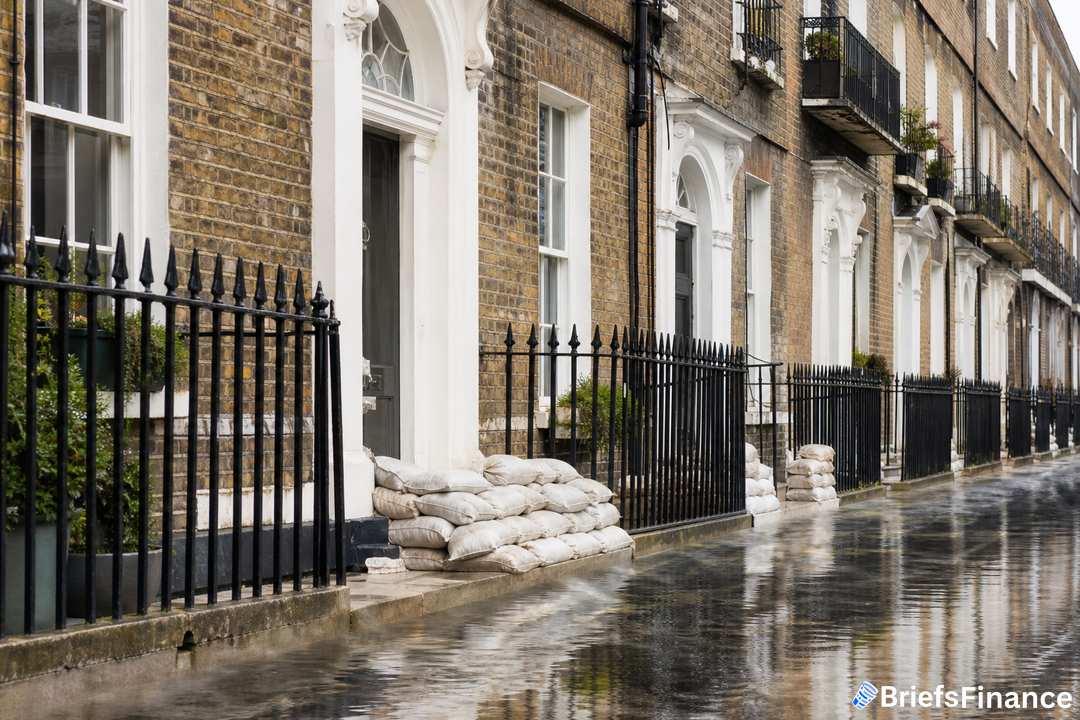
Savills' buying arm Prime Purchase warns many luxury London properties are ill-suited for more frequent extremes like heatwaves and flash floods.
Officials say climate pressures are mounting: nearly 320,000 London addresses face high surface-water flood risk, and City Hall now labels extreme heat a major and growing health threat.
Flood cover is tightening: Flood Re only applies to pre-2009 homes, a July plan curbs support for multimillion-pound properties from 2028, and many flats are excluded.
What buyers are running into right now
London's hottest season underscored a problem at the top of the market: a lot of prime homes are simply not built for today's climate shocks. That is the view of Guy Meacock, a director at Prime Purchase, which represents buyers in the upper tier. He says heat resilience is becoming a bigger deal across some of the city's priciest postcodes, and that too many elite properties still fall short.
Cooling is a particular sticking point. Fewer than 1 in 10 homes across the UK have air conditioning. Meacock says overseas clients are taken aback at how rare AC is in high-end London stock, so "your pool of potential properties suddenly shrinks." As he put it, "We are dealing with a lot of American buyers at the moment and the subject of air conditioning for them comes up every single time."
Even basic solutions are a headache. Buyers report that items like shutters and awnings can be surprisingly hard to secure for marquee addresses. Heritage rules add to the friction, especially in Westminster and Kensington & Chelsea, where a high concentration of protected buildings can make retrofits a slog.
Flood risk is rising, and the safety net has holes
Short, intense rainstorms linked to climate change are putting more homes in harm's way, including properties with vast basements that are proving tougher to insure. The government's Environment Agency said in July that close to 320,000 homes and businesses in London are now considered at high risk from surface-water flooding. A month later, the Mayor of London's office warned that extreme heat is a "major and growing public health threat," noting that 86% of Londoners surveyed said their homes overheated.
Insurance is getting harder to secure. Flood Re, the state-backed backstop for flood insurance, covers only properties built before 2009, and apartments located in blocks with over three units fall outside its remit. In July, Flood Re set out changes aimed at avoiding outsized benefits for wealthy homeowners, meaning commercial insurers with multimillion-pound properties will lose some of the public support they once had. The shift is expected to start in 2028.
"They just manage without flood insurance," she said, adding that while such owners "may well be asset rich," they are not always "day-to-day wealthy."
How insurers are adapting, and the knock-on for deals
Brokers say worries about insurability are already chilling transactions. At Howden Group, staff are fielding calls from clients anxious that a sale could collapse if buyers cannot get cover. Its position near the river Thames and ineligibility for Flood Re initially left buyers unable to secure a policy.
Seatter says a typical commercial carrier would see the site flagged as flood prone, note it was a second home built after 2009, realize it could not be passed into Flood Re, and stop there. In this instance, after a deeper review showed the precise riverside location wasn't the deal-killing hazard it seemed, Howden secured coverage underwritten by a US insurer. He adds that carriers who dig deeper are winning business from rivals spooked by the headline trend. "From a flood risk perspective, we're doing this all the time," he said. With more homes landing in flood affected areas, if an insurer can shift exposure and push more cost to the client, "why wouldn't you?"
The market backdrop and what it means for your wallet
This all arrives on top of a market already squeezed by expensive mortgages. Lloyds Banking Group's latest read shows Nationwide's index turned negative year over year in August for the first time since 2023. Savills says prime central London values are 26% below their 2014 peak.
Meacock warns that if London is seen as having "architecture that's fundamentally not fit for purpose," values could feel it. He singles out the golden postcodes in Kensington and Chelsea and parts of Westminster as uniquely sensitive to shifts in overseas sentiment. With roughly half of buyers in those areas coming from abroad, sellers "can't rely purely on domestic wealth, especially not with the current tax climate."
Translation for your money: if you own or are eyeing a trophy address, climate readiness and insurability are no longer nice-to-haves. They are part of the price, part of the timing, and increasingly part of whether a deal even gets done.
Anthropic has gone public at a valuation of about $1.5 trillion, while Amazon went public in 1997 at around $440 million. Anthropic has about $33 billion in revenue this year and no profit, and investors are paying more than 40 times its sales, against about 3 times for Amazon. Briefs Finance CEO Jaspreet Singh says nobody knows what comes next, and that long-term investors use downturns to buy instead of panic selling.
Tech stocks are selling off because investors don't know who will lead Nvidia, the company that has been funding the AI industry and selling it chips.
Inflation has the Federal Reserve planning to raise interest rates, with a hike expected in December, and that puts pressure on homebuyers, private equity and the $40 trillion national debt.
Briefs Finance CEO Jaspreet Singh says nobody has a crystal ball, so his rules are to buy when markets are low, hold long term and invest only what you're willing to lose.
The national debt is above $40 trillion, and the Federal Reserve has gone from sending Washington its profits to losing money.
President Trump's four-part plan leans on shorter-term debt, stablecoin companies buying Treasuries, a bigger balance sheet and government stakes in private companies.
The goal is to outgrow the debt, not pay it off, so Jaspreet Singh points investors to the seven industries where Washington wants growth.
The Fed makes its next rate decision on December 9 and is now talking about jumbo interest rate hikes of 0.5%, though one in December looks unlikely.
Washington will pay a record $1.05 trillion in interest this year on $40 trillion of debt, and that debt resets at higher rates as the Fed hikes.
Jaspreet Singh's five moves are to pay down variable-rate debt, earn interest on your savings, know which stocks feel the pressure, look at value and hedge.
Margin debt, the money investors borrow to buy stocks, is at a record of around 4.6% of GDP, up from 3.9% in 2021.
ETF money has more than tripled in five years to 7% of GDP, while corporate buybacks and 401(k) money sit below their earlier peaks.
Margin calls and panic selling can make the next downturn deeper, so Jaspreet Singh keeps buying broad market funds and says most investors should skip margin debt.
Jensen Huang is out at Nvidia over affairs with multiple people, and the company he founded has been the bank of American AI, with about $30 billion into OpenAI and $10 billion into Anthropic.
A hotter-than-expected inflation report has Fed officials talking about a possible 0.5% hike in December, and gold, silver, and bitcoin fell on the news.
President Trump said the US may not need a deal with Iran, keeping oil prices and inflation risk high. Jaspreet Singh breaks down what it all means for AI stocks and your portfolio.
Stocks are booming at the fastest pace in years, jobless claims just hit a 57-year low, and most investors still feel like nobody is hiring.
The Fed is protecting the dollar over the economy, oil swings on every Iran headline, and a few AI companies are carrying an S&P 500 where four of five stocks sit in a correction.
Jaspreet Singh explains why circular financing between Nvidia, OpenAI, Anthropic, and SpaceX rhymes with 2008's house of cards, and how his three investing pillars handle a stock market bubble.
The Fed has raised rates, cut them, then raised them again only twice in the last 60 years, and both times the economy fell into a recession and stocks crashed.
The same stop-and-go cycle is playing out now, with one big difference: US debt is 125% of GDP today versus about 30% in 1980.
In the 1970s gold rose roughly 24x, real estate 157%, stocks lagged, and cash lost half its value. Jaspreet Singh lays out five assets to consider before the next flip.
The IRS 2027 tax plan keeps the same seven rates but widens every bracket and lifts the married-filing-jointly standard deduction to $33,200.
The 0% long-term capital gains bracket rises to $102,100, so a household living on $135,300 of investment income could owe $0 in federal income tax.
C corporations still pay 21%, small businesses keep the 20% QBI deduction, and the 401(k) limit climbs to $25,500 with an $8,500 catch-up for investors over 50.
Make sure to check your inbox for the first email.
Before you go
We’re hosting our first ever livestream on how investors can use ChatGPT & Claude to invest like a pro. It’s on 11/17 and is hosted by our CEO Jaspreet Singh.