Free NewsletterPro Login

Warning: Undefined variable $stocks in /var/www/briefs.co/htdocs/wp-content/plugins/oxygen/component-framework/components/classes/code-block.class.php(133) : eval()'d code on line 448

Warning: foreach() argument must be of type array|object, null given in /var/www/briefs.co/htdocs/wp-content/plugins/oxygen/component-framework/components/classes/code-block.class.php(133) : eval()'d code on line 448

Warning: Undefined variable $funds in /var/www/briefs.co/htdocs/wp-content/plugins/oxygen/component-framework/components/classes/code-block.class.php(133) : eval()'d code on line 472

Warning: foreach() argument must be of type array|object, null given in /var/www/briefs.co/htdocs/wp-content/plugins/oxygen/component-framework/components/classes/code-block.class.php(133) : eval()'d code on line 472
/* the link was here */

Your Car's Getting Smarter. Your Repair Bill Is Too.

Published Oct 4, 2026
Share:
Summary:
  • A Brooklyn shop owner says keeping up with car tech now means buying more computers, software and calibration gear, and some of those costs land on customers.
  • Repair prices climbed about 60 percent from January 2019 to August 2026, nearly double overall inflation's 32 percent rise, per the St. Louis Fed.
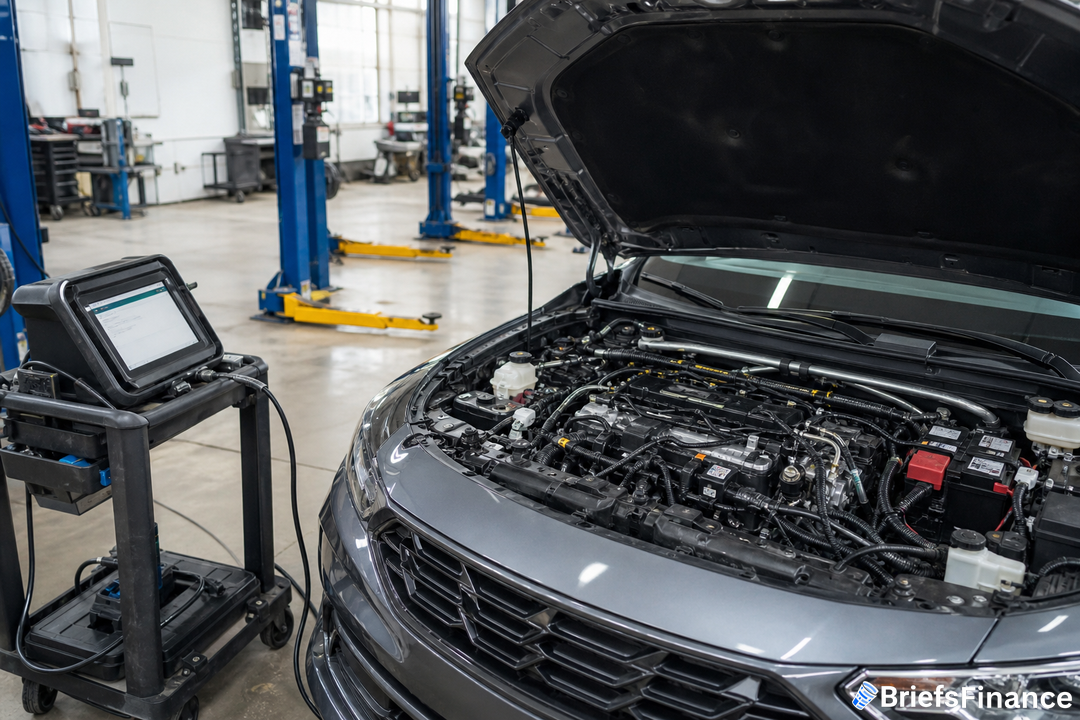
  • AAA says modern repairs often need brand-specific laptops and paid data access sold in time blocks from hours to a year, and ADAS calibration can lift collision repair costs by 37.6%.

What mechanics are up against

"Every year, I update all my computers," said Ralph Czeisler, who runs Emil's All-Tire in Brooklyn's Gravesend neighborhood. "I have multiple computers for domestic, Asian, European cars, and it's very costly. Every year they make changes, and it costs more money and more money. And it's getting very challenging."

He says the rapid churn in technology forces him to invest more time and cash just to handle basic work, and he's passing at least part of that bill along. Even old-school jobs have new hoops. During an oil change, he had to pay to access software solely to reset the dashboard reminder.

On a luxury model that would typically be a $400 service, the software alone added $75. "You can't just go and reset it," he said.

"You have to pay for information to download to your computer, to upload to the customer's computer to reset the light. Otherwise it's never going to reset and that costs more money. And the result? I pay more money. The consumer pays more money. It's not fair. But this is how the industry practice has gone."

The tech, the tools, and the tab

Greg Brannon, AAA's director of automotive engineering, said, "The repairs of these vehicles are so sophisticated now and almost always require a laptop." Sometimes that laptop must be tied to a single brand. On top of hardware, shops buy subscriptions for software and repair data in time slices that can run from just a couple of hours up to a full year. For smaller independents, those repeating charges stack up. "It has become increasingly financially difficult for independent shops to be able to service all makes and models," Brannon said.

Research points to one big cost driver: calibration of advanced driver-assistance systems, or ADAS. A 2023 AAA study found that step alone can raise a collision repair bill by 37.6%. Take windshields.

Swapping cracked glass used to be straightforward. Now the camera mounted behind the windshield often must be recalibrated, and that unit is only one of several cameras and sensors on many models, tied into the safety features automakers keep adding. "The consumer is getting the shaft at the end of the day because they're getting offset by the monetary cost as well," Czeisler said.

Repair costs are becoming one of the fastest growing lines in the cost of owning a car. Market Briefs tracks what households actually pay, free every morning.

The price of calibration gear

Invoices from Czeisler's shop show how the math escalates. A single calibration machine runs about $28,000, and the required computer adds another $12,000. A full setup can reach as high as $90,000.

Then come the target boards that align specific cameras. According to Ariella Czeisler, who works alongside her father, those boards can cost hundreds of dollars for mainstream brands and climb into the thousands for premium names. "God forbid we don't calibrate the windshield and that camera is malfunctioning," she said.

"The car can brake unexpectedly and cause an incident from the rear. We don't want to be liable for that."

Access, rules and the bigger picture

As vehicles and gadgets got more complex, the "right to repair" push grew louder, aiming to give consumers and small shops the tools, parts and know-how to fix their own stuff. In autos, industry groups for carmakers and repairers have struck agreements since 2014 to provide independent shops the same data, parts and tools available to dealers. "Generally the information is available to repair shops, both dealer and independent necessary to repair vehicles," Brannon said, with some exceptions. A joint task force fields complaints when access falls short, and Brannon said most issues revolve around the price and complexity of getting the data.

All this is showing up in what you pay. Vehicle repair costs rose about 60 percent between January 2019 and August 2026, far outpacing the 32 percent increase in overall inflation. The datasets do not pinpoint the causes, but the growing need for laptops, paid software windows as short as a few hours, and pricey calibration equipment helps explain why routine fixes feel anything but routine. If you budget for car ownership, that gap between inflation and repair inflation is the number to watch.

More technology in a vehicle means a bigger bill every time something breaks. Get the free Market Briefs daily newsletter and plan for it.

Disclosure

Recent News

1 2 3 … 92

Get Market Briefs delivered to your inbox every morning for free!

No fluff. No noise. No politics. Just finance news you can read in 5 minutes.

Blogs

October 2, 2026
Fed Interest Rates May Rise Again in 2026 - and the Newest Culprit Is AI
  • Fed Governor Barr told a meeting our head of investing research attended that higher rates are likely in 2026, lower inflation may not come soon, and AI is now pushing prices up.
  • The same week, President Trump asked the biggest AI companies to police themselves under an accord that's morally but not legally binding, because the White House sees AI as a race with China.
  • Higher rates put downward pressure on asset prices and squeeze borrowers, but the way through hasn't changed: own investments, buy on a schedule, and treat downturns as discounts.
Read More
October 1, 2026
Housing Market 2026: Why Office Buildings Are Cracking Before Houses Do
  • Office buildings are selling for 80% to 95% off because their five-year loans are resetting at much higher rates while half-empty floors have gutted the income those buildings are valued on.
  • Housing is under pressure, not cracking: a $400,000 mortgage costs $975 more a month than at 3%, but six of every seven mortgages are still under 6% and those owners are staying put.
  • Whether pressure turns into cracks is a race between unaffordability and the economy, and either way Jaspreet's rule is to treat your house as a liability and buy only what you can afford.
Read More
September 30, 2026
Dividend Investing vs. Growth Investing: Why the Slower Portfolio Can End Up Bigger
  • "What stock should I buy?" is the wrong first question. Growth, income, or wealth preservation comes first, and the goal changes which stocks even make sense.
  • At $500 a month for 30 years, 13% growth builds about $1.75 million. 10% growth plus a reinvested 4% dividend builds a little more than $2.2 million and pays a little more than $80,000 a year.
  • Income investors have US dividend ETFs, REITs, and international dividend funds to study. Growth investors have the Nasdaq 100, AI and chip funds, and small caps. None of it is a recommendation.
Read More
September 29, 2026
Why Is Gold Going Down? A 5.2% Treasury Yield Just Took Its Job
  • President Trump rejected Iran's deal to reopen the Strait of Hormuz, oil prices jumped back up, and gold fell instead of rising.
  • Treasury yields hit their highest level in more than 20 years, so investors sold gold and bought Treasuries that pay interest.
  • Higher Treasury yields make the national debt, mortgages, car loans, and credit cards more expensive, with the Fed's next rate decision due October 28.
Read More
September 28, 2026
The Strategic Bitcoin Reserve: Why the Government Wants Bitcoin to Explode
  • The US government holds about 328,000 Bitcoin, worth roughly $25 billion, and since a 2025 executive order it keeps seized coins instead of selling them.
  • Washington wants a bigger pile of assets so its $40 trillion national debt looks smaller next to them, which lets it keep borrowing and spending.
  • Bitcoin's wild price swings, and a government holding a coin built to escape governments, are the two risks investors need to watch.
Read More
September 25, 2026
BRIEFS EXCLUSIVE: 43% Of Respondents Say Bills Outran Their Income Over Past Two Years
  • 43% of the 494 Market Briefs readers surveyed said their bills grew faster than their income over the past two years, even though 79% could cover a surprise $5,000 expense tomorrow.
  • Half of readers own gold or crypto, the two classic bets against a weaker dollar, and only 13% bought nothing at all in the last 12 months.
  • The median reader says it takes $150,000 a year to feel financially secure, about $62,000 above the U.S. median household income.
Read More
September 25, 2026
The Economy Is Booming. So Why Did Stocks and Bonds Fall Together?
  • S&P Global says the US economy is growing at its fastest rate since 2021, with corporate profits up 28.9% in a year, almost four times the historical average.
  • Stocks and bonds fell at the same time, which is not how the two markets normally behave, because Treasury yields above 5% now compete with stocks for investors' money.
  • Jaspreet Singh lays out three ways to invest through a shift like this: always be buying, buy the crash, or follow the money before it hits the headlines.
Read More
September 24, 2026
The 2026 Economic Reset Is Starting: Are We in a Recession, or Is the Pain Still Ahead?
  • The Federal Reserve has flipped from stimulating the economy to fighting inflation with higher interest rates, while the White House still wants growth at almost any cost.
  • The national debt tops $40 trillion, has outgrown the entire U.S. economy, and its interest payments are now the government's fastest-growing expense.
  • Higher rates bring pain for private equity, private credit, and speculative assets, but they open opportunities for investors holding cash, treasuries, and value assets.
Read More
September 23, 2026
Are We in a Recession? Without AI, America Might Already Be in One - and Washington Knows It
  • The White House attributes about three quarters of U.S. economic growth to AI, and many believe the economy would already be in a recession without it.
  • Washington has three reasons it cannot let the AI boom slow down: staying the world's superpower, outgrowing $40 trillion in national debt, and protecting a government stock portfolio worth billions.
  • Every market goes through booms and busts, and investors who understand the cycle get to buy the downturn instead of panic-selling with the crowd.
Read More
September 22, 2026
Will Interest Rates Go Down in 2026? Where the Money Moves Either Way
  • The Fed is leaning toward higher rates to fight 4% inflation, while the White House and a cracking job market push the other way.
  • If rates rise, money has tended to move toward short-term Treasuries, floating-rate loans, energy, banks and dividend payers.
  • If rates fall, it has tended to move toward gold, silver and Bitcoin, real estate, small caps, the S&P 500 and speculative bets.
Read More
1 2 3 … 28
Share via
Copy link










