A Fifth Week of Falling Shipments
A fleet of 31 vessels moved 22.38 million barrels of Russian crude during the week ending Aug. 16.
Russia's broader output is sliding too.
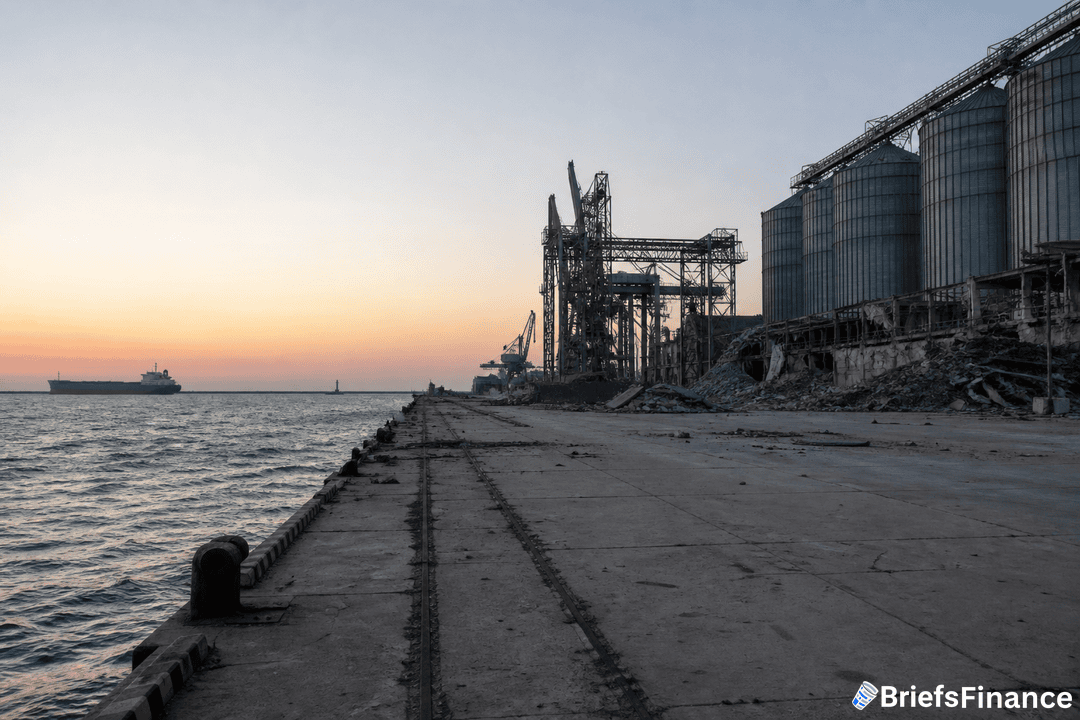
Drones and Delays at Key Ports
A tanker that had been at the port's terminal during Wednesday's attack remained at its berth in Monday's satellite images, while other berths resumed operations over the weekend.
Similar bottlenecks are showing up across Russia's export routes. Four Urals cargoes remain anchored off Egypt's Mersa el-Hamra, where offloading delays have stretched to about a month and a half, versus under a week earlier in the year.
Most Murmansk-loading cargoes end up on other vessels in the Riau archipelago, often after weeks at anchor, and many of those transfers happen with position signals hidden.
In the far east, Sokol and Sakhalin Blend cargoes may wait weeks for ship-to-ship transfers, while some ESPO cargoes, Russia's Pacific grade, sit idle near the port of Kozmino.
Russian crude at sea fell to about 94 million barrels in the week to Aug. 16, the lowest since September.
A few minutes a day is enough to stay genuinely informed about your money. Join Market Briefs free and start tomorrow.
Strong deliveries to India, close to June's record of about 2.4 million barrels per day, outweighed lower overall shipments.
Where the Oil Is Going
Most of Russia's crude is still heading to Asia. During the 28 days ending Aug. 16, Asia-bound flows averaged 3.43 million barrels per day, versus a revised 3.54 million in the prior period.
Observed flows to India fell to 670,000 barrels per day from 1.11 million, but recent trends suggest that figure will land above 2 million once arrivals are counted.
About 1.54 million barrels per day are on vessels with no final destination yet. That includes 1.3 million from western ports showing Singapore, Port Said, or Suez, plus 240,000 with no destination at all.
Turkey received roughly 80,000 barrels per day, after peaking at 180,000 in the period ending July 26.
Syria averaged about 40,000 barrels per day, unchanged, while Egypt averaged about 30,000, half the level of the prior four-week period.
Background
Russia's export problems come on top of an already reduced production picture. Its seaborne crude is a key source of supply for Asian refiners, and the recent drone strikes have added to delays at western and far eastern ports, forcing traders to rely on ship-to-ship transfers and longer voyages. With output near six-year lows and more cargoes stuck at sea, the market is watching whether the disruption spreads further.
To understand the scale, consider that Russia's July output of 8.89 million barrels per day was nearly a million barrels below its OPEC+ target. The combination of drone attacks, port bottlenecks, and longer transit times has created a backlog that is only now starting to clear. If these constraints persist, they could tighten global crude supplies further, especially for Asian buyers who depend on Russian grades.
What It Means for Your Money
Even as volumes fall, prices are climbing. Baltic Urals rose $3.30 to $67.08 per barrel, Black Sea Urals rose $3.20 to $65.85, and Pacific ESPO rose $0.80 to $70.45.
Urals is up about $3 to an eight-week high. The price of Russian crude delivered to India jumped $5 to $88.34, the fourth weekly increase in a row.
The higher prices are cushioning the revenue hit. For the 28-day period ending Aug. 16, the gross value of Russia's exports averaged $1.71 billion per week, only $10 million below the revised level for the period ending Aug. 9.
Week over week, export revenue dropped by $10 million to $1.54 billion during the period ending Aug. 16, the third straight weekly fall.
When a major exporter ships less, global supply tightens, and that pressure eventually shows up in fuel prices and in the energy stocks many portfolios hold. The next weekly update lands Tuesday, Aug. 25, and it will show whether this slump is a temporary stumble or something bigger.
Rates, prices and policy all end up in your budget eventually. Get the free Market Briefs daily newsletter and see it coming.