Free NewsletterPro Login

Warning: Undefined variable $stocks in /var/www/briefs.co/htdocs/wp-content/plugins/oxygen/component-framework/components/classes/code-block.class.php(133) : eval()'d code on line 448

Warning: foreach() argument must be of type array|object, null given in /var/www/briefs.co/htdocs/wp-content/plugins/oxygen/component-framework/components/classes/code-block.class.php(133) : eval()'d code on line 448

Warning: Undefined variable $funds in /var/www/briefs.co/htdocs/wp-content/plugins/oxygen/component-framework/components/classes/code-block.class.php(133) : eval()'d code on line 472

Warning: foreach() argument must be of type array|object, null given in /var/www/briefs.co/htdocs/wp-content/plugins/oxygen/component-framework/components/classes/code-block.class.php(133) : eval()'d code on line 472
/* the link was here */
Free Live Investor Workshop
The dollar is losing value. Here’s how investors can still profit. Click Here to Save Your Seat →         

Attacks on Refineries and Ports Leave Russia's Crude Production Nearly a Million Barrels Short of Its OPEC+ Target

Published Aug 13, 2026
Share:
Summary:
  • Russia's daily crude output in July was 8.887 million barrels, well below its OPEC+ target of 9.824 million barrels per day.
  • Ukrainian strikes on refineries, tankers, and ports happened almost daily throughout July.
  • Ukraine has now hit 9 of Russia's 34 largest refineries as of early August.

Picture this: you have a quota to meet, but someone keeps poking holes in your equipment. That is basically what is happening to Russia's oil industry right now.

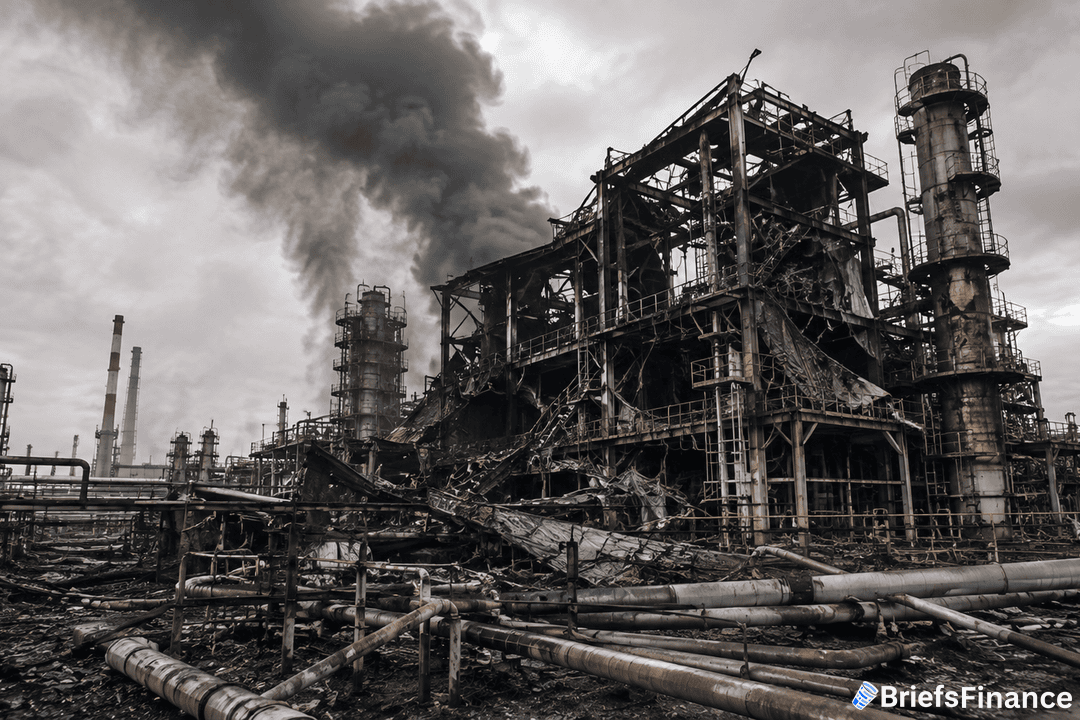
Ukrainian attacks on refineries and ports have pushed Russia's crude production far below what it promised OPEC+ it would pump. In July, the country produced about 937,000 barrels per day less than its target - a gap almost the size of a mid-sized oil producer's entire output.

The Numbers Behind the Shortfall

Here is the odd part: July's output was only 6,000 barrels per day less than June's. In other words, production basically flatlined. The damage from the attacks is not getting dramatically worse month over month, but Russia also cannot seem to push output back up.

What the Attacks Actually Did

Early in the month, attacks focused on refineries. That forced Russian producers to ship near-record amounts of crude by sea because their processing plants could not handle the volume. Refinery runs fell to multiyear lows.

Get the free Always Be Buying eBook and learn the simple system for building wealth on any income

Then the strategy shifted. As July wore on, Ukraine's attacks aimed at vessels in the Black and Azov Seas. That change gave refineries a chance to catch their breath, make repairs, and boost processing. But it also meant crude exports declined.

An overnight attack on the Novorossiysk port damaged three grain terminals, showing that no part of Russia's export infrastructure is off limits.

Russia's crude output has fallen well short of its OPEC+ commitment because Ukrainian strikes have repeatedly damaged refineries and port facilities. That shortfall is not just a numbers game. OPEC+ has been trying to manage global supply and prices, and Russia's inability to meet its quota complicates that effort.

With Russian output stuck below target, other members may need to compensate, or the group could face internal tensions. Meanwhile, the ongoing attacks have kept oil markets on edge, with prices experiencing volatility as traders weigh the risk of further disruptions.

The gap between Russia's actual output and its quota is not merely a statistical anomaly. For months, OPEC+ has carefully calibrated production levels to balance global inventories and support prices. When one of its largest members consistently underdelivers, the group's ability to present a united front weakens.

Some members have already exceeded their own targets, and they may be reluctant to compensate for Russia's shortfall. Russia's own budget relies heavily on energy revenues, so the lost production also strains its fiscal position. The situation is fluid, and any escalation in the conflict could push output even lower.

What Happens Next

What does this mean for markets? Each barrel Russia fails to produce is one less that reaches global supply. That pressure helps keep oil prices supported, which shows up in what you pay at the pump.

If the attacks continue, Russia's ability to meet its OPEC+ quota - or even come close - looks doubtful for the rest of the year. For anyone watching energy prices, this is a story worth following.

Download the free Always Be Buying eBook and start putting your money to work today
Disclosure

Recent News

1 2 3 77

Get Market Briefs delivered to your inbox every morning for free!

No fluff. No noise. No politics. Just finance news you can read in 5 minutes.

Blogs

September 15, 2026
Fiat Currency Runs on Trust, and the World Just Stopped Trusting the Dollar
  • Gold has overtaken US treasuries as the world's top reserve asset, and central banks are now buying less US debt and more gold.
  • The US dollar is a fiat currency, meaning it's backed by a promise rather than gold, so it loses value when fewer countries want to hold it.
  • Whether the US economy or its national debt grows faster from here decides which assets stand to benefit next.
Read More
September 14, 2026
Why RAM Prices Are Soaring - and Where the Money Is Moving
  • Memory chips - the RAM inside phones, laptops, fridges, and trucks - are in a shortage Tim Cook called a 100-year flood, and some memory prices have climbed about 90% in a single quarter.
  • Four forces hit at once: AI demand, a production shutdown in 2023, build times that push any fix to 2028 at the earliest, and a bombed helium plant in Qatar.
  • The last two supply shocks ended in aggressive Fed rate hikes and market drops of around 45% and 20%, and this time Washington is spending heavily to bring memory production home.
Read More
September 11, 2026
How Is the Economy Doing? Washington Says It's Fixed, but the Numbers Don't Agree
  • Treasury Secretary Scott Bessent says the economy is fixed because lower earners' incomes are now rising faster than top earners'.
  • The Atlanta Fed and Bank of America show different numbers, and Hilton, Marriott, and McDonald's can't agree on what they're seeing either.
  • Whichever side is right, the economy is built to make investors rich, and inflation is how it does it.
Read More
September 10, 2026
US National Debt Hits $40 Trillion: Why the Economy Hasn't Collapsed Yet
  • The US national debt crossed $40 trillion in 2026 and is growing faster than the economy. The debt to GDP ratio now sits at 125%, the highest outside the pandemic and higher than World War II.
  • On September 9, 2026, Treasury Secretary Scott Bessent rolled out an emergency plan for the government to lend money to itself. Ray Dalio now says the dollar has roughly three years before real pain.
  • Empires rarely default. They debase. Since 1971, median household income grew about 8x while houses grew 17x and the S&P 500 grew 360x, so investors got richer while workers fell behind.
Read More
September 9, 2026
Your 401k Is Fueling the AI Bubble
  • About $10 trillion of 401k money sits in a $77 trillion stock market, mostly through target date funds and S&P 500 funds. Roughly 30% of every S&P 500 dollar lands in five AI-heavy tech stocks.
  • Four bubble signals run hotter today than before the 2000 crash: top-ten concentration, tech's share of the index, the Buffett Indicator, and how much of the market index funds own.
  • You only lock in an AI bubble loss if you sell. The 2022, 2020, 2008, and 2000 crashes were all buying windows for long-term investors, and the US-China AI race means government money could keep flowing in.
Read More
September 9, 2026
What Is Wealth Preservation? How To Protect Your Money From Anything
  • Wealth preservation is an investing strategy built around keeping the money you've already made instead of chasing growth.
  • It leans on assets that hold steady when markets fall - gold, Treasury bonds, and companies that keep earning through wars, crashes, and pandemics.
  • The tradeoff is real: you give up some upside, and the two key numbers to check are maximum drawdown and correlation to the market.
Read More
September 8, 2026
Why Is Everything So Expensive? Why Prices May Never Come Back Down
  • Official inflation is 3.4% and prices are up 32% since 2020, but rent (41%), gas (47%), car insurance (64%) and ground beef (79%) all outran the 28% median wage.
  • The Federal Reserve targets 2% inflation on purpose. Rising prices push extra dollars to investors and shrink the real cost of a $40 trillion national debt.
  • Investors who simply owned the S&P 500 gained about 150% over the same six years, and the Fed's September 16 decision will show whether it protects the dollar or the economy first.
Read More
September 7, 2026
The U.S. Housing Market Just Flipped: Renting a Home Now Beats Buying One
  • The US is in a buyer's market in 41 of the 50 largest metro areas, but prices sit near record highs and mortgage rates are close to 7%.
  • The same median house costs 27% more than it did in 2021 while the monthly payment costs 90% more, and incomes rose a little more than 10%.
  • A 2008-style crash is not showing up in the data, so the pressure is landing on buyers instead of prices.
Read More
September 4, 2026
An Interest Rate Hike in 2026? The Fed Just Broke Its Own Script
  • The Federal Reserve spent a year signaling cheaper money, and its new chairman just warned that an interest rate hike may be coming instead.
  • The Fed is stuck between high inflation and a weak job market, and fixing one makes the other worse.
  • Higher rates also reprice roughly a third of America's $40 trillion national debt this year, which is why Washington wants cuts so badly.
Read More
September 3, 2026
5 Passive Income Ideas That Pay You Whether You Work or Not
  • School teaches one formula: work, earn, spend. Stop working and the money stops, so the wheel never ends.
  • Five assets pay you without your labor - dividends, rent, interest, royalties, and the things you already own.
  • $80,000 a year of cash flow takes about $1 million invested at 8%, or roughly 20 years of $1,000 a month.
Read More
1 2 3 26
Share via
Copy link













