Free NewsletterPro Login

Free Live Investors Workshop

Seats limited

Tue, Sep 29

The dollar is losing value.

Here’s how investors can still profit.

Hosted By

Jaspreet Singh

Founder, Briefs Finance

X

Warning: Undefined variable $stocks in /var/www/briefs.co/htdocs/wp-content/plugins/oxygen/component-framework/components/classes/code-block.class.php(133) : eval()'d code on line 448

Warning: foreach() argument must be of type array|object, null given in /var/www/briefs.co/htdocs/wp-content/plugins/oxygen/component-framework/components/classes/code-block.class.php(133) : eval()'d code on line 448

Warning: Undefined variable $funds in /var/www/briefs.co/htdocs/wp-content/plugins/oxygen/component-framework/components/classes/code-block.class.php(133) : eval()'d code on line 472

Warning: foreach() argument must be of type array|object, null given in /var/www/briefs.co/htdocs/wp-content/plugins/oxygen/component-framework/components/classes/code-block.class.php(133) : eval()'d code on line 472
/* the link was here */

JPMorgan Says AI's Crowded Bets Now Pose a Bond-Market Risk

Published Aug 18, 2026
[tts_player]
Share:
Summary:
  • JPMorgan's Gabriela Santos says the risk of overcrowded AI investments has spread from stocks into bond markets, where investors hold exposure on both sides at once.
  • July's tech-stock correction, which sent the Philadelphia Semiconductor Index down 21% and South Korea's Kospi down 22%, showed how quickly crowded trades can unwind.
  • Santos estimates the AI buildout will need $5.5 trillion in capital spending, and she warns that diversification now is prudent even if AI remains the dominant story.

The Warning Goes Beyond Stocks

You can believe AI will change everything and still get hurt by how everyone else is betting on it.

That is the message from Gabriela Santos, chief strategist for the Americas at JPMorgan Asset Management. "You can be very bullish on all things AI and still need to think very carefully on portfolio construction," she said.

Her point is simple. The trade is everywhere. That means the usual labels investors use to spread out their risk no longer work the way they used to.

"That's where it's getting complicated," Santos said. "Because you can't just think of traditional factors, or sectors or regions. Or even asset classes, because that AI tentacle is everywhere now."

July Showed How Fast Crowded Trades Crack

The proof came in July, when tech stocks suddenly turned south.

That kind of move does not happen by accident. It happens when too many investors pile into the same trade, and then a few start heading for the exit at once.

When even bonds feel the AI squeeze, the free Always Be Buying eBook shows a calmer path to steady wealth.

Santos said the episode should make investors check three things: how much they own, how much borrowed money they are using, and whether their holdings reach beyond AI at all.

The catch is that most portfolios already have AI exposure baked in, even when it is not obvious. A fund that owns "defensive" stocks might still hold companies selling chips to data centers. An "international" fund might lean heavily on the Korean and Taiwanese names that power the AI supply chain.

Bonds Are the New Front Line

The bond market is where the warning gets sharper.

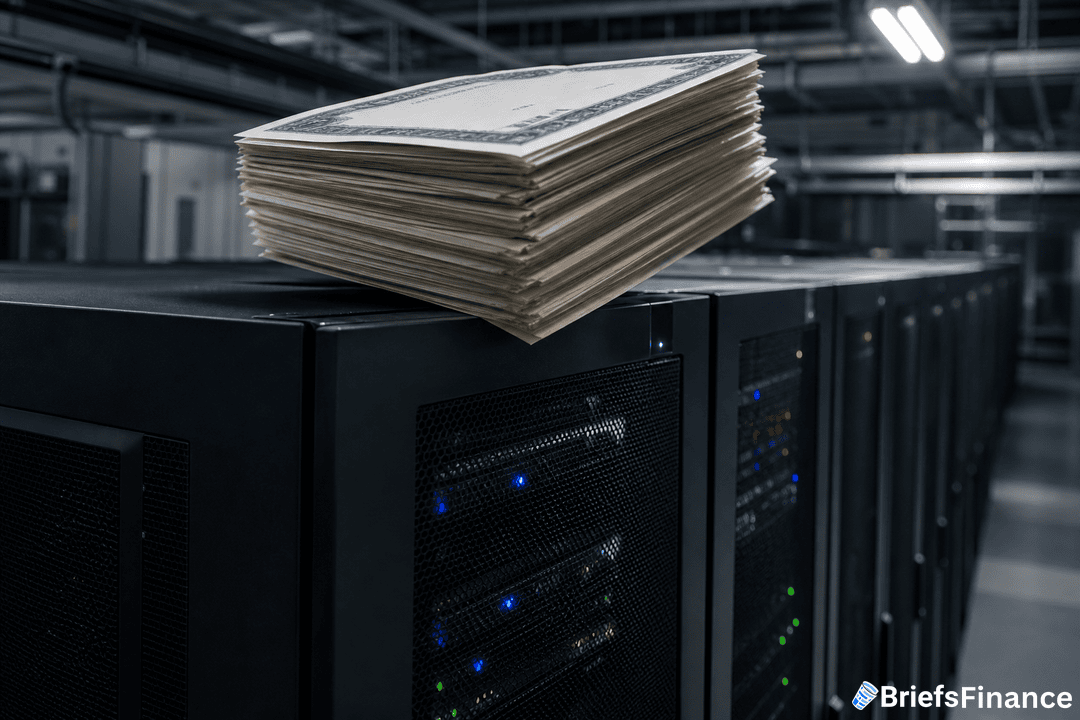
Companies have been selling investment-grade debt at record pace for four straight months. Alphabet is among the issuers selling bonds that do not mature for 100 years. That means bond investors are now lending money to the same AI giants whose stocks they already own.

So the person holding a broad stock fund and a corporate bond fund has AI risk on both sides of the ledger. When one side wobbles, the other may not catch it the way it used to.

Santos also flagged that debt from the big cloud companies, known as hyperscalers, should be reviewed one issue at a time rather than treated as a single group. Vehicles backed by leases on data centers have become more complex, she noted, which makes them harder to judge at a glance.

Only a small set of assets still appears to offer genuinely different return patterns, in her view. That list is short: U.S. Treasuries, gold, and core real estate.

The Bill Is $5.5 Trillion

Here is the scale of what is being built.

What makes this buildout unusual, she said, is that it is already showing up in corporate profits. Past technology booms often required years of losses before the money started flowing back.

Analysts at Goldman Sachs projected in June that spending on AI data centers will likely top $900 billion in 2026, with 2027 forecasts reaching as high as $1.4 trillion. Those are staggering numbers, and they help explain why investors keep piling in.

But here is the tension. No matter how fast AI stays the leading investment theme, its growth will eventually decelerate. Santos called the buildout "very unique," and she thinks starting to diversify now is the prudent move rather than waiting for the slowdown to arrive.

The bottom line: You do not have to bet against AI to protect yourself from its popularity. The question is whether your portfolio is built for the moment when everyone tries to leave the same trade at once.

If crowded trades make you nervous, grab the free Always Be Buying eBook and build wealth one consistent step at a time.

Disclosure

Recent News

1 2 3 71

Get Market Briefs delivered to your inbox every morning for free!

No fluff. No noise. No politics. Just finance news you can read in 5 minutes.

Blogs

September 8, 2026
Why Is Everything So Expensive? Why Prices May Never Come Back Down
  • Official inflation is 3.4% and prices are up 32% since 2020, but rent (41%), gas (47%), car insurance (64%) and ground beef (79%) all outran the 28% median wage.
  • The Federal Reserve targets 2% inflation on purpose. Rising prices push extra dollars to investors and shrink the real cost of a $40 trillion national debt.
  • Investors who simply owned the S&P 500 gained about 150% over the same six years, and the Fed's September 16 decision will show whether it protects the dollar or the economy first.
Read More
September 7, 2026
The U.S. Housing Market Just Flipped: Renting a Home Now Beats Buying One
  • The US is in a buyer's market in 41 of the 50 largest metro areas, but prices sit near record highs and mortgage rates are close to 7%.
  • The same median house costs 27% more than it did in 2021 while the monthly payment costs 90% more, and incomes rose a little more than 10%.
  • A 2008-style crash is not showing up in the data, so the pressure is landing on buyers instead of prices.
Read More
September 4, 2026
An Interest Rate Hike in 2026? The Fed Just Broke Its Own Script
  • The Federal Reserve spent a year signaling cheaper money, and its new chairman just warned that an interest rate hike may be coming instead.
  • The Fed is stuck between high inflation and a weak job market, and fixing one makes the other worse.
  • Higher rates also reprice roughly a third of America's $40 trillion national debt this year, which is why Washington wants cuts so badly.
Read More
September 3, 2026
5 Passive Income Ideas That Pay You Whether You Work or Not
  • School teaches one formula: work, earn, spend. Stop working and the money stops, so the wheel never ends.
  • Five assets pay you without your labor - dividends, rent, interest, royalties, and the things you already own.
  • $80,000 a year of cash flow takes about $1 million invested at 8%, or roughly 20 years of $1,000 a month.
Read More
September 2, 2026
The Best Way to Invest 10k: Three Options To Transform 10K into 10 Million
  • Passive investing in stocks or real estate targets around 10% a year, and time in the market matters more than the price you get in at.
  • Active investing means putting your time in alongside your money, which raises the target to roughly 20% a year and raises the risk of losing it all.
  • Investing in yourself has no ceiling, because a new skill can create a new income that no market return can match.
Read More
September 1, 2026
The Tax Write Offs the Rich Are Using in 2026 While the IRS Shrinks
  • The 2026 tax brackets landed lower than they were headed, and the standard deduction jumped from a planned $8,350 to $16,100 for single filers.
  • New write offs for overtime, tips, seniors and car loan interest are live now, and most of them are written to expire in 2028.
  • About a third of IRS auditors have been fired, and four assets do most of the work for people who want income without a matching tax bill.
Read More
August 31, 2026
America Is Running Out of Debt Buyers. Treasury Bills Are the Government's Fix
  • The government took in about $5 trillion in taxes in 2025 and spent about $7 trillion, and the national debt is now over $40 trillion.
  • Investors, banks, and foreign countries are all lending less to the U.S., so starting September 9 the government plans to sell more short-term treasury bills and use that cash to buy back its long-term debt.
  • Government interest rates set the floor for your mortgage, your car loan, and your credit card, and short-term Treasury ETFs like SGOV are one way investors are playing it.
Read More
August 23, 2026
How to Get the Most From Your Guideline 401k
  • Guideline is a company that provides low-cost 401k plans, popular with small businesses and their employees.
  • A "Guideline 401k" follows the same core rules as any 401k: tax-advantaged growth, contribution limits, and often an employer match.
  • The biggest results come from capturing the full match, choosing low-cost funds, and picking Roth or traditional to fit your situation.
Read More
August 23, 2026
Principal 401k: What to Know About Your Plan
  • Principal is one of many companies that manage workplace 401k plans, so a "Principal 401k" is simply a 401k where Principal is the provider.
  • The rules of a 401k are the same no matter who runs it: pre-tax or Roth contributions, tax-advantaged growth, and often an employer match.
  • The biggest wins come from grabbing the full match, picking low-cost funds, and knowing whether Roth or traditional fits you.
Read More
August 23, 2026
What a Tariff Dividend Means for Your Money
  • A "tariff dividend" is the idea of taking money the government collects from tariffs and paying some of it back to citizens.
  • To judge the idea, you first need to know what a tariff is: a tax on imported goods, usually paid by the companies bringing them in.
  • Tariffs ripple through prices, businesses, and your investments, so the smart move is understanding those ripples, not just the headline.
Read More
1 2 3 26
Share via
Copy link










