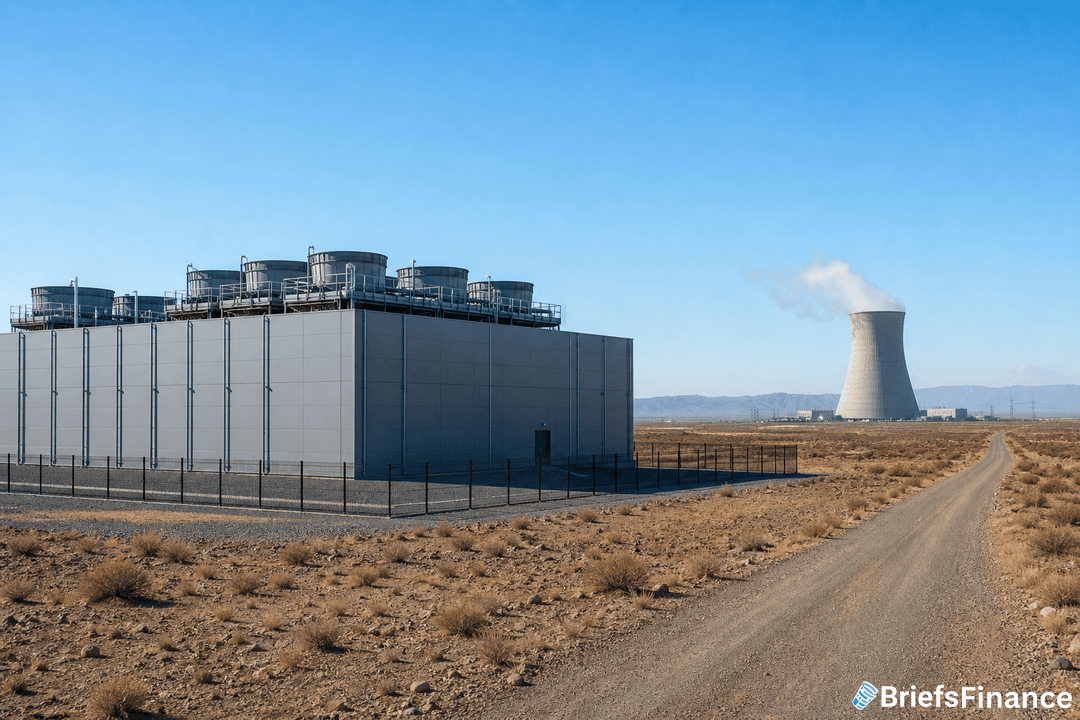
TerraPower's early purpose was to serve utilities, but data centers now offer a new avenue for growth. The emergence of power-hungry AI applications, as well as industrial facilities like semiconductor plants that are now exploring on-site generation, creates a new market for developers of small reactors.
In a Tuesday interview, TerraPower's CEO Chris Levesque said the firm will unveil its next project - designed for a data center - before the end of the year. He declined to name the customer. This timeline would put the company on track to start construction on its second unit in 2027.
TerraPower is constructing the only utility-scale nuclear power plant.
The Natrium reactor, designed by TerraPower, delivers 345 megawatts - far less than the typical 1-gigawatt output of conventional nuclear reactors.
As demand for data center power grows, steady investing is more important than ever, so grab the free Always Be Buying eBook.
Last week, TerraPower and several South Korean partners signed agreements backing the technology's rollout, including Hyundai Engineering & Construction, which agreed to build up to eight units. These contracts cover up to eight Natrium reactors.
Small modular reactors are designed to generate electricity on a smaller scale than traditional nuclear plants, which allows them to be sited closer to customers and built in phases. The Natrium design's 345-megawatt output is well suited to a single large data center or an industrial campus, and the Hyundai agreement is meant to help turn that design into a repeatable construction process.
TerraPower's partnership with Hyundai Engineering & Construction is intended to standardize the building process, potentially allowing multiple units to be erected in sequence. This approach could help address the growing electricity demand from data centers without the need for extensive new transmission infrastructure. The 2027 target for the second unit suggests the company is confident in its supply chain and its ability to repeat the construction process quickly.
What It Means for Investors
Small modular reactors are being developed as a faster, more flexible alternative to traditional nuclear plants. Their smaller size means they can be built closer to demand and financed in smaller steps, and they can be paired with renewable energy or placed near industrial sites. TerraPower's decision to target data centers shows how reactor developers are responding to a market where large technology companies need reliable, carbon-free power without waiting for new transmission lines.
The agreement with Hyundai Engineering & Construction also points to a broader strategy. Building up to eight Natrium reactors would move TerraPower beyond a one-off demonstration and toward a small fleet, using an established construction partner to reduce project risk. The 2027 target for the second unit suggests the company is confident in its supply chain and its ability to repeat the construction process quickly.
As power-hungry AI applications continue to grow, the demand for reliable, carbon-free baseload power intensifies. Data center operators face long connection queues and are increasingly seeking on-site generation to ensure uptime. Small modular reactors like the Natrium design offer a scalable solution that can be paired with renewable sources or deployed near industrial clusters. TerraPower's pivot to data centers reflects this broader market shift, and its partnership with Hyundai Engineering & Construction signals an ambition to build multiple units in rapid succession, leveraging existing construction expertise to bring the technology to scale.
If you want to build wealth steadily no matter your income, the free Always Be Buying eBook shows you how.