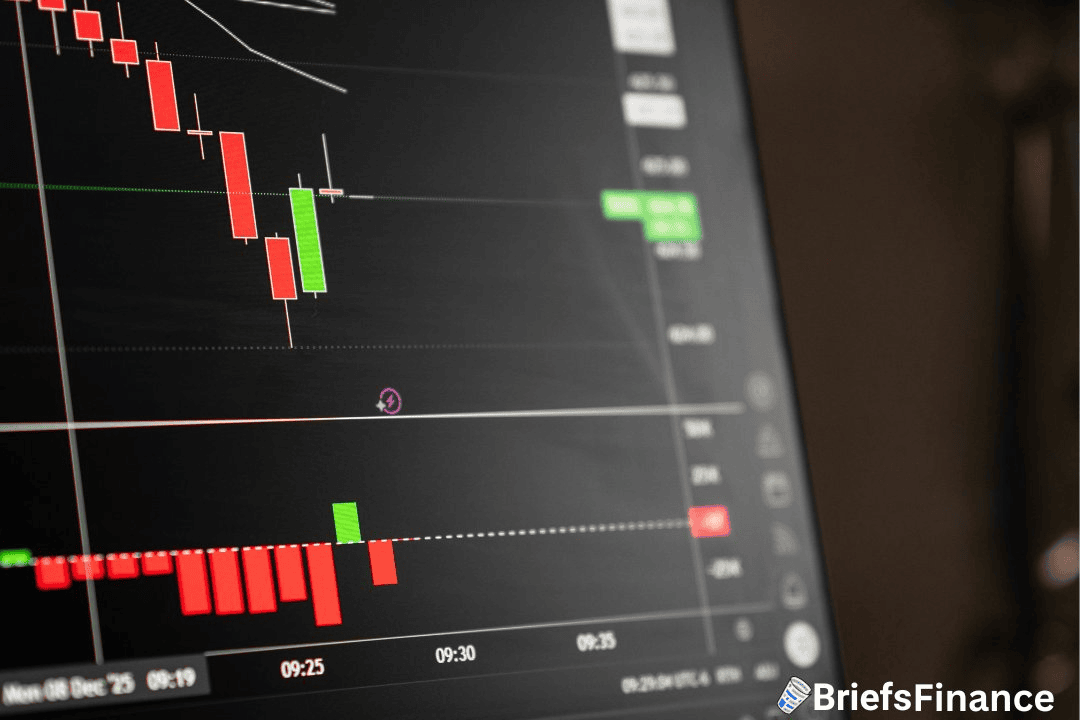
You can't stare at the market 24 hours a day. So what stops a stock from quietly bleeding out your gains while you're at work or asleep? A stop loss order. It's the closest thing investing has to autopilot for your downside.
Let's break down what a stop loss order is, how it works, and when it actually helps.
We make risk tools simple every morning in Market Briefs, our free daily newsletter.
What Is a Stop Loss Order?
A stop loss order is an instruction you give your broker: if this stock drops to a set price, sell it automatically.
That set price is your trigger. Once the stock hits it, the order activates and your shares are sold, no further action needed from you.
The purpose is simple: to limit how much you can lose on a position, or to protect a profit you've already made. You decide your pain point in advance, and the order enforces it.
It removes one of the hardest things in investing - acting decisively when a stock is falling and fear is loud.
How a Stop Loss Order Works, Step by Step
Walk through a basic example.
You buy a stock at $50. You're willing to risk about 10%, so you set a stop loss order at $45.
- If the stock stays above $45, nothing happens. You hold.
- If the stock falls to $45, the order triggers and sells your shares. Your loss is capped at roughly 10%.
You can also use a stop loss to protect gains. If that same stock climbs to $80, you might raise your stop loss to $72. Now you've locked in most of the profit. If it reverses, you're sold out near $72 instead of riding it all the way back down.
The Trailing Stop Loss Order
There's a smarter version worth knowing: the trailing stop loss.
Instead of a fixed price, you set the trigger a fixed percentage below the stock - say 10% to 15%. The magic is that the trigger rises as the stock rises, but never falls.
So if a stock climbs from $50 to $80, your 10% trailing stop rises with it, sitting around $72. If the stock then drops 10% from its peak, you're automatically sold, locking in your gains.
This makes the trailing stop a favorite exit tool for active strategies like momentum investing, where the goal is to ride a trend up and bail out when it breaks.
Stop Loss Order vs. a Regular Sell
How is this different from just selling when you feel like it?
| Approach | How it works | Best for |
|---|---|---|
| Manual sell | You watch and sell yourself | Investors who monitor daily |
| Stop loss order | Auto-sells at your trigger price | Capping losses without watching |
| Trailing stop loss | Trigger rises with the stock | Locking in gains on a trend |
The big advantage of a stop loss order is discipline. It executes your plan even when you're not looking, and even when emotion would tempt you to freeze.
When a Stop Loss Order Helps, and When It Hurts
A stop loss order is powerful, but it's not always the right call.
It helps when:
- You're an active investor or trading growth stocks that can move fast.
- You want to lock in gains on a position that's run up.
- You can't monitor your holdings closely.
It can hurt when:
- You're a long-term investor in broad index funds. Normal dips can trigger your stop and kick you out right before a recovery.
- The market is just being volatile. History is full of scary drops that quickly reversed, and a stop loss can sell you out at the worst moment.
This is the crucial judgment: is a drop real news about the business, or just temporary noise? A leadership shakeup or collapsing earnings is a real reason to be out. A single shaky quarter often isn't. Knowing the difference is the core of when to sell a stock.
Stop Loss Order vs. Other Protection
A stop loss isn't the only way to manage downside.
A put option can act like insurance, giving you the right to sell at a set price while you keep your shares. A covered call generates income that cushions small drops. And the simplest protection of all is diversification - owning many companies across sectors so no single one can sink you.
There's also a close cousin, the stop limit order, which only sells within a price range you set. Our guide on stop loss vs stop limit covers that trade-off.
The Bottom Line on a Stop Loss Order
A stop loss order is automation for your downside. Set a trigger price, and your broker sells if the stock falls to it - capping a loss or locking in a gain without you watching the screen.
Used well, on active positions and trends, it's a disciplined safety net. Used carelessly, on long-term holdings during normal volatility, it can sell you out of good investments at the worst time.
The tool is only as smart as the plan behind it. Pair it with a clear sense of when to buy a stock, an understanding of bull and bear markets, and a long-term mindset, and you'll use it the way the pros do. For the rest of the lingo, see our stock market terms guide.
Want risk and strategy explained in plain English? Join Market Briefs, our free daily newsletter and trade with a plan, not your emotions.