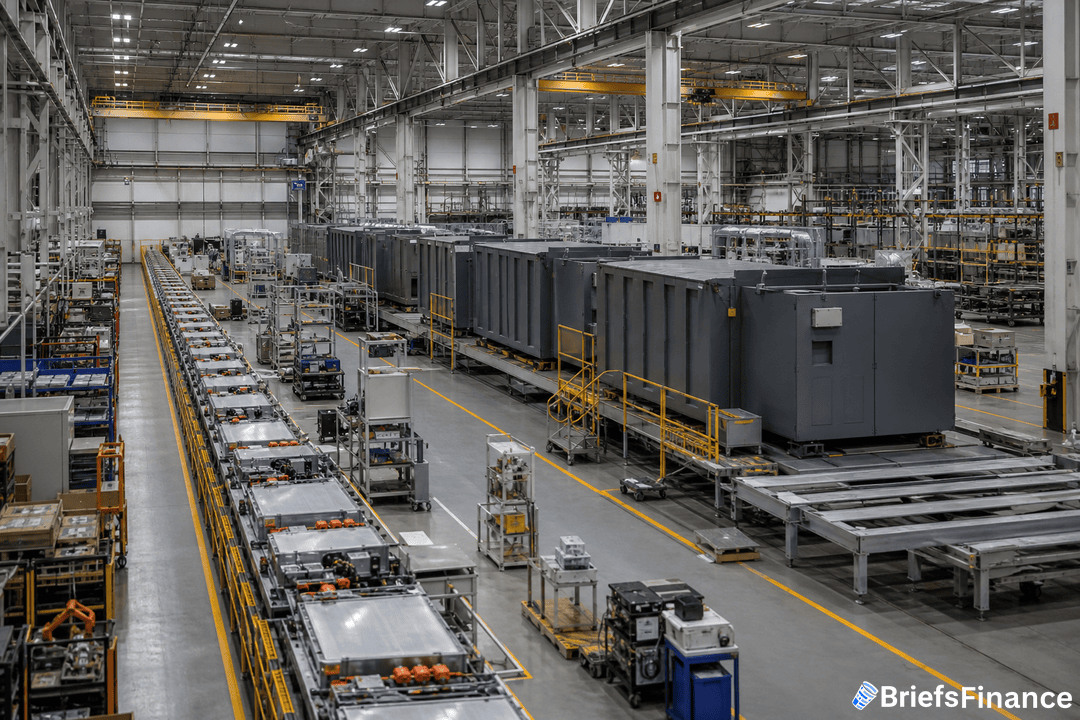
From EV Batteries to Defense Work
LG Energy Solution has long treated defense like a taboo. Bob Lee, the company's North America president, compared that old mindset to consumer companies refusing to sell alcohol or tobacco.
"That was kind of LG's perspective on defense, but we definitely see growth and opportunities," he said.
Now LG is in early talks with government officials and major defense contractors about batteries for drones and other unmanned military gear. Lee said several potential American partners have already reached out.
The discussions are still early, but entering defense would be a major shift for a company that avoided the sector for years. The move fits a wider pattern: commercial companies are stepping into defense as the Trump administration looks to rebuild munitions used in the wars involving Iran and Ukraine and to secure supply lines for drones and other strategic tech.
Storage Takes Over
Behind the defense talks is a simpler story: EVs did not grow the way LG expected. So the company is reorienting its North American operations around energy storage systems, or ESS, which are big batteries that hold power for buildings and the grid.
Storage now makes up most of LG Energy's business in the region, Lee said. In other regions, EV batteries still dominate.
The shift has been fast. Lee projected the storage operation would be in the black by December.
The company opened its new Lansing, Michigan, plant with General Motors on August 18, 2026.
The best financial decisions come from understanding the whole picture. Join Market Briefs free and get the full brief each morning.
It will supply about $4.3 billion in lithium-iron-phosphate cells, a type of battery, for Tesla's Megapack storage systems.
Deliveries start in 2027.
The plant will also make nickel-based cells for Toyota after a $1.5 billion order moved from LG's Holland, Michigan, site. That Holland site will instead make storage cells for DTE Energy, a Michigan utility.
LG anticipates the Lansing plant will reach an annual output of 35 gigawatt-hours by late 2027.
Samsung SDI is purchasing GM's share of a joint venture in Indiana, then repurposing the plant for storage. SK On, the battery arm of SK Innovation, will run a Tennessee plant for stationary batteries after its partnership with Ford ended.
What It Means for Your Money
The bigger question is whether all this new supply will flood the market. Michael Sanders, a senior adviser at Avicenne Energy, sees "very limited chance" of that.
"The big question is how long the data center hype will live on," he said. "But between ESS and EV demand, even if it loses a little luster we don't need to worry about oversupply."
He expects the domestic battery market to avoid excess capacity through 2035 or 2040.
The trade backdrop is important too. Last week, the Trump administration announced tariffs of up to 100% on imported drones and their parts.
China is also a big competitor in storage batteries. Lee said he asked Interior Secretary Doug Burgum, who attended the Lansing event, to consider limiting Chinese access to the storage market.
"It's very important for us to become more independent and be self-reliant," Lee said. Burgum, he added, was "very much on board."
On top of that, the two governments have some friction. Trump has cut back planned military drills with South Korea and praised Kim Jong Un, while administration officials say Seoul is stalling on a $350 billion investment pledge in the country.
For investors, the trend is not hard to spot. Battery companies are no longer betting everything on electric vehicles, and the country is becoming a more important market for defense and grid storage.
That could mean more stable revenue for LG and its rivals.
Energy storage is growing for concrete reasons: data centers need power, utilities need backup, and the military wants domestic supply. If those trends hold, the companies building this gear are in a solid spot.
If the data center boom cools, the sector appears to have enough demand elsewhere to avoid a crash. That is about as good a position as an industry can ask for.
Markets move every day, and most of it never reaches you in time. Get the free Market Briefs daily newsletter and stay ahead of it.