The Problem That Sand Solves
Renewable energy has one big flaw: the wind doesn't always blow and the sun doesn't always shine. That makes it hard to rely on clean power around the clock. The small Finnish town of Pornainen found a workaround. It built a giant battery filled with crushed soapstone that stores heat when electricity is cheap and releases it when needed.
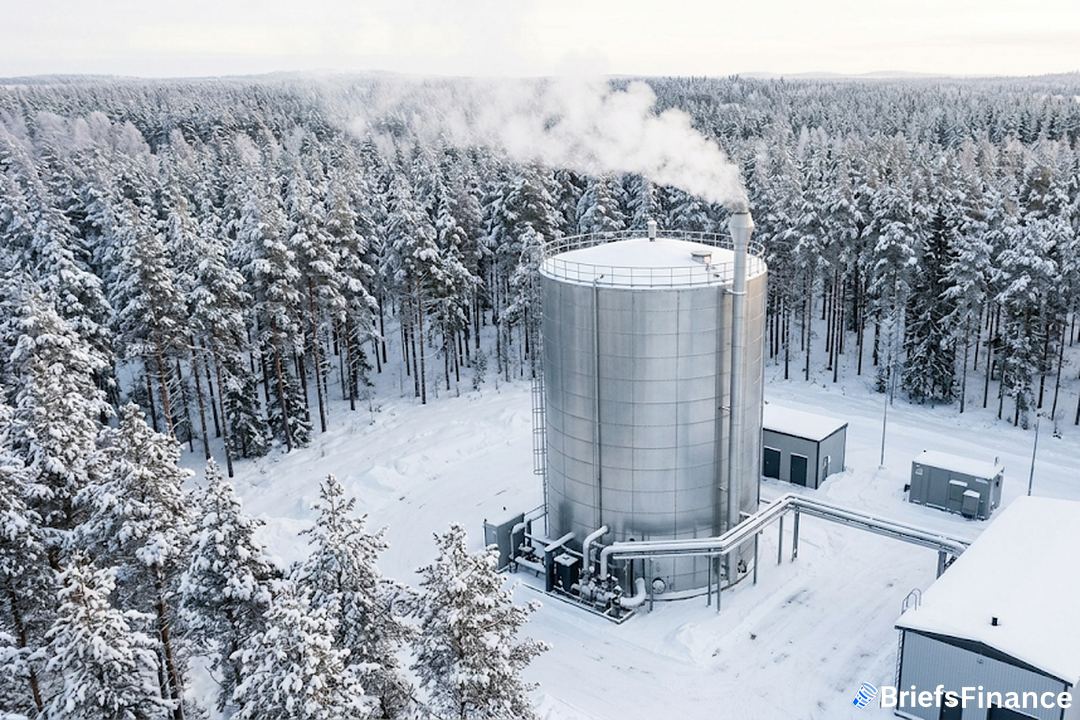
The battery stands 13 meters high and 15 meters wide. Inside sits 2,000 metric tons of crushed soapstone.
The whole setup can store 100 MWh of thermal energy. On a single charge, it can cover the town's heating needs for nearly a month in summer and about a week in winter.
The local heating company, Loviisan Lämpö, commissioned the project. Its CEO, Mikko Paajanen, said: "The main thing is that we can separate the electricity procurement from the district heating production because now we are able to deliver this heating during the wintertime for one week, with one charge of the battery, and during the summertime, it even lasts as long as one month."
Get the market news that matters in a five-minute read with Market Briefs, our free daily newsletter
Why Sand Beats Lithium
Most people think of batteries as those small rectangular packs in phones or electric cars. Those use lithium and other rare metals. This sand battery uses none of that. The Finnish company Polar Night Energy developed the technology, and its CEO Tommi Eronen said: "Hopefully a big portion of those storages could be sand battery-type of storages where we don't need rare earth materials."
The timing is key. Sand batteries let users buy power at the cheapest moment and turn it into heat they can pull out hours or days later.
Annette Höglund-Dönnes, the chief commercial officer at Polar Night Energy, explained the three-step process: "The sand enables you to have a delay between the time you use electricity, and you use the steam." She added: "That delay is your business advantage because you can heat up the sand when the electricity is cheap, and you use the steam when normally it would be very expensive."
Jan Rosenow, a professor at the University of Oxford, pointed out another advantage: "You can store it for long periods, not just two hours or four hours like lithium-ion batteries, but potentially for days and maybe even weeks."
What Comes Next
Compared to the earlier model Polar Night Energy built in 2022, this sand battery is about 10 times larger. In early 2026, Loviisan Lämpö plans to generate 55% to 60% of the town's district heating using the sand battery, a notable increase from about 30% in 2025. This represents a major change for a community that once depended on oil and wood chip combustion for heat.
Polar Night Energy is exploring ways to also employ electricity directly in future iterations. Finland's Minister of Climate, Sari Multala, described that potential development as "groundbreaking." According to Polar Night Energy, inquiries have arrived from all over the world, especially from towns and regions still reliant on coal and oil.
At roughly ten times the size of the previous prototype, the Pornainen installation highlights how sand-based storage could become a significant tool for reducing carbon output.
Join Market Briefs, our free daily newsletter, for a quick daily rundown of the markets