Free NewsletterPro Login

Colossal Buys Rare Moa Egg, Plans to Return It to New Zealand

Published Oct 19, 2026
Share:
Summary:
  • Colossal Biosciences purchased a rare moa egg at auction for about $14,000 and plans to send it back to New Zealand, where the species originated.
  • The egg ranks among the very few largely intact or fully intact moa shells, measures about 8.7 by 6.7 inches, and holds nearly twice an ostrich egg's volume.
  • The company says indigenous leadership will guide its moa program, which it believes can set de-extinction standards and help address biodiversity loss.

What happened

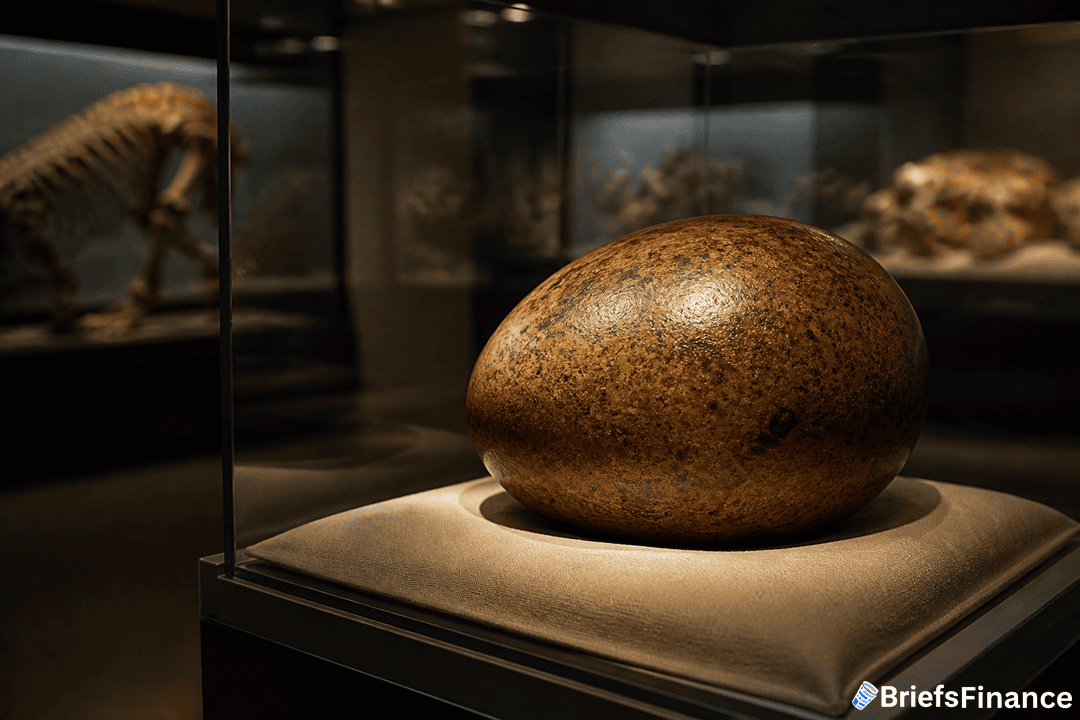
After purchasing a rare moa egg in June at Artemis Gallery in Louisville, Colorado, for around $14,000, Colossal Biosciences says it will transfer the specimen to Professor Te Maire Tau, a Māori scholar who is a tribal leader working from the Canterbury region of New Zealand's South Island. "To quote Indiana Jones, 'It belongs in a museum,' a museum in Aotearoa, under the care of the people whose ancestors lived alongside these extraordinary birds," said Colossal Co-Founder and Chief Executive Officer Ben Lamm.

First found on January 14, 1966, in New Zealand, the egg spent roughly six decades in a private American collection before it was acquired by the Dallas-based company. Assembled so far from numerous shards, the egg will receive additional pieces reaffixed under the direction of researchers from Ngāi Tahu, a South Island Māori tribe.

Why the egg matters

Moa stood as tall as 12 feet, weighed up to 230 kg, and went extinct about 600 years ago. The egg is sizable - nearly twice an ostrich egg's volume and roughly 8.7 by 6.7 inches - and belongs to a very small set of moa shells that are complete or nearly complete. Such eggshells have yielded ancient DNA and, through their structure and thickness, clues to nesting and incubation.

Film director Peter Jackson, an investor in Colossal who is working with the Ngāi Tahu Research Center and Canterbury Museum on the moa initiative, said he contacted the company when the egg came up for sale outside New Zealand. "When we learned that this exceptionally rare moa egg was being sold outside of New Zealand, we spoke to Colossal, who not only offered to rescue it at their own considerable expense - but to also fly it privately to New Zealand, so it returns home safely," he said. "After expert restoration, it will very likely become only the ninth known nearly intact moa egg - probably one of the five best-preserved examples."

When stories touch on culture and conservation, a quick daily update helps you stay grounded, so sign up for Market Briefs

The project and the people involved

Colossal is pursuing de-extinction programs for the moa, woolly mammoth, dodo, dire wolf, and Tasmanian tiger. Lamm said the moa effort was built around indigenous leadership: "When we launched the moa program, we made a clear commitment that indigenous leadership would guide the science and every decision surrounding the project. Securing and transporting this egg back to its rightful home is just part of that commitment."

Lamm told Bloomberg News the team is making "great progress" and may be positioned to bring the bird back by the early 2030s, though the timeline could change. He added that the Ngāi Tahu Research Center would decide when the public gets to see the bird. Work on the dodo is feeding into the moa research, he said: "Some of the editing technologies and delivery mechanisms are ahead of schedule, benefiting from our dodo project. We recently announced a new AI tool focused on the dodo that will also play a pivotal role in the moa de-extinction."

Colossal notes that, historically, moa supplied indigenous communities with meat, feathers, and bones. Bringing them back would require gene editing and surrogate species, with studies targeting close relatives like Australia's emu and Central America's tinamou. Paul Scofield, Canterbury Museum's senior natural history curator and an adviser on the project, called the prospect of returning moa to a New Zealand environment exciting, saying it offers Māori a direct connection and an economic opportunity.

What this could mean for your portfolio

De-extinction might sound cinematic, but the work is concrete: gene editing, surrogate development, and governance in partnership with Māori leaders. According to Colossal, its efforts could establish benchmarks for de-extinction and begin repairing harms tied to Earth's biodiversity loss, and the company has a tentative early 2030s target for moa, though that schedule could change. The bottom line: this egg is both a scientific resource and a signal of how biotech platforms, indigenous partnerships, and museum collaborations could shape timelines, funding, and eventual commercialization paths across conservation tech.

Across unexpected human interest stories, a short clear summary makes meaning easier, so try our free Market Briefs newsletter

Disclosure

Recent News

1 2 3 … 105

Get Market Briefs delivered to your inbox every morning for free!

No fluff. No noise. No politics. Just finance news you can read in 5 minutes.

Blogs

October 16, 2026
How Boring Math Makes You Rich: The Briefs Money Spreadsheet, Explained
  • Briefs Money shows you what to do with every paycheck, and in what order: how much to spend, save, and invest, when to build an emergency fund, and which debt to pay off first.
  • The Climb to Wealth course walks you through the system step by step, and the Personal Finance Spreadsheet is where you track your own numbers.
  • Investing is one piece of building wealth. The system that gets money to your investments, and keeps it there, decides the outcome.
Read More
October 16, 2026
Common Investing Mistakes: Why a Stock Grade Is One Tool, Not the Whole Toolkit
  • The Briefs Score shows growth, income, and wealth preservation investors how well a stock fits their goal, with a separate letter grade for each one.
  • The most common mistake is treating the letter as an instruction. An A tells you a stock scores well for one goal, not that you should buy today.
  • Research works best as one input in a process you own. The grade shows how a stock stacks up. You supply the goal, the timeline, and the rules for being wrong.
Read More
October 16, 2026
How to Read a Company's Numbers Without a Finance Degree (Using Briefs Terminal)
  • Briefs Terminal lets you size up any public company in about ten minutes: what the stock costs, what it earns, how fast sales are growing, and what it pays you, all on one page.
  • It lines those numbers up against the company's closest competitors for you, so you can tell if a number is impressive or just average.
  • Below that are the income statement, balance sheet, and cash flow statement from the company's SEC filings, the latest news, and transcripts of its earnings calls.
Read More
October 16, 2026
What Type of Investor Am I? The Three Investor Archetypes, Explained
  • Briefs sorts its stock grades and monthly reports by three investor goals: growth, income, and wealth preservation. Pick yours and you know which report and which grade to read first.
  • Growth investors want stocks that beat the S&P 500. Income investors want to get paid in cash. Wealth preservation investors want stocks that hold up when the market drops.
  • The same stock can score an A- for one goal and a D- for another, so picking your goal comes before picking any stock.
Read More
October 16, 2026
How to Build a Stock Watchlist That Isn't Just Stocks You Heard About
  • A watchlist on Briefs Terminal lets you group stocks by the idea you're tracking and follow each one's price, one-day move, and 52-week high and low in one place.
  • Each list has its own name and description, so you always know why a stock is on it, and you can make as many lists as you have ideas.
  • The monthly growth, income, and wealth preservation reports under the Briefs Research tab hand you new themes to track that you didn't hear about online.
Read More
October 16, 2026
How to Choose an ETF That Matches Your Idea (Using the ETF Planning Tool)
  • The ETF planning tool takes an idea like "I want to invest in fast food companies," asks what you mean, and finds the ETFs that match, with the reasons, the holdings, and the sources.
  • Build a Plan then shows what your money could grow to in those ETFs over the years you choose, with conservative, expected, and optimistic estimates next to the S&P 500.
  • It gets you from an idea to an actual plan without researching dozens of companies one at a time.
Read More
October 16, 2026
Is This Stock a Good Buy? How to Use the Briefs Score to Tell If a Stock Fits the Way You Invest
  • The Briefs Score shows growth, income, and wealth preservation investors how well a stock fits their goal, with a separate letter grade for each one.
  • One stock can score very differently for each. Nvidia showed an A- for growth and a D- for income, because it grows fast and pays almost no dividend.
  • Seven sub scores under each grade show what earned the letter, so you can see exactly where a stock is strong or weak for your goal.
Read More
October 16, 2026
How to Tell an Asset From a Liability: The One Question to Ask Before You Buy Anything
  • The typical American household earned more in 2025 than in any year on record, yet only 30% of Americans say they could pay a surprise $1,000 bill from savings, so the problem isn't income but what the income gets spent on.
  • An asset puts money in your pocket and a liability takes money out, and the wealthy buy assets first, then let the assets pay for the fun stuff.
  • Before you buy anything, ask one question: does this put money in my pocket, or take money out of my pocket? Then you need a plan for the money you keep.
Read More
October 16, 2026
How to Build Your First $2,000 Emergency Fund and Wipe Out Every Debt Over 10%
  • Your first money goal isn't investing, it's $2,000 in its own account named Do Not Touch, built by moving 10% of every paycheck into it automatically.
  • More than a third of American adults couldn't cover a $400 surprise bill with cash or savings, according to the Federal Reserve, and that's how one bad day turns into years of credit card payments.
  • Once the $2,000 is there, attack every debt charging more than 10% interest, highest rate first, because you can't out-invest a 22% credit card so paying it off is the investment.
Read More
October 16, 2026
How to Invest Through a Crash: 3 Rules From the Worst-Timed Investor Alive
  • Meet Bunty, a fictional investor with the worst timing in history: he put $100,000 into the market in four chunks right before four crashes, never sold, and by 2025 it had grown to more than $500,000.
  • Investors who jump in and out of the market miss its best days, and missing just a handful of those days can cut your final result roughly in half.
  • The fix is ABB, Always Be Buying: you buy on a schedule through booms, crashes and scary headlines, which matches the market, and beating it takes knowing where the money is moving first.
Read More
1 2 3 … 29
Share via
Copy link










