Free NewsletterPro Login
S&P 500 6,287 +0.42%
DOW 44,521 -0.18%
NASDAQ 21,103 +0.71%

Warning: Undefined variable $funds in /var/www/briefs.co/htdocs/wp-content/plugins/oxygen/component-framework/components/classes/code-block.class.php(133) : eval()'d code on line 491

Warning: foreach() argument must be of type array|object, null given in /var/www/briefs.co/htdocs/wp-content/plugins/oxygen/component-framework/components/classes/code-block.class.php(133) : eval()'d code on line 491
/* the link was here */

Incoming Apple CEO John Ternus Brings a Retired Hardware VP Back to Apple

Published Aug 3, 2026
[tts_player]
Share:
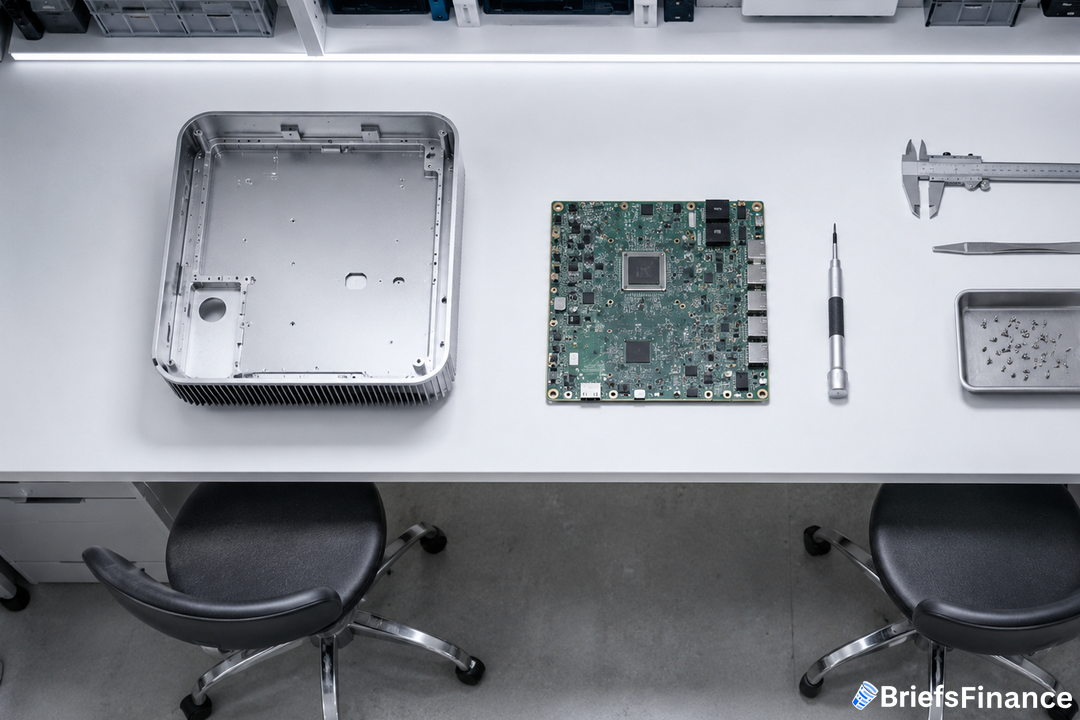
Overhead view of an engineering workbench with an aluminum enclosure, circuit board and calipers
Summary:
  • John Ternus, Apple's incoming chief executive, has recruited Laura Legros, a retired hardware engineering vice president, back to Apple.
  • Legros, who retired in 2022, will report directly to Ternus once he becomes CEO on Sept. 1.
  • More leadership changes are expected as several senior Apple executives approach retirement.

A Familiar Face Returns

John Ternus has not taken over as Apple's CEO yet, but he is already putting his own team in place.

People with knowledge of the matter say Ternus has brought Laura Legros back to Apple. Before stepping down in 2022, Legros held the role of vice president of hardware engineering at Apple.

They spoke on condition of anonymity because the move has not been announced. A spokesperson for Apple declined to comment.

She will work as a vice president across Apple's different divisions.

Apple's senior leadership is in the middle of a significant transition. Ternus takes over on Sept. 1, Cook becomes executive chairman, and several veterans are expected to retire around the same time. Legros's return gives the incoming CEO a lieutenant who already knows Apple's engineering organization and product processes.

This return is an early signal of how Ternus wants to shape Apple's executive team. Apple seldom brings back former executives, making the move notable.

Legros spent most of her Apple career in hardware engineering, a critical area for the company as it develops new Macs, iPads and other devices. Her return gives Ternus someone who understands both the technical details and the internal processes that keep product launches on schedule.

Get the market news that matters in a five-minute read with Market Briefs, our free daily newsletter

Product Experience That Ternus Trusts

At Apple, Legros oversaw product delivery, schedule management and coordination across engineering groups so teams stayed in sync. She became one of Ternus's most trusted deputies before stepping away.

In 2018, she appeared at an Apple launch event to present the latest MacBook Air. Two years later, she showed off the current iPad Air design.

A Leadership Shake-Up Takes Shape

Ternus will take over from Tim Cook, Apple's longest-serving CEO, who is moving to executive chairman.

Ternus has spent several months working next to Cook, sitting in on executive meetings, meeting company leaders, and joining roadmap reviews across several divisions.

Apple's design teams have also seen a lot more of him since late last year. Bloomberg News has reported that he wants to shake up Apple's design organization.

The timing gives Ternus a chance to build relationships with senior managers before Cook moves to the chairman role.

More Retirements Are on the Way

Kate Adams, Apple's former general counsel who now heads government affairs, has announced that she will leave Apple when this year closes. Jennifer Newstead, the new general counsel, will take over Adams's current duties.

Luca Maestri, Apple's ex-CFO now in charge of property and IT, and Phil Schiller, who was marketing chief until 2020 and now leads the App Store, are likewise approaching retirement from Apple.

What It Means for Apple

Ternus will take charge at a time when Apple is reshaping its senior leadership. Legros's return is one of the first visible signs of how he intends to build his team. She also brings continuity to the hardware organization just as several veteran managers are expected to exit.

Join Market Briefs, our free daily newsletter, for a quick daily rundown of the markets
Disclosure

Recent News

1 2 3 47

Get Market Briefs delivered to your inbox every morning for free!

No fluff. No noise. No politics. Just finance news you can read in 5 minutes.

Blogs

June 29, 2026
Portfolio Diversification: Why Putting All Your Eggs in One Basket Destroys Wealth
  • Real diversification means spreading investments across all 11 economic sectors plus bonds, alternatives, and cash so no single bet can sink the portfolio.
  • Different sectors perform at different times, so a diversified portfolio captures upswings while smoothing the brutal drawdowns that wipe out concentrated bets.
  • Total market index funds offer the simplest path to diversification, and annual rebalancing is what keeps the structure working over time.
Read More
June 29, 2026
Non Taxable Income: What It Is and Why It Matters
  • Non taxable income is money you receive that you don't owe income tax on.
  • The tax code treats workers, investors, and business owners very differently, and investors often come out ahead.
  • Learning how income is taxed is a quiet superpower for keeping more of what you earn.
Read More
June 29, 2026
Semiconductor Stocks: A Simple Guide for Investors
  • Semiconductor stocks are companies that design and make computer chips, the brains inside nearly every modern device.
  • The AI boom has turned chips into one of the market's most important and most watched groups.
  • They offer big growth potential, but come with high valuations and a notoriously cyclical history.
Read More
June 25, 2026
How Stocks Work: A Simple Guide for Beginners
  • A stock is a slice of ownership in a company - buy one, and you own a piece of the business.
  • You make money two ways: the share price rising over time, and dividends paid to shareholders.
  • The simplest path for most beginners is buying into the whole market through a low-cost index fund.
Read More
June 25, 2026
Stop Loss vs Stop Limit: What's the Difference?
  • A stop loss order sells your stock once it hits a trigger price, prioritizing getting you out.
  • A stop limit order only sells within a price range you set, prioritizing price over a guaranteed exit.
  • The trade-off: a stop loss almost always executes; a stop limit might not if the price moves too fast.
Read More
June 25, 2026
Energy Stocks: A Simple Guide for Investors
  • Energy stocks are companies that produce and supply the power the world runs on, from oil and gas to newer sources.
  • They make up one of the 11 sectors of the market and tend to move with energy prices and big-picture shifts.
  • Like any sector, the key is diversification and understanding the forces driving demand.
Read More
June 18, 2026
What Is a Stop Loss Order? A Simple Guide
  • A stop loss order automatically sells a stock once it falls to a price you set.
  • It's a tool to cap losses or lock in gains without watching the market all day.
  • It works best for active strategies, and can backfire if used carelessly on long-term holdings.
Read More
June 18, 2026
Best S&P 500 Index Fund: How to Choose One
  • The best S&P 500 index fund for most investors is simply the cheapest, most established one that tracks the index well.
  • Funds like VOO, IVV, and SPY all hold the same 500 companies, so the biggest difference is the fee.
  • Pick one, automate your buys, and let time do the heavy lifting.
Read More
June 17, 2026
What Are Penny Stocks? Risks and Rewards Explained
  • Penny stocks are very low-priced shares of very small companies, often trading for just a few dollars or less.
  • They promise huge gains but carry huge risks: low liquidity, high failure rates, and wild price swings.
  • Most investors are better served by quality companies and funds than by chasing cheap shares.
Read More
June 17, 2026
Best Stocks for Beginners With Little Money
  • The best stocks for beginners with little money usually aren't individual stocks at all - they're low-cost index funds.
  • You can start with $100 or less and use small, regular investments to build wealth over time.
  • Focus on diversification and consistency, not on picking the next big winner.
Read More
1 2 3 24
Share via
Copy link












