Free NewsletterPro Login

Warning: Undefined variable $stocks in /var/www/briefs.co/htdocs/wp-content/plugins/oxygen/component-framework/components/classes/code-block.class.php(133) : eval()'d code on line 448

Warning: foreach() argument must be of type array|object, null given in /var/www/briefs.co/htdocs/wp-content/plugins/oxygen/component-framework/components/classes/code-block.class.php(133) : eval()'d code on line 448

Warning: Undefined variable $funds in /var/www/briefs.co/htdocs/wp-content/plugins/oxygen/component-framework/components/classes/code-block.class.php(133) : eval()'d code on line 472

Warning: foreach() argument must be of type array|object, null given in /var/www/briefs.co/htdocs/wp-content/plugins/oxygen/component-framework/components/classes/code-block.class.php(133) : eval()'d code on line 472
/* the link was here */
×
Free investor livestream — Nov 17

How To Use ChatGPT & Claude To Research Stocks Like A Pro

01
The prompt we use to break down any stock
02
How to fact-check what AI tells you
03
How to compare two stocks in minutes

Young Chinese Investors Turn Stock Rout Into Halloween Jokes

Published Nov 2, 2026
Share:
Summary:
  • China's stock market is roughly 20% below its June peak as a generation of investors turns the slump into Halloween material.
  • The world's second-largest equities market has shed $3.5 trillion from a May high by late October, with the CSI 300 slipping into a bear market and ending the month with its worst drop in more than a decade.
  • Chinese shares rose Monday after reports that regulators plan to meet banks and brokerages to discuss support for the capital market.

Costumes that cut close to the bone

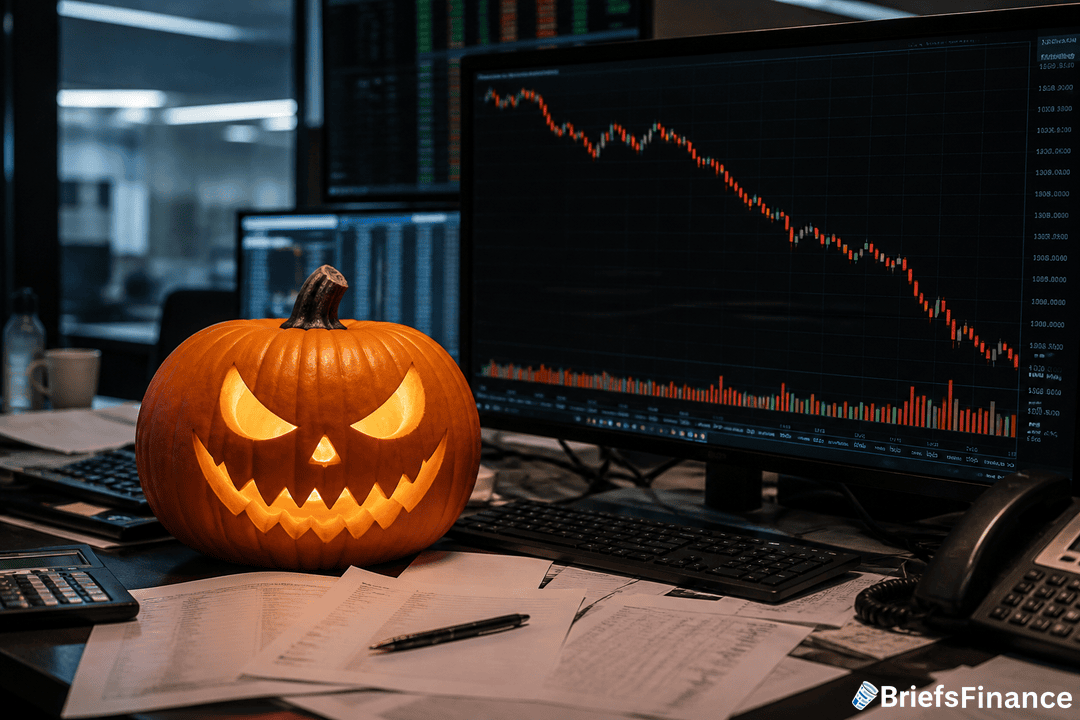
Over the weekend, young investors turned market misery into party props, posting Halloween getups styled as index charts and trading screens. These outfits showed up in the busy city centers of China's largest metros and surfaced across social platforms.

In Hangzhou, a tech hub in the east, one woman wore a candlestick chart of the sliding Shanghai Composite and carried leeks - a wink to internet slang for naive retail traders who keep getting "harvested." In Shenzhen, a reveler donned a boxed headpiece featuring steep selloffs in both the Shenzhen Composite and the tech-leaning STAR Composite. Another costume riffed on the Tonghuashun trading app by swapping in the word "Tonghuani," replacing "smooth" with a character meaning "adverse," and flashed a phone reading "Stay away from scam markets."

The market behind the jokes

The punch line is rooted in painful math. By late October, China's equity market had given up $3.5 trillion from a May top, consumer spending remained notably soft, and worries around the artificial intelligence trade were shaking global stocks. The CSI 300 fell into a bear market and closed the month with its sharpest monthly slide in more than ten years.

The anxiety spilled into social chatter too. "I'm so scared of what might happen on Monday that I can't fall asleep," one user posted on Weibo early Monday. "It's 10,000 times scarier than ghosts during Halloween."

The right tools can help investors make smarter, more confident decisions over time. We're hosting our first ever investor livestream on 11/17 to show you how to use ChatGPT and Claude to invest like a pro, hosted by Briefs Finance CEO Jaspreet Singh. Save your seat.

Global echoes and a policy watch

Costumes dunking on market declines also turned up in the US, where a darker outlook for tech has taken hold after recent earnings raised doubts about the payoff from AI spending. In China, shares climbed Monday after reports said regulators intend to sit down with banks and securities firms to consider steps to shore up the capital market - a fresh signal that officials want to slow the slide.

Why it matters for your portfolio

In plain English: sentiment is fragile, policy hopes are doing some lifting, and fundamentals like weak consumption still weigh on the backdrop. For global investors, China's drawdown, the AI debate, and policy headlines remain key drivers of risk appetite and sector swings.

Adapting to new technology quietly improves how people approach investing and risk. On 11/17, our CEO Jaspreet Singh goes live for our first ever investor livestream on how to use ChatGPT and Claude to invest like a pro. Register to join him.

Disclosure

Recent News

1 2 3 … 116

Get Market Briefs delivered to your inbox every morning for free!

No fluff. No noise. No politics. Just finance news you can read in 5 minutes.

Blogs

November 2, 2026
Credit Utilization: How Paying Down Cards Can Help Your Score
  • Credit utilization is your card balances divided by your credit limits, checked overall and card by card.
  • Lower is generally better, and Experian says the effect becomes more noticeable around 30%.
  • Paying down balances and keeping new charges off your cards are the main ways to lower it.
Read More
November 2, 2026
How to Calculate Your Net Worth, With a Worked Example
  • Net worth is what you own minus what you owe, and it can be negative early on.
  • Use today's value for your assets and today's payoff balances for your debts.
  • Recalculate on the same date each quarter or year, since the trend matters more than the starting number.
Read More
November 2, 2026
How to Get Out of Debt on a Low Income, Step by Step
  • List every debt with its balance, APR, minimum and due date, then pause new charges.
  • An extra $50 a month on a $3,000 card at 22% cuts the payoff from about 44 months to about 26.
  • If nothing is left over, call your lenders and a nonprofit credit counselor, and avoid anyone who charges fees before settling debt.
Read More
November 2, 2026
How to Save Money on a Low Income, With a Budget Example
  • Saving 10% of a $2,000 paycheck is $200 a month, which reaches a first $2,000 in 10 months.
  • Set the transfer for payday and keep the money in a separate savings account.
  • Lower your biggest bills, cancel unused subscriptions and check programs like Lifeline and the EITC.
Read More
November 2, 2026
How to Budget With an Irregular Income, Even in Lean Months
  • Build your budget on your lowest recent month, not your average, so slow months don't leave you short.
  • Pay yourself a fixed salary from a holding account, and keep extra from good months as a cushion.
  • If no one withholds tax from your pay, set tax money aside every month.
Read More
November 2, 2026
How to Track Your Spending in 15 Minutes a Week
  • Start with last month's bank and card statements, receipts and any cash purchases.
  • Sort every purchase into a few groups that match your budget, like groceries and eating out.
  • Spend about 15 minutes each week adding purchases, checking each group and picking one change.
Read More
November 2, 2026
Should You Invest or Pay Off Debt? How to Decide
  • Card interest is a cost you can see ahead of time, while investing returns can go up or down.
  • A $3,000 card balance at 24% costs about $60 in interest in the first month.
  • Check whether you have a cushion, how high your rate is, whether your employer offers a match and how you'd handle a market drop.
Read More
November 2, 2026
Pay Yourself First: What It Means and How to Automate It
  • Paying yourself first means moving money to savings and investing on payday, before bills and spending.
  • The 75/15/10 split puts at least 10% toward savings and at least 15% toward investing.
  • Start smaller if money is tight, and automate the transfers so you only make the decision once.
Read More
November 2, 2026
What Is a Good Credit Score? Ranges and What Moves Yours
  • On the FICO scale, a good credit score is 670 to 739, and very good starts at 740.
  • Payment history (35%) and amounts owed (30%) are the two biggest parts of your score.
  • Paying every bill on time and paying down card balances are the two best places to start.
Read More
November 2, 2026
How to Lower Your Credit Card Interest Rate, With a Call Script
  • Before you call, have your APR, balance, card history, on-time record and any lower-rate offers ready.
  • Use the script to ask for a lower rate, then ask for a temporary cut or a hardship program if the answer is no.
  • On a $5,000 balance paid at $200 a month, dropping from 26.99% to 23.99% saves about $430 in interest.
Read More
1 2 3 … 31
Share via
Copy link