Free NewsletterPro Login

Warning: Undefined variable $stocks in /var/www/briefs.co/htdocs/wp-content/plugins/oxygen/component-framework/components/classes/code-block.class.php(133) : eval()'d code on line 448

Warning: foreach() argument must be of type array|object, null given in /var/www/briefs.co/htdocs/wp-content/plugins/oxygen/component-framework/components/classes/code-block.class.php(133) : eval()'d code on line 448

Warning: Undefined variable $funds in /var/www/briefs.co/htdocs/wp-content/plugins/oxygen/component-framework/components/classes/code-block.class.php(133) : eval()'d code on line 472

Warning: foreach() argument must be of type array|object, null given in /var/www/briefs.co/htdocs/wp-content/plugins/oxygen/component-framework/components/classes/code-block.class.php(133) : eval()'d code on line 472
/* the link was here */
×
Free investor livestream — Nov 17

How To Use ChatGPT & Claude To Research Stocks Like A Pro

01
The prompt we use to break down any stock
02
How to fact-check what AI tells you
03
How to compare two stocks in minutes

US-Iran ship attacks are keeping fuel pricey while squeezing Iran's oil cash

Published Oct 31, 2026
Share:
Summary:
  • President Donald Trump has signaled he intends to resume strikes on Iran following the Nov. 3 midterms.
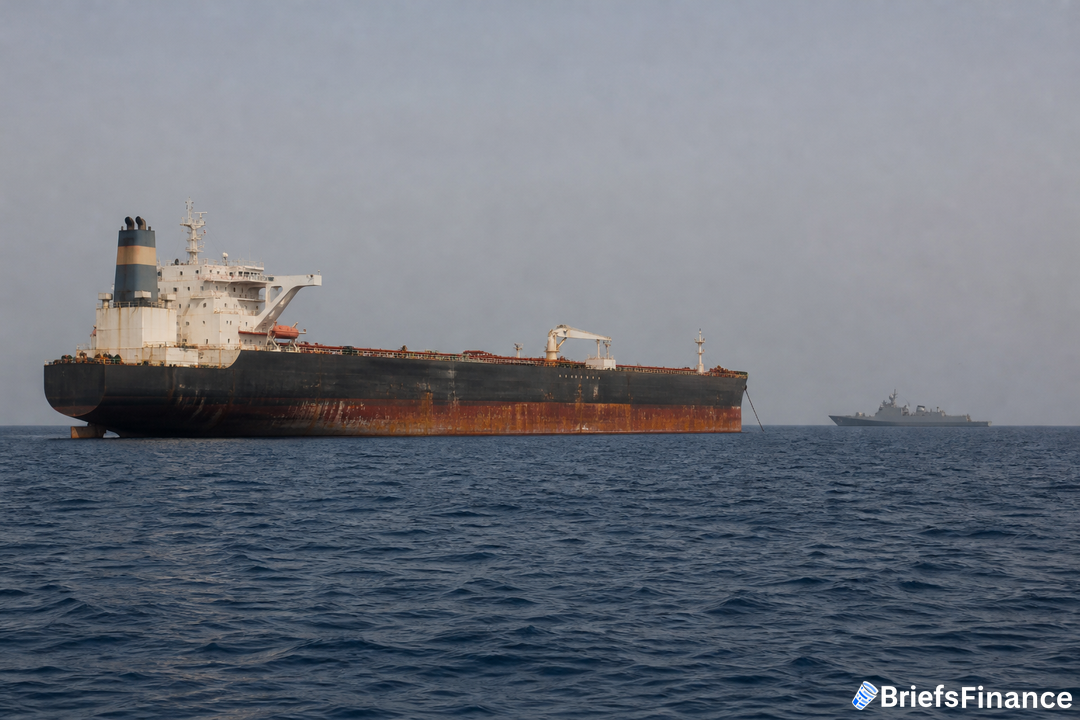
  • Intermittent Iranian hits on commercial vessels in and near the Strait of Hormuz have pushed up shipping and insurance costs even as a US clampdown has choked Iran's oil revenue.
  • According to the International Maritime Organization, there have been 121 recorded incidents in Hormuz and the broader area since the war began, with 24 confirmed deaths among seafarers.

What is happening at sea

Iran's sporadic strikes on merchant shipping have collided with US efforts to throttle Tehran's oil income, turning the Strait of Hormuz into an economic pressure point. Washington's squeeze on Iranian crude has hit a critical military funding stream and weighed on an economy of roughly $300 billion, with only a thin slice of the prewar 2 million barrels a day now trickling out over land.

Even so, traffic through the strait continues. Shipments are running at about 80% of prewar levels, and tankers are still hauling Middle East barrels. The risk premium is doing the price work: insurance has climbed, and in early October, chartering a supertanker in some regions temporarily topped the cost of launching a rocket into space.

The scale of incidents and how transits are protected

Open-source tallies recorded at least 28 cases of vessel damage in the strait in October. A US official with direct knowledge said Iran has not increased how often it fires, but more severe hits have led to more reports, with about one quarter of the incidents in the first two weeks targeting engine rooms that can put ships out of action. Since the war began, the International Maritime Organization counts 121 incidents across Hormuz and nearby waters, including 24 confirmed seafarer fatalities.

According to US Central Command, the vast majority of Iranian attacks are thwarted or miss, and roughly 95% of vessels transit without incident. The same US official said Iran is using both cruise missiles and drones. In response, US forces are coordinating transits and providing protection, mostly from aircraft overhead. The military is in direct contact with the tanker industry, sharing updates and aligning on timing, routes and convoy sizes, then assigning assets to monitor voyages and shoot down threats if needed.

No ship has hit a floating mine while crossing the strait, the US official said. Iran said in late October that a mine struck a tanker, and the UKMTO later reported on Friday that another vessel suffered damage from charges attached to its hull.

Geopolitical events remind investors that understanding risk can sharpen long term decisions. We're hosting our first ever investor livestream on 11/17 to show you how to use ChatGPT and Claude to invest like a pro, hosted by Briefs Finance CEO Jaspreet Singh. Save your seat.

Capabilities, constraints and what strikes can do

Per Jim Lamson - a visiting research fellow at King's College London and a former CIA analyst with a focus on Iran and the Middle East - Tehran can continue assembling anti-ship systems from stored missile components, even as US airstrikes have severely cut back Iran's capacity to produce them in large quantities. "They have been planning for a long-term asymmetric conflict with the US for decades," Lamson said. "Things like building in resilience, building in redundancy, building in stockpiling - these have been part of their military culture."

John Miller, a former CENTCOM commander and retired US Navy vice admiral, said Iran can keep attacking ships in Hormuz as long as it wants to sustain a blockade, framing the choice as making them unwilling or unable. He added that much of Iran's ability to track targets beyond sight over the last eight months has been largely destroyed. That leaves weapons often launched toward general areas, with radar or infrared seekers directing them to nearby objects at the end. To counter those, aircraft use low cost munitions such as APKWS, where a BAE Systems Plc guidance kit is about $20,000, while high-cost ship-based interceptors such as Raytheon's SM-6 and the SM-3 Block IIA are held back primarily to counter ballistic missile threats.

In recent days, Trump has indicated he plans to restart attacks on Iran after the Nov. 3 midterm elections. Even so, Emma Salisbury - who holds a non-resident senior fellowship at the Foreign Policy Research Institute and an associate fellowship at the Royal Navy Strategic Studies Centre - said it is not clear that airstrikes will change conditions in the strait, especially against an adversary that has spent decades shielding key capabilities from such raids.

Prices, politics and your portfolio

Higher risk and insurance around Hormuz have kept US fuel prices elevated, and the political blowback is building ahead of the midterms. Iran does not need a rapid tempo of attacks to keep oil supported, and Ziad Daoud, chief emerging markets economist at Bloomberg Economics, estimates a flare up could push crude into the 120 to 130 dollar range. He also wrote that both sides "may prefer a brief conflict to improve their negotiating power."

Despite the dangers, the tanker market is still moving barrels at near prewar levels. Owners can earn tens of millions of dollars on these runs, and crews are pocketing months of pay for just a few days in high-risk waters, which is keeping voyages going. The bottom line: flows through Hormuz mostly continue, but at a higher cost that props up prices and leaves your energy exposure sensitive to any escalation.

Knowing how new tools reveal market risks can help you find smarter opportunities. On 11/17, our CEO Jaspreet Singh goes live for our first ever investor livestream on how to use ChatGPT and Claude to invest like a pro. Register to join him.

Disclosure

Recent News

1 2 3 … 115

Get Market Briefs delivered to your inbox every morning for free!

No fluff. No noise. No politics. Just finance news you can read in 5 minutes.

Blogs

October 23, 2026
Are We in a Recession? 5 Threats to the Economy and Where the Money Is Moving
  • The S&P 500 is up about 13% this year, but without AI it's in a bear market, with nearly 40% of its companies down more than 20% for four months or longer.
  • Jackson, Briefs Finance's head of investing research, sees five threats: rising interest rates, sticky inflation, an economy propped up by AI, a struggling UK, and high oil prices.
  • The opportunities he's watching mostly sit outside the dollar: rising economies like Brazil and Indonesia, US-backed emerging market bonds paying 7% to 9%, and the shifts that fear creates.
Read More
October 16, 2026
How Boring Math Makes You Rich: The Briefs Money Spreadsheet, Explained
  • Briefs Money shows you what to do with every paycheck, and in what order: how much to spend, save, and invest, when to build an emergency fund, and which debt to pay off first.
  • The Climb to Wealth course walks you through the system step by step, and the Personal Finance Spreadsheet is where you track your own numbers.
  • Investing is one piece of building wealth. The system that gets money to your investments, and keeps it there, decides the outcome.
Read More
October 16, 2026
Common Investing Mistakes: Why a Stock Grade Is One Tool, Not the Whole Toolkit
  • The Briefs Score shows growth, income, and wealth preservation investors how well a stock fits their goal, with a separate letter grade for each one.
  • The most common mistake is treating the letter as an instruction. An A tells you a stock scores well for one goal, not that you should buy today.
  • Research works best as one input in a process you own. The grade shows how a stock stacks up. You supply the goal, the timeline, and the rules for being wrong.
Read More
October 16, 2026
How to Read a Company's Numbers Without a Finance Degree (Using Briefs Terminal)
  • Briefs Terminal lets you size up any public company in about ten minutes: what the stock costs, what it earns, how fast sales are growing, and what it pays you, all on one page.
  • It lines those numbers up against the company's closest competitors for you, so you can tell if a number is impressive or just average.
  • Below that are the income statement, balance sheet, and cash flow statement from the company's SEC filings, the latest news, and transcripts of its earnings calls.
Read More
October 16, 2026
What Type of Investor Am I? The Three Investor Archetypes, Explained
  • Briefs sorts its stock grades and monthly reports by three investor goals: growth, income, and wealth preservation. Pick yours and you know which report and which grade to read first.
  • Growth investors want stocks that beat the S&P 500. Income investors want to get paid in cash. Wealth preservation investors want stocks that hold up when the market drops.
  • The same stock can score an A- for one goal and a D- for another, so picking your goal comes before picking any stock.
Read More
October 16, 2026
How to Build a Stock Watchlist That Isn't Just Stocks You Heard About
  • A watchlist on Briefs Terminal lets you group stocks by the idea you're tracking and follow each one's price, one-day move, and 52-week high and low in one place.
  • Each list has its own name and description, so you always know why a stock is on it, and you can make as many lists as you have ideas.
  • The monthly growth, income, and wealth preservation reports under the Briefs Research tab hand you new themes to track that you didn't hear about online.
Read More
October 16, 2026
How to Choose an ETF That Matches Your Idea (Using the ETF Planning Tool)
  • The ETF planning tool takes an idea like "I want to invest in fast food companies," asks what you mean, and finds the ETFs that match, with the reasons, the holdings, and the sources.
  • Build a Plan then shows what your money could grow to in those ETFs over the years you choose, with conservative, expected, and optimistic estimates next to the S&P 500.
  • It gets you from an idea to an actual plan without researching dozens of companies one at a time.
Read More
October 16, 2026
Is This Stock a Good Buy? How to Use the Briefs Score to Tell If a Stock Fits the Way You Invest
  • The Briefs Score shows growth, income, and wealth preservation investors how well a stock fits their goal, with a separate letter grade for each one.
  • One stock can score very differently for each. Nvidia showed an A- for growth and a D- for income, because it grows fast and pays almost no dividend.
  • Seven sub scores under each grade show what earned the letter, so you can see exactly where a stock is strong or weak for your goal.
Read More
October 16, 2026
How to Tell an Asset From a Liability: The One Question to Ask Before You Buy Anything
  • The typical American household earned more in 2025 than in any year on record, yet only 30% of Americans say they could pay a surprise $1,000 bill from savings, so the problem isn't income but what the income gets spent on.
  • An asset puts money in your pocket and a liability takes money out, and the wealthy buy assets first, then let the assets pay for the fun stuff.
  • Before you buy anything, ask one question: does this put money in my pocket, or take money out of my pocket? Then you need a plan for the money you keep.
Read More
October 16, 2026
How to Build Your First $2,000 Emergency Fund and Wipe Out Every Debt Over 10%
  • Your first money goal isn't investing, it's $2,000 in its own account named Do Not Touch, built by moving 10% of every paycheck into it automatically.
  • More than a third of American adults couldn't cover a $400 surprise bill with cash or savings, according to the Federal Reserve, and that's how one bad day turns into years of credit card payments.
  • Once the $2,000 is there, attack every debt charging more than 10% interest, highest rate first, because you can't out-invest a 22% credit card so paying it off is the investment.
Read More
1 2 3 … 29
Share via
Copy link










