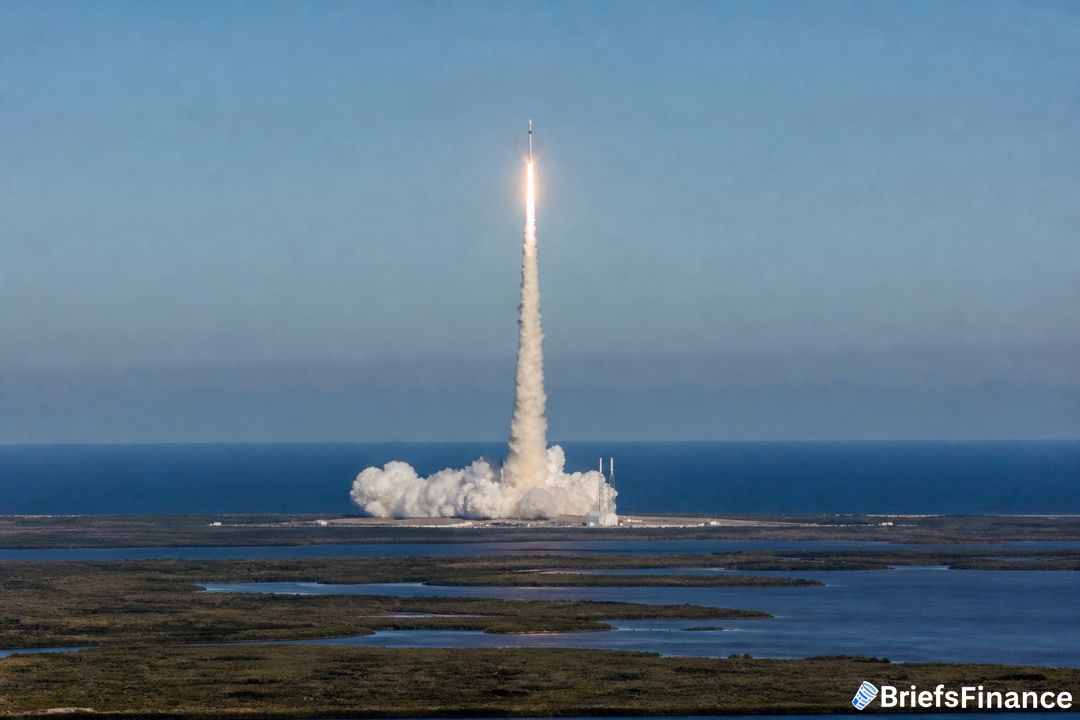
What happened
India's space agency used its Geosynchronous Satellite Launch Vehicle to haul the NVS-03 payload to space, with liftoff from the Satish Dhawan Space Centre at about 11:50 p.m. local time Friday.
ISRO later confirmed on X that the mission hit its mark, delivering the spacecraft to the targeted orbit.
Why it matters
NVS-03 weighs 2,250 kilograms, or 4,960 pounds, and is the third satellite in a series of navigation platforms stationed in geosynchronous orbit. In plain English, that orbit lets a satellite match Earth's rotation so it can watch the same region continuously.
The satellite carries indigenous and procured atomic clocks. Its signal system is engineered to serve the Indian mainland and extend roughly 1,500 kilometers, or 932 miles, beyond the country's borders.
Advances in space technology remind investors to explore new tools for an edge. We're hosting our first ever investor livestream on 11/17 to show you how to use ChatGPT and Claude to invest like a pro, hosted by Briefs Finance CEO Jaspreet Singh. Save your seat.
The bigger picture for investors
The flight extends GSLV's recent streak after it deployed a joint NASA ISRO satellite and an Earth observation payload. Considered together, these accomplishments strengthen trust in India's launch tempo, even as ISRO moves past a run of setbacks associated with its workhorse Polar Satellite Launch Vehicle.
Keeping an eye on technological shifts can help investors sharpen their decision making. On 11/17, our CEO Jaspreet Singh goes live for our first ever investor livestream on how to use ChatGPT and Claude to invest like a pro. Register to join him.