What Fitch announced and why
Fitch cut France's outlook to negative in a surprise move, saying the change "reflects a deterioration since our August 2026 review comprising weaker growth, higher borrowing costs and a wider deficit." It warned that "these worsen debt dynamics from an already weak starting point," and that "persistent political fragmentation and a challenging social backdrop increase the difficulty of delivering sustained fiscal consolidation."
The firm added that "the emerging policy debate ahead of the presidential election has not materially strengthened Fitch's confidence in the prospects for durable deficit reduction" and that "large protests over public services and living costs further complicate the social context for fiscal consolidation." Fitch said recent events warranted a "deviation from the calendar" and that its next scheduled review should wrap up by the end of February.
The numbers behind the move
France stays at A+ on Fitch's scale, the same level as Portugal and Belgium and six steps above high-yield territory. Moody's, which sits one notch higher, chose last week not to downgrade and kept a negative outlook. That reprieve was applauded by Finance Minister Roland Lescure as recognizing "the solidity of our economy and the credibility of the budget presented by the government." On Friday, he said Fitch's "assessment underlines the pressing need to pass a responsible budget before the end of the year."
Fitch said "the cumulative fiscal adjustment needed to stabilize debt has risen to around 3.5% of GDP, from 3.0% in August." The deficit is now projected to reach 5.4% of GDP this year, with political stalemate, weaker activity and pricier borrowing undermining consolidation efforts. The economic picture dimmed further after data showed output fell in the third quarter, pulled down by a prolonged downturn in investment.
When markets feel uncertain, investors seek smarter tools to preserve and grow capital. We're hosting our first ever investor livestream on 11/17 to show you how to use ChatGPT and Claude to invest like a pro, hosted by Briefs Finance CEO Jaspreet Singh. Save your seat.
Markets and the political backdrop
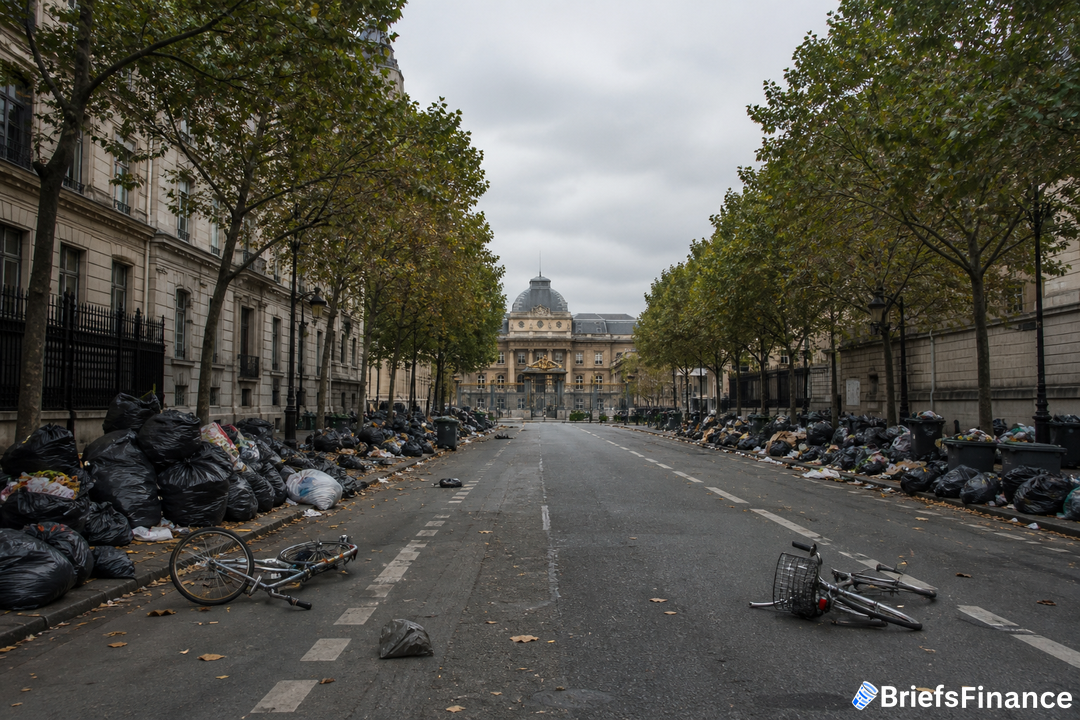
The timing lands as France heads into another protest-filled weekend in major cities such as Paris, with officials seeking to prevent further violence after severe riots earlier this month. The struggle to rein in a growing debt load has already put France at the center of recent bond-market jitters. French yields have climbed more than any other developed market this month, reaching a 24-year high.
Credit stress is visible in the spread between 10-year French and German bonds, which widened to 178 basis points this month compared with roughly 85 basis points at the beginning of September, and hovered around 165 on Friday. Fitch has been more forceful than peers on France's fiscal trajectory, moving ahead of other agencies on prior cuts.
What it means for your portfolio
Prime Minister Sébastien Lecornu has put forward a finance bill that would tighten spending and lift tax receipts to target a 5% deficit next year, but passage is uncertain given the lack of a parliamentary majority. Opposition parties are dug in with a presidential vote about six months away, and leading contenders across the spectrum are pitching big policy shifts, including a lower retirement age and large tax increases on companies.
For investors, the takeaway is straightforward: deteriorating fiscal math meets political gridlock as growth cools and funding costs rise. Watch the spread with Bunds, the budget's path through parliament, and Fitch's review by end February for the next signals on France's risk premium.
Learning how new technologies can sharpen your investment decisions starts with practical guidance. On 11/17, our CEO Jaspreet Singh goes live for our first ever investor livestream on how to use ChatGPT and Claude to invest like a pro. Register to join him.