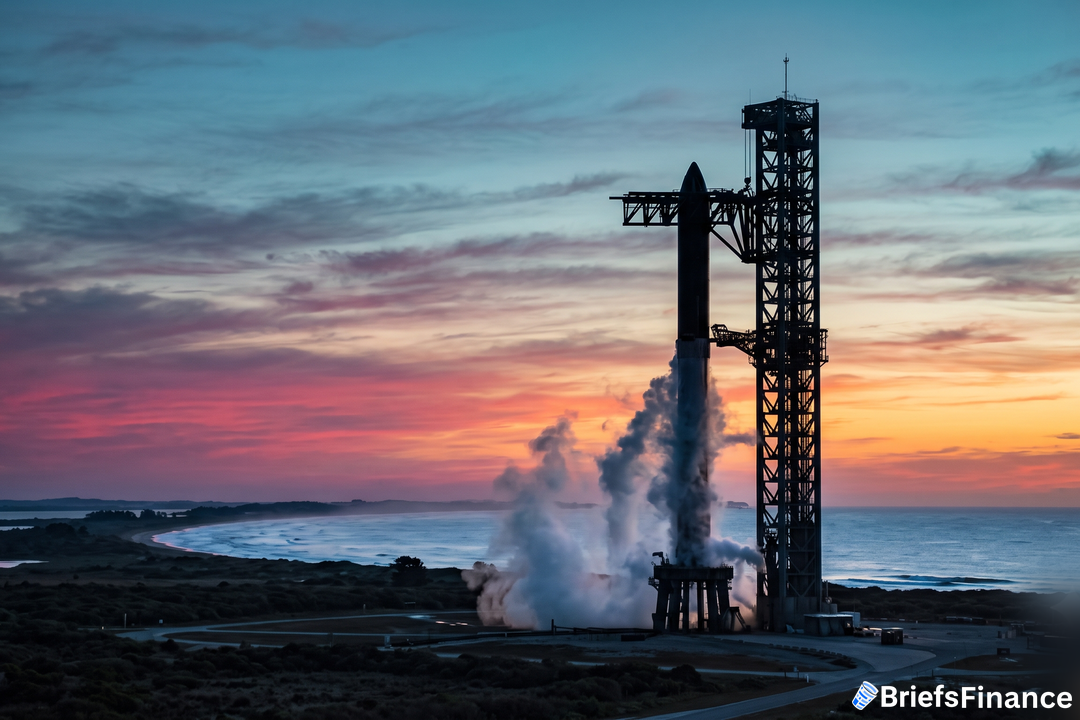
SpaceX's stock price settled at $148 on Wednesday, dipping beneath its debut price of $150 per share for the second straight day. The aerospace and defense firm led by Elon Musk was added to the Nasdaq-100 index on Tuesday, under a month after its initial public offering on June 12. The exchange added SpaceX to the index quickly, partly due to a recent change in eligibility rules for newly public companies.
To reflect the new composition, index funds and ETFs tracking the benchmark were required to purchase SpaceX shares. The company's record IPO raised $85.7 billion after underwriters exercised the "greenshoe" overallotment. This option lets firms issue extra shares during an IPO if investor demand exceeds the original supply.
SpaceX offered 555.6 million shares at a fixed price of $135 per share. The shares surged after the IPO, reaching a closing peak of $201.80 on June 16.
What Analysts Say
Analyst sentiment turned mostly positive after the Nasdaq-100 inclusion was announced. Morgan Stanley started coverage with an "overweight" rating and a $300 price target on SpaceX. Bernstein initiated coverage at "outperform" with a price target of $239.
Get your free investing masterclass bonus when you join Market Briefs, our free daily newsletter
RBC initiated with an "outperform" rating and price target of $225. UBS initiated with a "buy" rating and 12-month price target of $210 per share.
Bullish analysts point to SpaceX's leadership in reusable rocketry and launch operations, its extensive Starlink satellite internet network, and opportunities to improve profit margins in both areas. For future expansion, analysts cite SpaceX's ability to create artificial intelligence offerings - such as agentic coding tools that could compete with Anthropic's Claude or OpenAI's Codex - as well as orbital data centers.
On the bearish side, MoffettNathanson started coverage with a neutral rating, and CFRA advised selling the stock.
The wide range of targets - from $210 to $300 - shows how much uncertainty surrounds the stock. SpaceX's high of $201.80 is still far above current levels, but the drop below $150 worries some investors.
Background on the IPO and Index Inclusion
SpaceX's rapid addition to the Nasdaq-100 highlights its massive market capitalization and investor enthusiasm. The index normally requires companies to be public for at least 12 months, but a rule change now allows early inclusion for firms with a market cap above a certain threshold. This shift benefited SpaceX, whose valuation exceeded $250 billion at the IPO.
Meanwhile, the stock's pullback may reflect profit-taking after a sharp post-IPO rally, as well as broader market volatility in the aerospace sector. The company's next major catalyst could be its planned Starship orbital test flight, which analysts believe will further demonstrate its technological edge.
Subscribe to Market Briefs, our free daily newsletter, and claim your bonus investing masterclass