Free NewsletterPro Login

Warning: Undefined variable $stocks in /var/www/briefs.co/htdocs/wp-content/plugins/oxygen/component-framework/components/classes/code-block.class.php(133) : eval()'d code on line 448

Warning: foreach() argument must be of type array|object, null given in /var/www/briefs.co/htdocs/wp-content/plugins/oxygen/component-framework/components/classes/code-block.class.php(133) : eval()'d code on line 448

Warning: Undefined variable $funds in /var/www/briefs.co/htdocs/wp-content/plugins/oxygen/component-framework/components/classes/code-block.class.php(133) : eval()'d code on line 472

Warning: foreach() argument must be of type array|object, null given in /var/www/briefs.co/htdocs/wp-content/plugins/oxygen/component-framework/components/classes/code-block.class.php(133) : eval()'d code on line 472
/* the link was here */

Qatar's LNG Plant Damage to Keep Fertilizer Prices Elevated Through 2027

Published Jul 5, 2026
[tts_player]
Share:
Summary:
  • Urea prices are projected to remain 35% to 56% above pre-crisis levels through fall 2026 even if the Strait of Hormuz reopens quickly.
  • Repairs to Qatar’s damaged Ras Laffan LNG complex will take 3 to 5 years, creating a sustained feedstock shortage.
  • U.S. farmers have secured nitrogen for only 60% of the 2026 season, leaving millions of acres exposed to high spot prices.

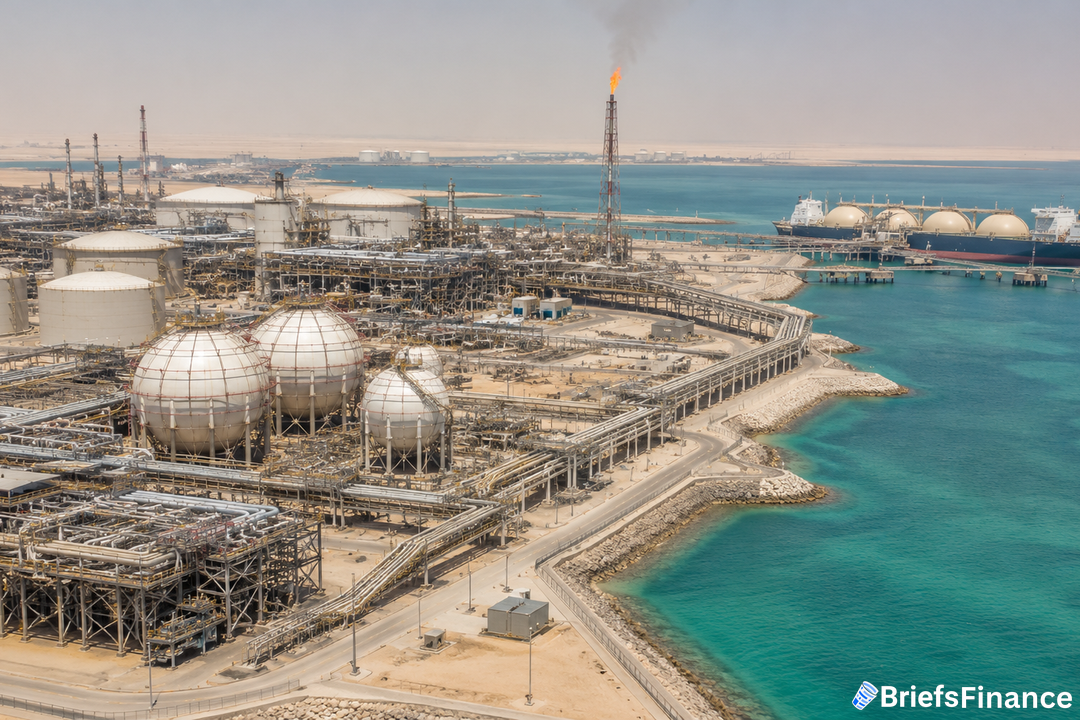
Qatar's Ras Laffan complex is one of the world's largest natural gas liquefaction facilities, and its output feeds directly into the global ammonia and urea supply chain. Without a reliable supply of methane feedstock, fertilizer producers face a sustained input shortage that will persist for years. This structural constraint underpins the elevated price forecasts.

The Strait of Hormuz carries 43% of seaborne urea exports, but the region that caused the crisis is not the region that will keep prices elevated. The real damage lies in Qatar's natural gas plants, which supply the raw material for fertilizer production, and those will take years to fix.

That long tail explains a strange tension: even in the best-case scenario where the strait reopens quickly, fertilizer prices stay high through 2027. In their analysis, the five economists (Arita, Wang, Kim, Chakravorty, and Steinbach) noted that farmers face a fall 2026 purchasing window where prepay urea costs are "materially above pre‑crisis levels."

Why Prices Stay High

The war closed the Strait of Hormuz, a narrow waterway that moves nearly half the world's seaborne urea and sulfur. But the conflict also hit Qatar's Ras Laffan LNG complex, a massive natural gas facility that produces the methane used to make nitrogen fertilizer. That damage creates a structural floor for prices.

Get your free investing masterclass bonus when you join Market Briefs, our free daily newsletter

Under a "quick reopening" scenario, fall 2026 prepay urea sits at $636 per short ton - 35% above the pre-crisis level of $470. In the "contested transit" scenario, where shipping remains disrupted, urea hits $733 per short ton, or 56% higher. DAP, a common phosphate fertilizer, reaches $825 per short ton under that same scenario.

The report's long-run floor for urea, assuming the damage assessments are accurate, is $532 per short ton - still 13% above pre-crisis. "Therefore, the 2026 pattern is structurally different with a slower ramp, a sustained plateau through fall, and a normalization that never returns to pre‑crisis levels," the authors wrote.

What This Means for U.S. Farmers

The math is simple but painful. Corn currently trades around $4.40 to $4.60 per bushel - flat compared to $7.50 in 2022. Fertilizer costs, meanwhile, are sharply higher. The report uses an affordability ratio: how many bushels of corn a farmer must sell to buy one short ton of urea.

Under the "contested transit" scenario, that ratio hits 174 bushels of corn per ton of urea. The long-run average is 79 bushels. Think of it as needing to sell twice as much grain just to cover the same bag of fertilizer.

"The affordability ratio shows why 2026 feels different," the report states. To clear the market under the contested transit scenario, global urea demand must shrink by 7 million metric tons - a 14% reduction. Brazil, the European Union, and the U.S. will bear most of that adjustment.

The National Corn Growers Association survey found only 60% of U.S. farmers had fully secured nitrogen for the 2026 season, and 64% had secured phosphate. That leaves millions of acres still exposed to spot pricing as fall approaches.

What to Watch

Economists are watching whether reduced fertilizer applications will trim 2026 U.S. corn yields and shift the crop mix toward less fertilizer-intensive crops like soybeans. The report notes that grain stocks remain adequate and the Strait of Hormuz carries negligible grain trade, so food supplies are not immediately threatened. But the price of growing that grain just went up - and it is not coming back down anytime soon.

Subscribe to Market Briefs, our free daily newsletter, and claim your bonus investing masterclass

Disclosure

Recent News

1 2 3 63

Get Market Briefs delivered to your inbox every morning for free!

No fluff. No noise. No politics. Just finance news you can read in 5 minutes.

Blogs

August 23, 2026
How to Get the Most From Your Guideline 401k
  • Guideline is a company that provides low-cost 401k plans, popular with small businesses and their employees.
  • A "Guideline 401k" follows the same core rules as any 401k: tax-advantaged growth, contribution limits, and often an employer match.
  • The biggest results come from capturing the full match, choosing low-cost funds, and picking Roth or traditional to fit your situation.
Read More
August 23, 2026
Principal 401k: What to Know About Your Plan
  • Principal is one of many companies that manage workplace 401k plans, so a "Principal 401k" is simply a 401k where Principal is the provider.
  • The rules of a 401k are the same no matter who runs it: pre-tax or Roth contributions, tax-advantaged growth, and often an employer match.
  • The biggest wins come from grabbing the full match, picking low-cost funds, and knowing whether Roth or traditional fits you.
Read More
August 23, 2026
What a Tariff Dividend Means for Your Money
  • A "tariff dividend" is the idea of taking money the government collects from tariffs and paying some of it back to citizens.
  • To judge the idea, you first need to know what a tariff is: a tax on imported goods, usually paid by the companies bringing them in.
  • Tariffs ripple through prices, businesses, and your investments, so the smart move is understanding those ripples, not just the headline.
Read More
August 23, 2026
No Tax on Overtime: How Overtime Pay Is Taxed
  • "No tax on overtime" refers to a tax break that lets certain workers deduct some overtime pay, lowering the income they get taxed on.
  • A deduction does not mean overtime is truly tax-free. It means part of that pay is subtracted before your tax is figured.
  • The bigger money lesson: how you earn money changes how it is taxed, and investors often get the friendliest treatment of all.
Read More
August 23, 2026
Reading the Silver Price Forecast for 2026
  • Nobody can honestly promise a specific silver price for 2026. Any exact number is a guess, so treat forecasts as opinions, not facts.
  • Silver is unusual because it is both a precious metal and an industrial metal, so its price answers to two very different forces.
  • Instead of chasing a forecast, learn the drivers - inflation, interest rates, recession fear, and industrial demand - so you can judge any prediction yourself.
Read More
August 23, 2026
What to Do When Reddit Stocks Go Viral
  • "Reddit stocks" usually means stocks getting hyped in online communities, where crowds can send a price soaring or crashing fast.
  • These tips can be entertaining and sometimes useful, but they are opinions, not research, and often come loaded with hype.
  • The safe move is to treat every online tip as a starting point, then do your own homework before risking a dollar.
Read More
August 23, 2026
Why Is Bitcoin Dropping Right Now?
  • Bitcoin drops for a mix of reasons: interest rates, big-picture money policy, regulation news, and simple shifts in how much risk investors want to take.
  • Bitcoin has a fixed supply and no earnings, so its price runs almost entirely on supply, demand, and sentiment.
  • Sharp drops are normal for bitcoin. Understanding the drivers matters more than reacting to any single day.
Read More
August 23, 2026
The Fidelity 500 Index Fund, Made Simple for Beginners
  • The Fidelity 500 Index Fund is a low-cost fund that tracks the S&P 500, an index of 500 large U.S. companies.
  • Buying it means owning a tiny slice of 500 businesses at once, which spreads your risk in a single purchase.
  • Index funds like this win over time mostly by keeping fees low and letting compounding do the work.
Read More
August 23, 2026
USA Penny Stocks: Risks and Rewards Explained
  • USA penny stocks are very low-priced shares of very small companies, often trading under $5 and sometimes under $1.
  • They dangle the dream of huge, fast gains, but carry brutal risks: low liquidity, wild swings, and high failure rates.
  • Most investors build wealth faster with quality companies and funds than by chasing cheap shares.
Read More
August 23, 2026
Finding Cheap Stocks to Buy Now Without Getting Burned
  • A low share price does not mean a stock is cheap. Real value compares the price to what the business is actually worth.
  • The best cheap stocks to buy now are quality companies trading below their true value, not the tiniest, riskiest shares on the market.
  • For most beginners, a low-cost index fund is the simplest "cheap" way to own great companies at once.
Read More
1 2 3 25
Share via
Copy link










