Free NewsletterPro Login
S&P 500 6,287 +0.42%
DOW 44,521 -0.18%
NASDAQ 21,103 +0.71%
S&P 500 +12.4%
Briefs Finance Fund +24.8%
JOIN THE FUND →

Soaring Costs Leave 70% of Farmers Without Needed Spring Fertilizer

Published Jul 5, 2026
[tts_player]
Share:
Summary:
  • 70% of surveyed farmers cannot afford all needed fertilizer for spring planting
  • Diesel prices rose 46% and urea prices 47% since late February 2026
  • 94% of farmers said their finances worsened or stayed the same compared to last year

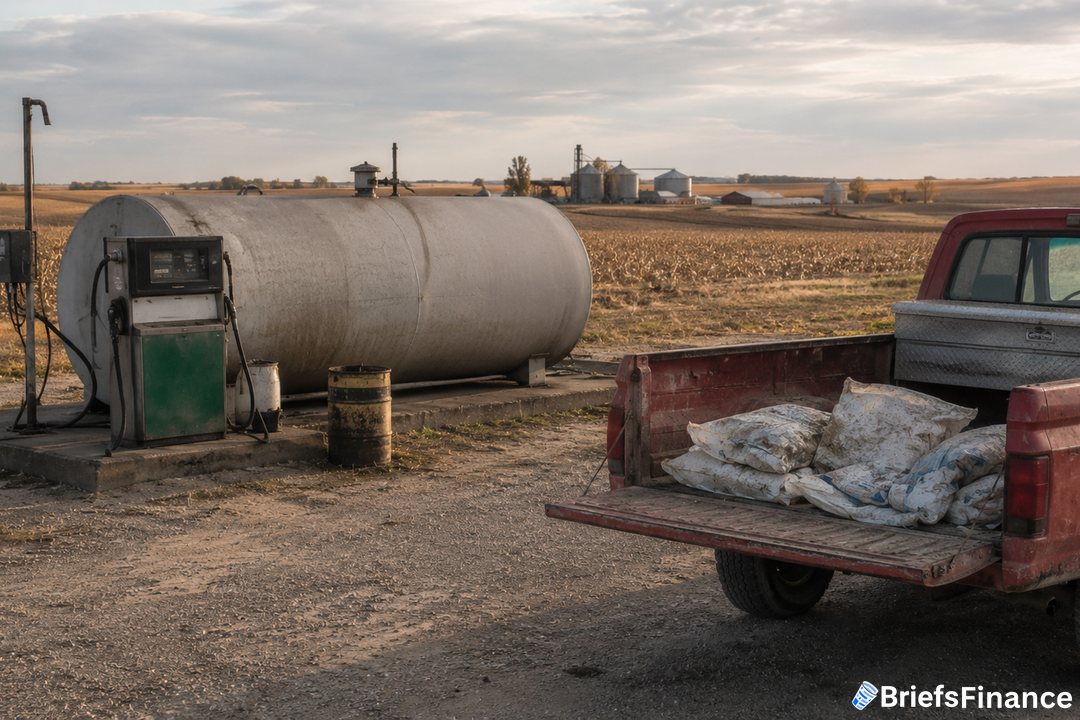
More than 5,700 farmers responded to a survey by the American Farm Bureau Federation between April 3 and April 11, 2026. The survey reveals that seven out of ten growers are unable to purchase their complete fertilizer requirements for spring planting.

Global Disruptions Send Costs Soaring

The trouble started when the Strait of Hormuz was closed and tensions in the Middle East escalated. Nitrogen fertilizer prices rose by more than 30% since the conflict began.

Fertilizer production is heavily dependent on natural gas, which accounts for a major share of nitrogen fertilizer manufacturing costs. The disruption of global supply chains and sharp price increases were caused by the blocking of the Strait of Hormuz, a critical passage for natural gas used in nitrogen fertilizer production. This directly pushed up energy and input costs for farmers.

Pre-Booking Patterns Show Regional Divide

Some farmers were able to lock in fertilizer prices earlier by pre-booking - ordering in advance. Among crops, 49% of soybean producers pre-booked, 47% of barley producers, 44% of corn producers, and 42% of wheat producers. Cotton and peanut producers lagged far behind at 13% and 9%.

Get your free investing masterclass bonus when you join Market Briefs, our free daily newsletter

Regionally, Midwestern farmers had the highest pre-booking rate at 67%, while only 19% of Southern producers pre-booked. Northeastern farmers came in at 30%, and Western farmers at 31%.

Larger farms were more likely to pre-book, but the gap varied by region. In the Midwest, 77% of farms with 500 to 2,499 acres pre-booked, versus 49% of farms with 1 to 499 acres. In the Northeast, only 24% of small farms pre-booked, while 67% of the largest farms did.

In the South, 16% of small farms pre-booked, compared to 28% of the largest. In the West, 25% of small farms pre-booked, while 54% of the largest farms did.

Despite pre-booking, many farmers still face shortfalls. That number is highest in the South at 78%, followed by the Northeast at 69%, the West at 66%, and the Midwest at 48%.

Financial Strain Widespread

The survey results show deep financial stress. Only 6% of farmers said their financial situation improved over the past year. Specialty crops are hit hardest.

More than 80% of rice, cotton, and peanut producers said they cannot afford all required fertilizer. Midwestern farmers fared relatively better, but even there 48% cannot afford all needed inputs.

"This is the most severe input cost crisis I've seen in my 30 years of farming," said Mark Jensen, a corn and soybean grower from Illinois who participated in the survey. "We're being forced to cut back on nitrogen applications, which will hurt yields."

What It Means for Farmers and the Food Supply

The conflict-driven surge in energy and fertilizer costs has created a cascade effect across the agricultural economy. Farmers who did not pre-book - particularly small operations in the South and Northeast - now face the hardest choices: reduce fertilizer use and risk lower crop output, or take on more debt.

The American Farm Bureau Federation noted that even pre-booking did not fully shield farmers, as many still lacked the capital to cover the full amount needed. If widespread fertilizer shortfalls lead to lower harvests, food prices could rise further in the months ahead.

Subscribe to Market Briefs, our free daily newsletter, and claim your bonus investing masterclass

Disclosure

Recent News

1 2 3 32

Get Market Briefs delivered to your inbox every morning for free!

No fluff. No noise. No politics. Just finance news you can read in 5 minutes.

Blogs

June 29, 2026
Portfolio Diversification: Why Putting All Your Eggs in One Basket Destroys Wealth
  • Real diversification means spreading investments across all 11 economic sectors plus bonds, alternatives, and cash so no single bet can sink the portfolio.
  • Different sectors perform at different times, so a diversified portfolio captures upswings while smoothing the brutal drawdowns that wipe out concentrated bets.
  • Total market index funds offer the simplest path to diversification, and annual rebalancing is what keeps the structure working over time.
Read More
June 29, 2026
Non Taxable Income: What It Is and Why It Matters
  • Non taxable income is money you receive that you don't owe income tax on.
  • The tax code treats workers, investors, and business owners very differently, and investors often come out ahead.
  • Learning how income is taxed is a quiet superpower for keeping more of what you earn.
Read More
June 29, 2026
Semiconductor Stocks: A Simple Guide for Investors
  • Semiconductor stocks are companies that design and make computer chips, the brains inside nearly every modern device.
  • The AI boom has turned chips into one of the market's most important and most watched groups.
  • They offer big growth potential, but come with high valuations and a notoriously cyclical history.
Read More
June 25, 2026
How Stocks Work: A Simple Guide for Beginners
  • A stock is a slice of ownership in a company - buy one, and you own a piece of the business.
  • You make money two ways: the share price rising over time, and dividends paid to shareholders.
  • The simplest path for most beginners is buying into the whole market through a low-cost index fund.
Read More
June 25, 2026
Stop Loss vs Stop Limit: What's the Difference?
  • A stop loss order sells your stock once it hits a trigger price, prioritizing getting you out.
  • A stop limit order only sells within a price range you set, prioritizing price over a guaranteed exit.
  • The trade-off: a stop loss almost always executes; a stop limit might not if the price moves too fast.
Read More
June 25, 2026
Energy Stocks: A Simple Guide for Investors
  • Energy stocks are companies that produce and supply the power the world runs on, from oil and gas to newer sources.
  • They make up one of the 11 sectors of the market and tend to move with energy prices and big-picture shifts.
  • Like any sector, the key is diversification and understanding the forces driving demand.
Read More
June 18, 2026
What Is a Stop Loss Order? A Simple Guide
  • A stop loss order automatically sells a stock once it falls to a price you set.
  • It's a tool to cap losses or lock in gains without watching the market all day.
  • It works best for active strategies, and can backfire if used carelessly on long-term holdings.
Read More
June 18, 2026
Best S&P 500 Index Fund: How to Choose One
  • The best S&P 500 index fund for most investors is simply the cheapest, most established one that tracks the index well.
  • Funds like VOO, IVV, and SPY all hold the same 500 companies, so the biggest difference is the fee.
  • Pick one, automate your buys, and let time do the heavy lifting.
Read More
June 17, 2026
What Are Penny Stocks? Risks and Rewards Explained
  • Penny stocks are very low-priced shares of very small companies, often trading for just a few dollars or less.
  • They promise huge gains but carry huge risks: low liquidity, high failure rates, and wild price swings.
  • Most investors are better served by quality companies and funds than by chasing cheap shares.
Read More
June 17, 2026
Best Stocks for Beginners With Little Money
  • The best stocks for beginners with little money usually aren't individual stocks at all - they're low-cost index funds.
  • You can start with $100 or less and use small, regular investments to build wealth over time.
  • Focus on diversification and consistency, not on picking the next big winner.
Read More
1 2 3 24
Share via
Copy link










