Free NewsletterPro Login
S&P 500 6,287 +0.42%
DOW 44,521 -0.18%
NASDAQ 21,103 +0.71%
S&P 500 +12.4%
Briefs Finance Fund +24.8%
JOIN THE FUND →

Electricity Prices on East Coast Soar Past $2,000 During Record Heat Wave

Published Jul 2, 2026
[tts_player]
Share:
Summary:
  • 142.7 million people face extreme heat warnings from Kansas to Maine.
  • Real-time electricity prices in Northern Virginia exceeded $2,000 per megawatt-hour.
  • PJM Interconnection projected peak demand of 163.4 gigawatts, just below a 2006 record.

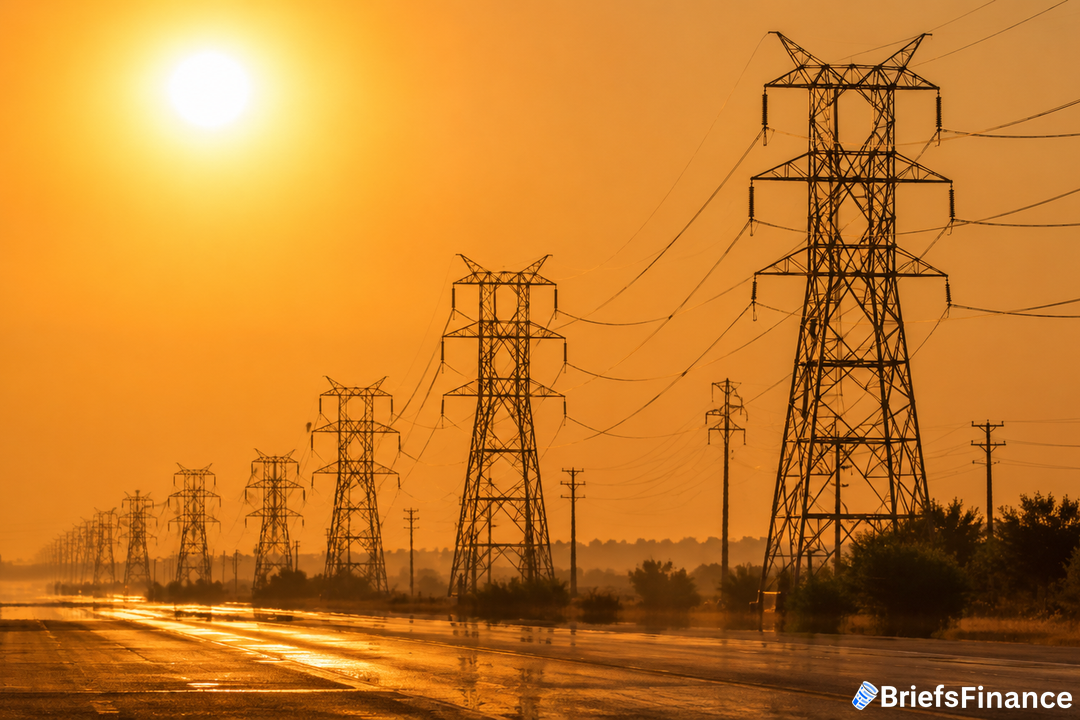
A stationary high-pressure system known as a heat dome has moved over the eastern United States. Temperatures are pushing 100°F in New York City, tying a record set in 1966. Electricity costs on America's biggest grid soared as a historic heatwave hit the East Coast, expected to be the year's hottest day. Utilities are scrambling to keep the lights on.

Record Heat Across the East

"This is the day when the most records are possible," said David Roth, a high-ranking forecaster with the US Weather Prediction Center. Washington's Reagan National Airport expects a high of 103°F, a new record. Trenton, New Jersey could hit 104°F. Even Caribou, Maine may reach 93°F, breaking a record set in 1914.

In total, 152 warm weather records may be threatened, tied or broken across the eastern half of the US. Between now and the Fourth of July holiday, forecasters say 411 daily records for high temperatures or warm overnight lows could be matched or broken. With humidity, it will feel like 105F to 115F across New York City and the entire Northeast.

The heat dome is being driven by a stagnant high-pressure system that traps hot air and prevents cooling, a pattern that has become more frequent and intense in recent years due to climate change. This prolonged strain on the power grid has forced operators to dip into emergency reserves and rely on aging fossil-fuel plants that are more prone to outages during extreme weather.

Get your free investing masterclass bonus when you join Market Briefs, our free daily newsletter

Grid Strain and Price Spikes

PJM Interconnection, the operator of the largest US grid, called a level 1 emergency - its lowest alert - for the third straight day to boost supplies and allow it to request extra backup resources. To prevent rolling blackouts, the US Department of Energy gave PJM special permission to use on-site power generation at data centers and other big industrial users as a final option.

One problem: an 810-megawatt combined cycle gas plant in Gettysburg, Pennsylvania, owned by LS Power - a highly efficient method of burning natural gas - went offline Thursday after a transformer caught fire.

Real-time power prices in PJM's Dominion region (Northern Virginia) hit $1,800 per megawatt-hour on Thursday afternoon, after exceeding $2,000 the prior evening. In New England, day-ahead power for the evening was contracted at almost $1,000 per megawatt-hour. On-peak power in northeast Massachusetts (including Boston) jumped 244% to $424.64 per megawatt-hour for Thursday.

Emergency Measures and Travel Warnings

Consolidated Edison briefly cut electricity to a few customers in the Riverdale section of the Bronx and urged 89,000 homes and businesses in a wider area to reduce their power usage while the utility performs equipment repairs. The company also lowered voltage across its system, a precaution that can dim lights and trip air conditioners or other appliances. New York City Mayor Zohran Mamdani urged residents to help conserve energy by keeping air conditioners at 78F, unplugging unused devices, and delaying dishwasher and laundry use until early morning. "During a historic heatwave, AC will save lives," he posted on X. "But only if we keep the grid stable enough for it to stay on."

ISO New England Inc., operator of the New England grid, alerted that conditions would be "exceptionally tight" for meeting Thursday evening's peak demand because there is very little spare generating capacity. Even Canada is affected. Environment and Climate Change Canada reported that heat warnings of orange and yellow levels have been issued for regions including Ontario, Quebec, and the Maritimes, as well as Toronto, the fourth most populous city in North America.

What to Watch

The worst of the heat will occur Thursday and Friday, after which the ridge of high pressure, known as a heat dome, will start to weaken. By next week, most of the eastern US will see temperatures return to normal levels, Roth said.

Subscribe to Market Briefs, our free daily newsletter, and claim your bonus investing masterclass

Disclosure

Recent News

1 2 3 31

Get Market Briefs delivered to your inbox every morning for free!

No fluff. No noise. No politics. Just finance news you can read in 5 minutes.

Blogs

June 29, 2026
Portfolio Diversification: Why Putting All Your Eggs in One Basket Destroys Wealth
  • Real diversification means spreading investments across all 11 economic sectors plus bonds, alternatives, and cash so no single bet can sink the portfolio.
  • Different sectors perform at different times, so a diversified portfolio captures upswings while smoothing the brutal drawdowns that wipe out concentrated bets.
  • Total market index funds offer the simplest path to diversification, and annual rebalancing is what keeps the structure working over time.
Read More
June 29, 2026
Non Taxable Income: What It Is and Why It Matters
  • Non taxable income is money you receive that you don't owe income tax on.
  • The tax code treats workers, investors, and business owners very differently, and investors often come out ahead.
  • Learning how income is taxed is a quiet superpower for keeping more of what you earn.
Read More
June 29, 2026
Semiconductor Stocks: A Simple Guide for Investors
  • Semiconductor stocks are companies that design and make computer chips, the brains inside nearly every modern device.
  • The AI boom has turned chips into one of the market's most important and most watched groups.
  • They offer big growth potential, but come with high valuations and a notoriously cyclical history.
Read More
June 25, 2026
How Stocks Work: A Simple Guide for Beginners
  • A stock is a slice of ownership in a company - buy one, and you own a piece of the business.
  • You make money two ways: the share price rising over time, and dividends paid to shareholders.
  • The simplest path for most beginners is buying into the whole market through a low-cost index fund.
Read More
June 25, 2026
Stop Loss vs Stop Limit: What's the Difference?
  • A stop loss order sells your stock once it hits a trigger price, prioritizing getting you out.
  • A stop limit order only sells within a price range you set, prioritizing price over a guaranteed exit.
  • The trade-off: a stop loss almost always executes; a stop limit might not if the price moves too fast.
Read More
June 25, 2026
Energy Stocks: A Simple Guide for Investors
  • Energy stocks are companies that produce and supply the power the world runs on, from oil and gas to newer sources.
  • They make up one of the 11 sectors of the market and tend to move with energy prices and big-picture shifts.
  • Like any sector, the key is diversification and understanding the forces driving demand.
Read More
June 18, 2026
What Is a Stop Loss Order? A Simple Guide
  • A stop loss order automatically sells a stock once it falls to a price you set.
  • It's a tool to cap losses or lock in gains without watching the market all day.
  • It works best for active strategies, and can backfire if used carelessly on long-term holdings.
Read More
June 18, 2026
Best S&P 500 Index Fund: How to Choose One
  • The best S&P 500 index fund for most investors is simply the cheapest, most established one that tracks the index well.
  • Funds like VOO, IVV, and SPY all hold the same 500 companies, so the biggest difference is the fee.
  • Pick one, automate your buys, and let time do the heavy lifting.
Read More
June 17, 2026
What Are Penny Stocks? Risks and Rewards Explained
  • Penny stocks are very low-priced shares of very small companies, often trading for just a few dollars or less.
  • They promise huge gains but carry huge risks: low liquidity, high failure rates, and wild price swings.
  • Most investors are better served by quality companies and funds than by chasing cheap shares.
Read More
June 17, 2026
Best Stocks for Beginners With Little Money
  • The best stocks for beginners with little money usually aren't individual stocks at all - they're low-cost index funds.
  • You can start with $100 or less and use small, regular investments to build wealth over time.
  • Focus on diversification and consistency, not on picking the next big winner.
Read More
1 2 3 24
Share via
Copy link










