Free NewsletterPro Login
S&P 500 6,287 +0.42%
DOW 44,521 -0.18%
NASDAQ 21,103 +0.71%

Warning: Undefined variable $funds in /var/www/briefs.co/htdocs/wp-content/plugins/oxygen/component-framework/components/classes/code-block.class.php(133) : eval()'d code on line 491

Warning: foreach() argument must be of type array|object, null given in /var/www/briefs.co/htdocs/wp-content/plugins/oxygen/component-framework/components/classes/code-block.class.php(133) : eval()'d code on line 491
/* the link was here */

Urea Fertilizer Prices Soar 50% After Hormuz Strait Blockade

Published Jul 5, 2026
[tts_player]
Share:
Summary:
  • On Feb. 28, 2026, U.S. and Israeli strikes against Iran severely disrupted traffic through the Strait of Hormuz.
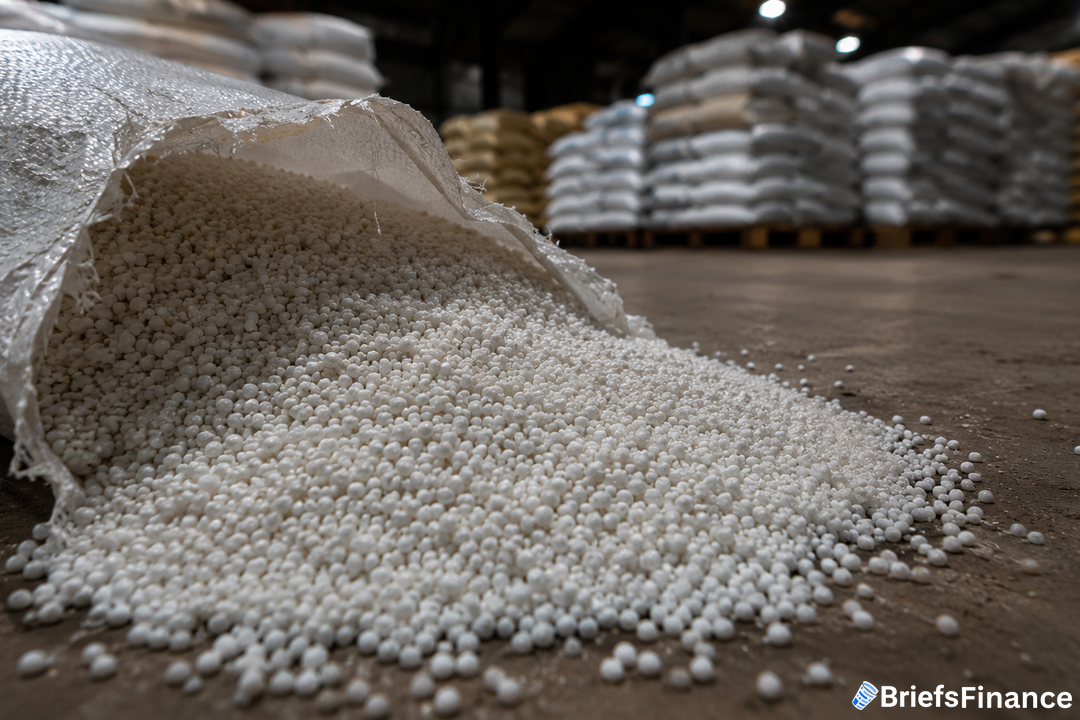
  • Urea prices surged around 50% since the conflict began, now around $700 per metric ton, up from $400-$490.
  • According to the United Nations, the Strait of Hormuz typically handles about a third of all fertilizer cargo transported by sea globally.

Now the route is essentially closed, as multiple vessels have been struck by ordnance while in or around the strait. Fertilizer costs have already spiked, but the worst may come when spring planting begins.

Fertilizer is not oil or gas - without it, crop yields suffer, leading to higher food prices.

Why Fertilizer Prices Are Surging

On February 28, 2026, the United States and Israel carried out military attacks against Iran. Since then, shipping movements through the Strait of Hormuz - a tight channel off Iran's southern coast - have faced major interruptions. Major fertilizer-producing countries in the region, including Saudi Arabia, Qatar, Bahrain, Iran, Kuwait, and the United Arab Emirates, have stopped or reduced shipments.

Chris Lawson, a CRU vice president focusing on market intelligence and pricing, said, "With the Strait of Hormuz essentially cut off, there's a big chunk of global trade that isn't able to move right now."

Sarah Marlow, who leads fertilizer pricing globally at the price reporting agency Argus, explained: "Almost 50% of all globally traded sulfur comes from that region. For urea, it's around a third of all globally traded urea that comes from that region and for ammonia, it's close to 25%."

Get your free investing masterclass bonus when you join Market Briefs, our free daily newsletter

According to Oxford Economics' Alpine Macro, urea prices surged around 50% and ammonia prices around 20% since the war began. Additionally, prices for other fertilizers, including potash and sulfur, have increased as well since the conflict started.

This disruption echoes the 2022 Russia-Ukraine war, which also sent fertilizer costs soaring. However, analysts note that the current closure is even more disruptive because of the high concentration of production in Gulf states. "I'm a lot more concerned about the current crisis than I was when Russia-Ukraine happened four years ago," said Dawid Heyl, co-manager of the natural resources team at Ninety One.

One energy company, QatarEnergy, said it would halt further downstream urea output after pausing its LNG production. China also put restrictions on fertilizer exports to protect its domestic market, Reuters reported last week.

Why Nitrogen Matters Most

Not all fertilizers are equal. Unlike potash or phosphates, which farmers can skip for a season, nitrogen is essential every year.

"You can skip a season of potash, you can skip a season of phosphates, but you can't skip a season of nitrogen," Heyl said. He added: "There's a direct correlation to your nitrogen application and your agricultural yield in the end."

Iran itself ranks as a significant manufacturer of nitrogen fertilizers and is among the world's top exporters.

What to Watch

Heyl noted that markets entered 2026 with fairly high stocks of basic food commodities reliant on fertilizer, providing "buffer stocks" that might help offset some shortages. "If agricultural yields were [hypothetically] impacted by 5% this year, I don't think we'll be looking at starvation, but it would certainly cause food inflation," he said. He noted that developing nations would probably bear the brunt of the effects.

The ripple effects of the Hormuz closure extend beyond immediate price spikes. Developing countries that depend on imported fertilizers face the greatest risk, as they lack the financial buffers to absorb higher costs. Without swift resolution, the disruption could lead to reduced fertilizer application and lower crop yields in key agricultural regions, ultimately exacerbating global food insecurity.

With the conflict ongoing and no clear timeline for reopening, fertilizer prices may continue rising until shipping resumes or alternative supply routes emerge.

Subscribe to Market Briefs, our free daily newsletter, and claim your bonus investing masterclass

Disclosure

Recent News

1 2 3 60

Get Market Briefs delivered to your inbox every morning for free!

No fluff. No noise. No politics. Just finance news you can read in 5 minutes.

Blogs

August 23, 2026
How to Get the Most From Your Guideline 401k
  • Guideline is a company that provides low-cost 401k plans, popular with small businesses and their employees.
  • A "Guideline 401k" follows the same core rules as any 401k: tax-advantaged growth, contribution limits, and often an employer match.
  • The biggest results come from capturing the full match, choosing low-cost funds, and picking Roth or traditional to fit your situation.
Read More
August 23, 2026
Principal 401k: What to Know About Your Plan
  • Principal is one of many companies that manage workplace 401k plans, so a "Principal 401k" is simply a 401k where Principal is the provider.
  • The rules of a 401k are the same no matter who runs it: pre-tax or Roth contributions, tax-advantaged growth, and often an employer match.
  • The biggest wins come from grabbing the full match, picking low-cost funds, and knowing whether Roth or traditional fits you.
Read More
August 23, 2026
What a Tariff Dividend Means for Your Money
  • A "tariff dividend" is the idea of taking money the government collects from tariffs and paying some of it back to citizens.
  • To judge the idea, you first need to know what a tariff is: a tax on imported goods, usually paid by the companies bringing them in.
  • Tariffs ripple through prices, businesses, and your investments, so the smart move is understanding those ripples, not just the headline.
Read More
August 23, 2026
No Tax on Overtime: How Overtime Pay Is Taxed
  • "No tax on overtime" refers to a tax break that lets certain workers deduct some overtime pay, lowering the income they get taxed on.
  • A deduction does not mean overtime is truly tax-free. It means part of that pay is subtracted before your tax is figured.
  • The bigger money lesson: how you earn money changes how it is taxed, and investors often get the friendliest treatment of all.
Read More
August 23, 2026
Reading the Silver Price Forecast for 2026
  • Nobody can honestly promise a specific silver price for 2026. Any exact number is a guess, so treat forecasts as opinions, not facts.
  • Silver is unusual because it is both a precious metal and an industrial metal, so its price answers to two very different forces.
  • Instead of chasing a forecast, learn the drivers - inflation, interest rates, recession fear, and industrial demand - so you can judge any prediction yourself.
Read More
August 23, 2026
What to Do When Reddit Stocks Go Viral
  • "Reddit stocks" usually means stocks getting hyped in online communities, where crowds can send a price soaring or crashing fast.
  • These tips can be entertaining and sometimes useful, but they are opinions, not research, and often come loaded with hype.
  • The safe move is to treat every online tip as a starting point, then do your own homework before risking a dollar.
Read More
August 23, 2026
Why Is Bitcoin Dropping Right Now?
  • Bitcoin drops for a mix of reasons: interest rates, big-picture money policy, regulation news, and simple shifts in how much risk investors want to take.
  • Bitcoin has a fixed supply and no earnings, so its price runs almost entirely on supply, demand, and sentiment.
  • Sharp drops are normal for bitcoin. Understanding the drivers matters more than reacting to any single day.
Read More
August 23, 2026
The Fidelity 500 Index Fund, Made Simple for Beginners
  • The Fidelity 500 Index Fund is a low-cost fund that tracks the S&P 500, an index of 500 large U.S. companies.
  • Buying it means owning a tiny slice of 500 businesses at once, which spreads your risk in a single purchase.
  • Index funds like this win over time mostly by keeping fees low and letting compounding do the work.
Read More
August 23, 2026
USA Penny Stocks: Risks and Rewards Explained
  • USA penny stocks are very low-priced shares of very small companies, often trading under $5 and sometimes under $1.
  • They dangle the dream of huge, fast gains, but carry brutal risks: low liquidity, wild swings, and high failure rates.
  • Most investors build wealth faster with quality companies and funds than by chasing cheap shares.
Read More
August 23, 2026
Finding Cheap Stocks to Buy Now Without Getting Burned
  • A low share price does not mean a stock is cheap. Real value compares the price to what the business is actually worth.
  • The best cheap stocks to buy now are quality companies trading below their true value, not the tiniest, riskiest shares on the market.
  • For most beginners, a low-cost index fund is the simplest "cheap" way to own great companies at once.
Read More
1 2 3 25
Share via
Copy link










