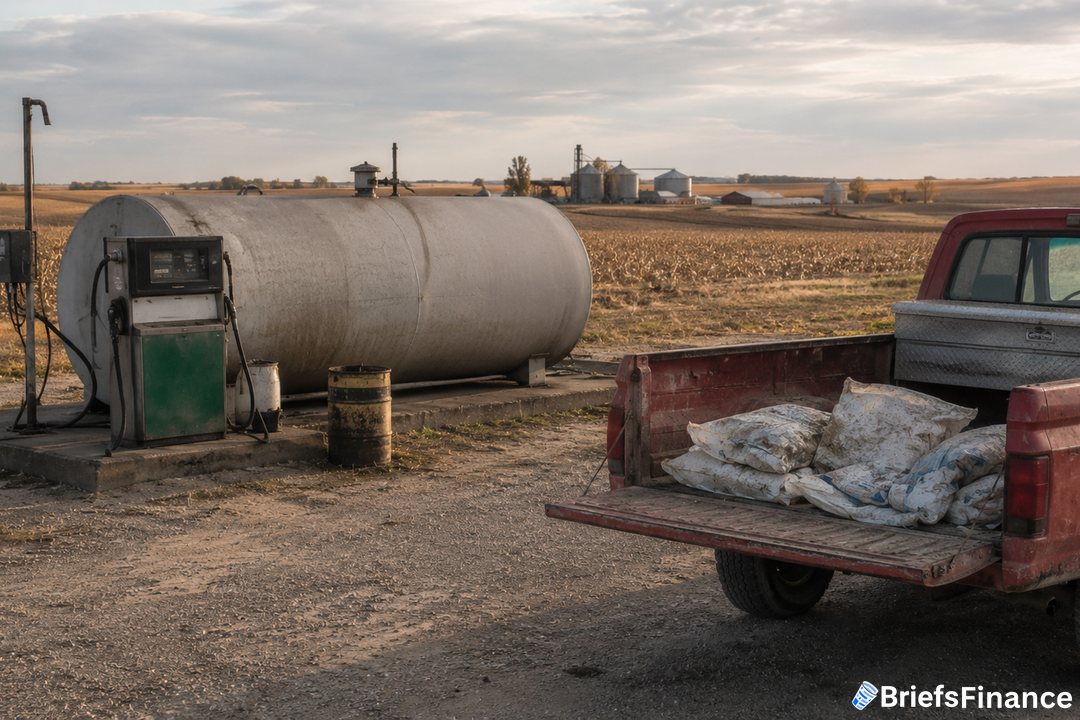
More than 5,700 farmers responded to a survey by the American Farm Bureau Federation between April 3 and April 11, 2026. The survey reveals that seven out of ten growers are unable to purchase their complete fertilizer requirements for spring planting.
Global Disruptions Send Costs Soaring
The trouble started when the Strait of Hormuz was closed and tensions in the Middle East escalated. Nitrogen fertilizer prices rose by more than 30% since the conflict began.
Fertilizer production is heavily dependent on natural gas, which accounts for a major share of nitrogen fertilizer manufacturing costs. The disruption of global supply chains and sharp price increases were caused by the blocking of the Strait of Hormuz, a critical passage for natural gas used in nitrogen fertilizer production. This directly pushed up energy and input costs for farmers.
Pre-Booking Patterns Show Regional Divide
Some farmers were able to lock in fertilizer prices earlier by pre-booking - ordering in advance. Among crops, 49% of soybean producers pre-booked, 47% of barley producers, 44% of corn producers, and 42% of wheat producers. Cotton and peanut producers lagged far behind at 13% and 9%.
Get your free investing masterclass bonus when you join Market Briefs, our free daily newsletter
Regionally, Midwestern farmers had the highest pre-booking rate at 67%, while only 19% of Southern producers pre-booked. Northeastern farmers came in at 30%, and Western farmers at 31%.
Larger farms were more likely to pre-book, but the gap varied by region. In the Midwest, 77% of farms with 500 to 2,499 acres pre-booked, versus 49% of farms with 1 to 499 acres. In the Northeast, only 24% of small farms pre-booked, while 67% of the largest farms did.
In the South, 16% of small farms pre-booked, compared to 28% of the largest. In the West, 25% of small farms pre-booked, while 54% of the largest farms did.
Despite pre-booking, many farmers still face shortfalls. That number is highest in the South at 78%, followed by the Northeast at 69%, the West at 66%, and the Midwest at 48%.
Financial Strain Widespread
The survey results show deep financial stress. Only 6% of farmers said their financial situation improved over the past year. Specialty crops are hit hardest.
More than 80% of rice, cotton, and peanut producers said they cannot afford all required fertilizer. Midwestern farmers fared relatively better, but even there 48% cannot afford all needed inputs.
"This is the most severe input cost crisis I've seen in my 30 years of farming," said Mark Jensen, a corn and soybean grower from Illinois who participated in the survey. "We're being forced to cut back on nitrogen applications, which will hurt yields."
What It Means for Farmers and the Food Supply
The conflict-driven surge in energy and fertilizer costs has created a cascade effect across the agricultural economy. Farmers who did not pre-book - particularly small operations in the South and Northeast - now face the hardest choices: reduce fertilizer use and risk lower crop output, or take on more debt.
The American Farm Bureau Federation noted that even pre-booking did not fully shield farmers, as many still lacked the capital to cover the full amount needed. If widespread fertilizer shortfalls lead to lower harvests, food prices could rise further in the months ahead.
Subscribe to Market Briefs, our free daily newsletter, and claim your bonus investing masterclass