Free NewsletterPro Login
S&P 500 6,287 +0.42%
DOW 44,521 -0.18%
NASDAQ 21,103 +0.71%

Warning: Undefined variable $funds in /var/www/briefs.co/htdocs/wp-content/plugins/oxygen/component-framework/components/classes/code-block.class.php(133) : eval()'d code on line 491

Warning: foreach() argument must be of type array|object, null given in /var/www/briefs.co/htdocs/wp-content/plugins/oxygen/component-framework/components/classes/code-block.class.php(133) : eval()'d code on line 491
/* the link was here */

Ford Pushes for USMCA Rules That Favor Domestic Production Following Record Output

Published Jul 3, 2026
[tts_player]
Share:
Summary:
  • Ford built over 2 million vehicles in the U.S. last year, the most of any automaker.
  • Ford imported just 378,000 vehicles, or 17% of its U.S. sales.
  • General Motors imported 1.17 million vehicles in 2025, representing 41% of its U.S. sales.

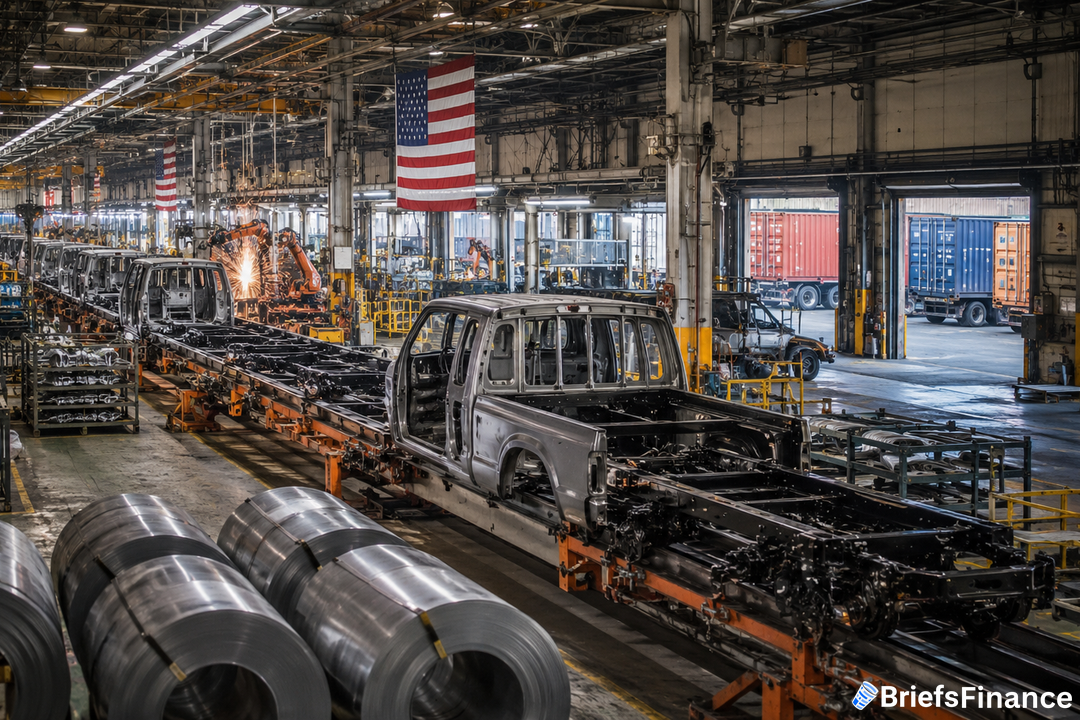
Ford builds more vehicles in the United States than any other automaker. Yet its CEO says the company faces a competitive disadvantage against rivals that import heavily from lower-cost countries. He wants the upcoming USMCA trade deal rewrite to fix that.

Farley's Pitch

Jim Farley, Ford's chief executive, argues that the revised USMCA should reward automakers that build most of their vehicles inside the United States. It should also add penalties for companies that import many vehicles from places like Japan and South Korea.

"It's imperative that any new agreement makes it easier, not harder, to compete with U.S. makers who import from Japan, South Korea and global competitors that import from those locations," Farley said in a CNBC interview on July 2, 2026. "That's the key for us."

Ford exported 311,000 vehicles to more than 60 countries last year, while importing only 378,000. That import share of 17% is far lower than many competitors. Farley also highlighted Ford's U.S. workforce: "Ford's a leader of U.S. auto production with the most U.S.-built vehicles but, more importantly, we import very few, and we export the most, and we have the most UAW workers here."

The Import Gap

General Motors, the No. 1 seller in the U.S., imported 1.17 million vehicles in 2025 - 41% of its U.S. sales. Toyota, the No. 2 seller, imported more than 1.19 million vehicles, or 47% of its sales. Hyundai, the largest importer from South Korea, plans to produce 80% of its U.S. sales domestically by 2030.

Get your free investing masterclass bonus when you join Market Briefs, our free daily newsletter

The auto industry accounts for about 18% of total U.S. trade with Canada and Mexico.

The Broader Context

The USMCA, which replaced NAFTA in 2020, was designed to modernize North American trade. Its built-in review process allows for renegotiation every six years, but the Trump administration's decision to shift to annual reviews has injected new uncertainty. With the auto industry deeply integrated across borders, any changes to rules of origin or tariff preferences could force automakers to reconfigure supply chains, potentially raising costs and affecting vehicle prices across the region.

Uncertainty Ahead

Automakers, dealers and suppliers worry that reopening the deal will create uncertainty, which might reduce investment and cost jobs. A coalition of American industry organizations representing the majority of car manufacturers, dealerships, and parts suppliers released a statement calling for a swift extension agreement among the three nations.

"We urge the leaders of the U.S., Canada, and Mexico to swiftly reach consensus on an extension of USMCA that preserves the existing trilateral partnership," the group said. "Returns to preferential treatment for qualifying goods, and continues the stability and predictability that has helped the industry thrive for the past six years."

The stakes are high: the annual review process creates a rolling threat of renegotiation, and any major shift in rules could disrupt the cross-border supply chains that have grown under the current framework. Even small changes in tariff preferences or content requirements can ripple through factory planning, employment levels, and vehicle pricing across North America.

What to Watch

The USMCA talks officially reopened on July 2, 2026. How the three nations balance Farley's demands with the broader industry's call for stability will determine whether the deal survives to 2036. The outcome could reshape the competitive landscape for every major automaker selling in the United States.

Subscribe to Market Briefs, our free daily newsletter, and claim your bonus investing masterclass

Disclosure

Recent News

1 2 3 60

Get Market Briefs delivered to your inbox every morning for free!

No fluff. No noise. No politics. Just finance news you can read in 5 minutes.

Blogs

August 23, 2026
How to Get the Most From Your Guideline 401k
  • Guideline is a company that provides low-cost 401k plans, popular with small businesses and their employees.
  • A "Guideline 401k" follows the same core rules as any 401k: tax-advantaged growth, contribution limits, and often an employer match.
  • The biggest results come from capturing the full match, choosing low-cost funds, and picking Roth or traditional to fit your situation.
Read More
August 23, 2026
Principal 401k: What to Know About Your Plan
  • Principal is one of many companies that manage workplace 401k plans, so a "Principal 401k" is simply a 401k where Principal is the provider.
  • The rules of a 401k are the same no matter who runs it: pre-tax or Roth contributions, tax-advantaged growth, and often an employer match.
  • The biggest wins come from grabbing the full match, picking low-cost funds, and knowing whether Roth or traditional fits you.
Read More
August 23, 2026
What a Tariff Dividend Means for Your Money
  • A "tariff dividend" is the idea of taking money the government collects from tariffs and paying some of it back to citizens.
  • To judge the idea, you first need to know what a tariff is: a tax on imported goods, usually paid by the companies bringing them in.
  • Tariffs ripple through prices, businesses, and your investments, so the smart move is understanding those ripples, not just the headline.
Read More
August 23, 2026
No Tax on Overtime: How Overtime Pay Is Taxed
  • "No tax on overtime" refers to a tax break that lets certain workers deduct some overtime pay, lowering the income they get taxed on.
  • A deduction does not mean overtime is truly tax-free. It means part of that pay is subtracted before your tax is figured.
  • The bigger money lesson: how you earn money changes how it is taxed, and investors often get the friendliest treatment of all.
Read More
August 23, 2026
Reading the Silver Price Forecast for 2026
  • Nobody can honestly promise a specific silver price for 2026. Any exact number is a guess, so treat forecasts as opinions, not facts.
  • Silver is unusual because it is both a precious metal and an industrial metal, so its price answers to two very different forces.
  • Instead of chasing a forecast, learn the drivers - inflation, interest rates, recession fear, and industrial demand - so you can judge any prediction yourself.
Read More
August 23, 2026
What to Do When Reddit Stocks Go Viral
  • "Reddit stocks" usually means stocks getting hyped in online communities, where crowds can send a price soaring or crashing fast.
  • These tips can be entertaining and sometimes useful, but they are opinions, not research, and often come loaded with hype.
  • The safe move is to treat every online tip as a starting point, then do your own homework before risking a dollar.
Read More
August 23, 2026
Why Is Bitcoin Dropping Right Now?
  • Bitcoin drops for a mix of reasons: interest rates, big-picture money policy, regulation news, and simple shifts in how much risk investors want to take.
  • Bitcoin has a fixed supply and no earnings, so its price runs almost entirely on supply, demand, and sentiment.
  • Sharp drops are normal for bitcoin. Understanding the drivers matters more than reacting to any single day.
Read More
August 23, 2026
The Fidelity 500 Index Fund, Made Simple for Beginners
  • The Fidelity 500 Index Fund is a low-cost fund that tracks the S&P 500, an index of 500 large U.S. companies.
  • Buying it means owning a tiny slice of 500 businesses at once, which spreads your risk in a single purchase.
  • Index funds like this win over time mostly by keeping fees low and letting compounding do the work.
Read More
August 23, 2026
USA Penny Stocks: Risks and Rewards Explained
  • USA penny stocks are very low-priced shares of very small companies, often trading under $5 and sometimes under $1.
  • They dangle the dream of huge, fast gains, but carry brutal risks: low liquidity, wild swings, and high failure rates.
  • Most investors build wealth faster with quality companies and funds than by chasing cheap shares.
Read More
August 23, 2026
Finding Cheap Stocks to Buy Now Without Getting Burned
  • A low share price does not mean a stock is cheap. Real value compares the price to what the business is actually worth.
  • The best cheap stocks to buy now are quality companies trading below their true value, not the tiniest, riskiest shares on the market.
  • For most beginners, a low-cost index fund is the simplest "cheap" way to own great companies at once.
Read More
1 2 3 25
Share via
Copy link










