Free NewsletterPro Login

Warning: Undefined variable $stocks in /var/www/briefs.co/htdocs/wp-content/plugins/oxygen/component-framework/components/classes/code-block.class.php(133) : eval()'d code on line 448

Warning: foreach() argument must be of type array|object, null given in /var/www/briefs.co/htdocs/wp-content/plugins/oxygen/component-framework/components/classes/code-block.class.php(133) : eval()'d code on line 448

Warning: Undefined variable $funds in /var/www/briefs.co/htdocs/wp-content/plugins/oxygen/component-framework/components/classes/code-block.class.php(133) : eval()'d code on line 472

Warning: foreach() argument must be of type array|object, null given in /var/www/briefs.co/htdocs/wp-content/plugins/oxygen/component-framework/components/classes/code-block.class.php(133) : eval()'d code on line 472
/* the link was here */

Poll: Majority of American Growers Cannot Afford Full Fertilizer This Season

Published Jul 5, 2026
[tts_player]
Share:
Summary:
  • A survey by the American Farm Bureau Federation found that roughly 70% of U.S. farmers cannot afford all the fertilizer they need this season.
  • Intel indicates major harm to the South Pars petrochemical facility in Iran and the Ras Laffan LNG infrastructure that supplies Qatari fertilizer manufacturers.
  • Even under the best-case “Quick Reopening” scenario, analysts project urea prices to peak at $782 per short ton - 66% above the pre-crisis price of $470.

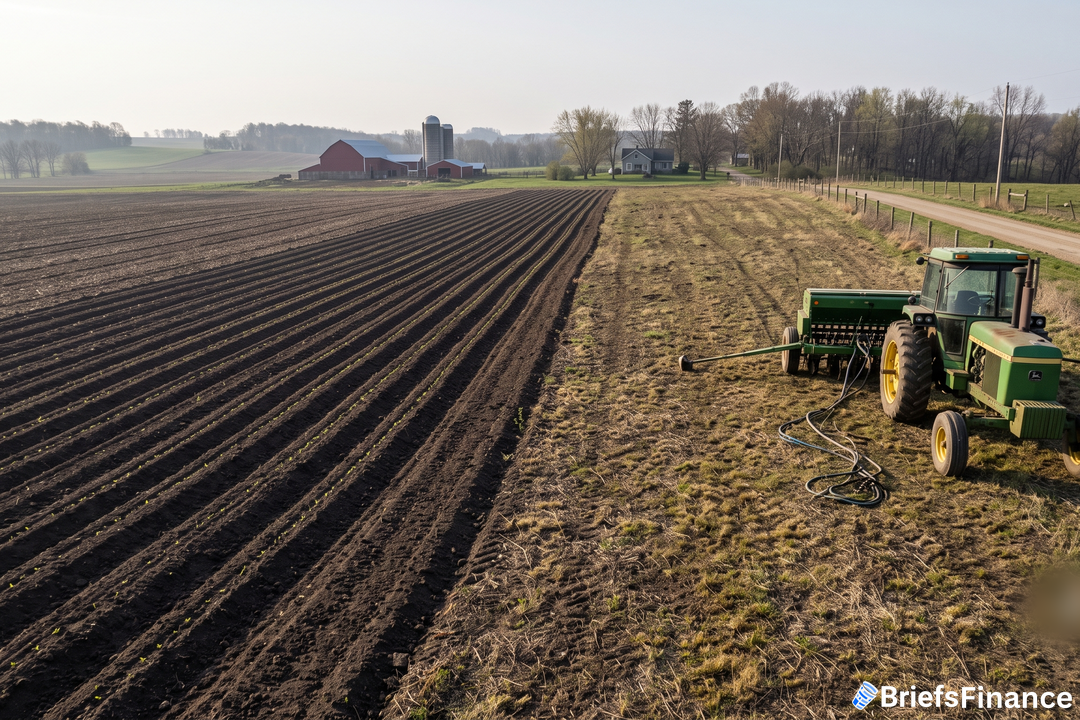
A recent poll conducted by the American Farm Bureau Federation reveals that approximately 7 in 10 American growers cannot purchase sufficient fertilizer for the current season because of climbing input expenses linked to the conflict in Iran and a pre-existing tough agricultural climate. The poll took place between April 3 and April 11, drawing responses from over 5,700 farmers.

The Regional Breakdown of Fertilizer Shortages

Faith Parum, an economist at the American Farm Bureau Federation, reported the results. She noted that farmers in the Southern region are hurting the most.

"Farmers in the Southern region reported the greatest difficulty securing fertilizer, with 78% unable to afford all needed inputs this season," Parum said. "Producers in the Northeast and West also reported significant challenges, with 69% and 66%, respectively, unable to afford all required fertilizer, compared to 48% in the Midwest."

The cost issue becomes even starker when looking at specific crops. Over four-fifths of growers of rice, cotton, and peanuts stated they lack funds for complete fertilizer application, underscoring the fragility of these crop systems to price spikes. Across the board, more than 50% of all commodity producers say they are unable to cover their full fertilizer requirements this season.

Get your free investing masterclass bonus when you join Market Briefs, our free daily newsletter

Price Projections: How High Can Fertilizer Go?

According to intelligence, the South Pars petrochemical facility in Iran and the Ras Laffan LNG infrastructure supplying Qatari fertilizer plants have suffered severe damage, putting urea production out of commission. A team of analysts from North Dakota State University created three scenarios to show where prices could land.

Under the "Contested Transit" scenario - where a ceasefire holds but the Strait of Hormuz only partially reopens - urea is projected to peak at $784 per short ton in July 2026, a 67% increase. DAP is projected to peak at $866 per short ton in October, up 39%.

If the ceasefire collapses and the Strait remains closed through fall 2026 - the "Extended Conflict" scenario - prices go much higher. Urea would reach $996 per short ton in October, a 112% jump. DAP would hit $945 per short ton in November, up 52%.

Even the best-case scenario, called "Quick Reopening," in which all parties collaborate completely and the waterway resumes normal function by July, still results in prices far above typical levels. Urea would peak at $782 per short ton, 66% above the pre-crisis price of $470. The NDSU team warned that "if this damage assessment is accurate, the pre‑crisis pricing environment is unlikely to return before 2028."

What Farmers Are Doing - and What It Means for Food Supply

"When producers cannot afford full fertilizer application rates, they may reduce nutrient use or shift acreage decisions," Parum said. "Both of which increase the risk of lower yields and reduced production potential in the 2026 crop year."

Corn and soybean growers in the Midwest placed fertilizer preorders at a greater frequency than their Southern counterparts cultivating cotton and rice. Within the Midwest, 67% of survey participants indicated they had purchased fertilizer in advance. Despite these higher prebooking rates, almost a third of Midwestern farmers still began the season without all the nutrients secured.

Farmers elsewhere tend to buy fertilizer nearer to the time of application. In the South, only 19% had prebooked fertilizer for this year's crop, while Western farmers reported 31% and Northeastern growers 30%.

Subscribe to Market Briefs, our free daily newsletter, and claim your bonus investing masterclass

Disclosure

Recent News

1 2 3 64

Get Market Briefs delivered to your inbox every morning for free!

No fluff. No noise. No politics. Just finance news you can read in 5 minutes.

Blogs

August 31, 2026
America Is Running Out of Debt Buyers. Treasury Bills Are the Government's Fix
  • The government took in about $5 trillion in taxes in 2025 and spent about $7 trillion, and the national debt is now over $40 trillion.
  • Investors, banks, and foreign countries are all lending less to the U.S., so starting September 9 the government plans to sell more short-term treasury bills and use that cash to buy back its long-term debt.
  • Government interest rates set the floor for your mortgage, your car loan, and your credit card, and short-term Treasury ETFs like SGOV are one way investors are playing it.
Read More
August 23, 2026
How to Get the Most From Your Guideline 401k
  • Guideline is a company that provides low-cost 401k plans, popular with small businesses and their employees.
  • A "Guideline 401k" follows the same core rules as any 401k: tax-advantaged growth, contribution limits, and often an employer match.
  • The biggest results come from capturing the full match, choosing low-cost funds, and picking Roth or traditional to fit your situation.
Read More
August 23, 2026
Principal 401k: What to Know About Your Plan
  • Principal is one of many companies that manage workplace 401k plans, so a "Principal 401k" is simply a 401k where Principal is the provider.
  • The rules of a 401k are the same no matter who runs it: pre-tax or Roth contributions, tax-advantaged growth, and often an employer match.
  • The biggest wins come from grabbing the full match, picking low-cost funds, and knowing whether Roth or traditional fits you.
Read More
August 23, 2026
What a Tariff Dividend Means for Your Money
  • A "tariff dividend" is the idea of taking money the government collects from tariffs and paying some of it back to citizens.
  • To judge the idea, you first need to know what a tariff is: a tax on imported goods, usually paid by the companies bringing them in.
  • Tariffs ripple through prices, businesses, and your investments, so the smart move is understanding those ripples, not just the headline.
Read More
August 23, 2026
No Tax on Overtime: How Overtime Pay Is Taxed
  • "No tax on overtime" refers to a tax break that lets certain workers deduct some overtime pay, lowering the income they get taxed on.
  • A deduction does not mean overtime is truly tax-free. It means part of that pay is subtracted before your tax is figured.
  • The bigger money lesson: how you earn money changes how it is taxed, and investors often get the friendliest treatment of all.
Read More
August 23, 2026
Reading the Silver Price Forecast for 2026
  • Nobody can honestly promise a specific silver price for 2026. Any exact number is a guess, so treat forecasts as opinions, not facts.
  • Silver is unusual because it is both a precious metal and an industrial metal, so its price answers to two very different forces.
  • Instead of chasing a forecast, learn the drivers - inflation, interest rates, recession fear, and industrial demand - so you can judge any prediction yourself.
Read More
August 23, 2026
What to Do When Reddit Stocks Go Viral
  • "Reddit stocks" usually means stocks getting hyped in online communities, where crowds can send a price soaring or crashing fast.
  • These tips can be entertaining and sometimes useful, but they are opinions, not research, and often come loaded with hype.
  • The safe move is to treat every online tip as a starting point, then do your own homework before risking a dollar.
Read More
August 23, 2026
Why Is Bitcoin Dropping Right Now?
  • Bitcoin drops for a mix of reasons: interest rates, big-picture money policy, regulation news, and simple shifts in how much risk investors want to take.
  • Bitcoin has a fixed supply and no earnings, so its price runs almost entirely on supply, demand, and sentiment.
  • Sharp drops are normal for bitcoin. Understanding the drivers matters more than reacting to any single day.
Read More
August 23, 2026
The Fidelity 500 Index Fund, Made Simple for Beginners
  • The Fidelity 500 Index Fund is a low-cost fund that tracks the S&P 500, an index of 500 large U.S. companies.
  • Buying it means owning a tiny slice of 500 businesses at once, which spreads your risk in a single purchase.
  • Index funds like this win over time mostly by keeping fees low and letting compounding do the work.
Read More
August 23, 2026
USA Penny Stocks: Risks and Rewards Explained
  • USA penny stocks are very low-priced shares of very small companies, often trading under $5 and sometimes under $1.
  • They dangle the dream of huge, fast gains, but carry brutal risks: low liquidity, wild swings, and high failure rates.
  • Most investors build wealth faster with quality companies and funds than by chasing cheap shares.
Read More
1 2 3 25
Share via
Copy link










