Free NewsletterPro Login
S&P 500 6,287 +0.42%
DOW 44,521 -0.18%
NASDAQ 21,103 +0.71%
S&P 500 +12.4%
Briefs Finance Fund +24.8%
JOIN THE FUND →

Gold Turns Bearish After $18 Billion in ETF Withdrawals

Published Jul 8, 2026
[tts_player]
Share:
Summary:
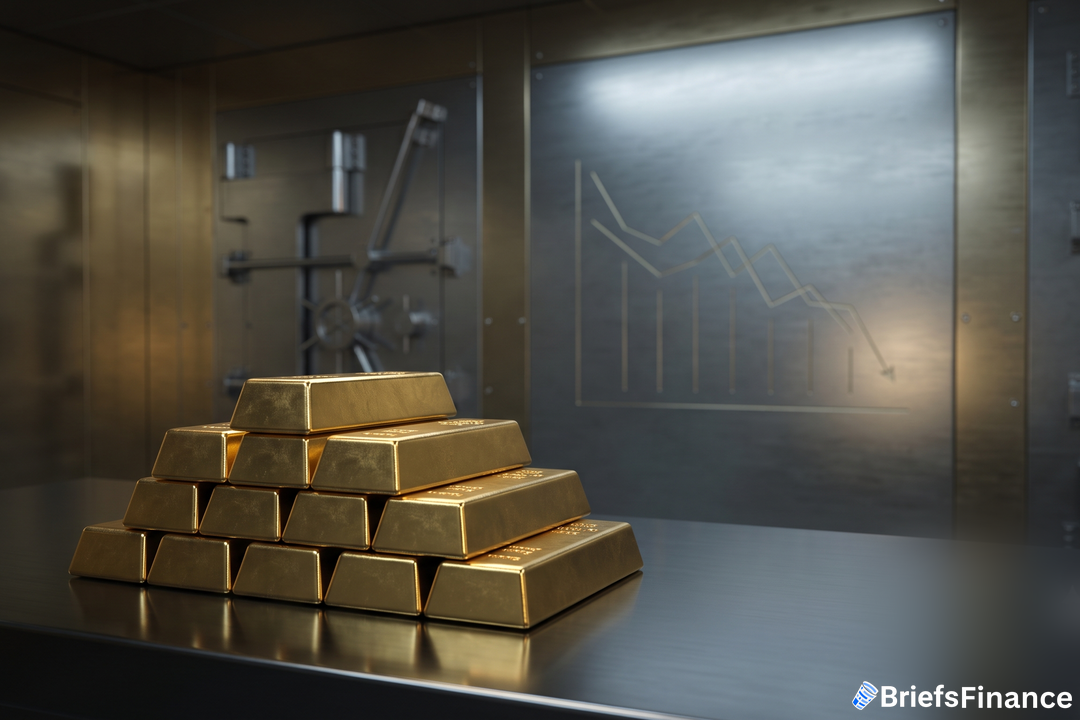
  • Gold prices have dropped more than 20% from their January peak of nearly $5,600, entering a bear market.
  • Investors have pulled nearly $18 billion from gold ETFs since the high, and JPMorgan now sees about 50 tons of outflows from global gold ETFs this year.
  • Central banks bought more than 240 tons of gold in the first quarter, with China extending its buying streak to a 20th consecutive month.

The Great Profit‑Taking

Since reaching the January peak, investors have withdrawn nearly $18 billion from exchange-traded funds tracked by Bloomberg. Greg Shearer and his JPMorgan team currently forecast global gold ETF outflows of roughly 50 tons this year, a sharp drop from the roughly 400 tons of inflows they previously projected.

The selling is mainly due to investors taking profits, according to Bart Melek, who serves as TD Securities' head of commodity strategy. "Most of gold's correction seems to be long liquidations as opposed to people taking on short exposure," he explained. "At this point, we just don't have a lot of shorts in there. So there's a lot of room to expand, and still a lot of room to cut long exposure."

Central Banks Keep Buying

While ETF investors are selling, central banks are buying. In the first quarter, central banks as a whole upped their pace of buying. Sovereigns bought more than 240 tons of gold in the first quarter. Notably, the People's Bank of China has kept purchasing gold during the entire decline, reaching its fastest acquisition pace since 2023 in June.

Get your free investing masterclass bonus when you join Market Briefs, our free daily newsletter

Chris Louney, who works as a commodities strategist at Royal Bank of Canada, stated: "I generally see consistency in how central banks are thinking about gold reserves. If you're trying to de‑dollarize and diversify, gold stands out as that long term reserve asset that's already a part of the global monetary system."

What the Analysts Say

Banks have turned more cautious. In recent weeks, a number of banks - UBS, Goldman Sachs, and Deutsche Bank among them - have lowered their gold price projections. Nicky Shiels, who oversees metals strategy at MKS Pamp SA, said the market has shifted "from euphoria to reckoning."

The macro outlook is a headwind. Oil prices have surged due to the Iran conflict, prompting investors to expect rate increases that would reduce gold's attractiveness compared to yield-bearing assets. JPMorgan's Greg Shearer expects the pressure to continue: "the macro/rates setup will likely continue to cap gold in a lower range over the coming quarters."

Some investors are waiting for better timing. Alexandre Carrier, from DNCA Invest Strategic Resource Fund, commented: "With more clarity on rates and when the US dollar stops strengthening, we will probably reinforce our positions."

What to Watch

Quantitative funds that trade rapidly, along with other speculators, still have potential to increase short positions if the macroeconomic environment deteriorates, especially if the dollar and yields remain high or inflation maintains the Fed's hawkish stance, according to Bart Melek. Central bank buying provides a floor, but many analysts expect gold to trade in a lower range for the coming quarters. The metal breached $4,000 an ounce on multiple occasions during the sell‑off.

Subscribe to Market Briefs, our free daily newsletter, and claim your bonus investing masterclass

Disclosure

Recent News

1 2 3 33

Get Market Briefs delivered to your inbox every morning for free!

No fluff. No noise. No politics. Just finance news you can read in 5 minutes.

Blogs

June 29, 2026
Portfolio Diversification: Why Putting All Your Eggs in One Basket Destroys Wealth
  • Real diversification means spreading investments across all 11 economic sectors plus bonds, alternatives, and cash so no single bet can sink the portfolio.
  • Different sectors perform at different times, so a diversified portfolio captures upswings while smoothing the brutal drawdowns that wipe out concentrated bets.
  • Total market index funds offer the simplest path to diversification, and annual rebalancing is what keeps the structure working over time.
Read More
June 29, 2026
Non Taxable Income: What It Is and Why It Matters
  • Non taxable income is money you receive that you don't owe income tax on.
  • The tax code treats workers, investors, and business owners very differently, and investors often come out ahead.
  • Learning how income is taxed is a quiet superpower for keeping more of what you earn.
Read More
June 29, 2026
Semiconductor Stocks: A Simple Guide for Investors
  • Semiconductor stocks are companies that design and make computer chips, the brains inside nearly every modern device.
  • The AI boom has turned chips into one of the market's most important and most watched groups.
  • They offer big growth potential, but come with high valuations and a notoriously cyclical history.
Read More
June 25, 2026
How Stocks Work: A Simple Guide for Beginners
  • A stock is a slice of ownership in a company - buy one, and you own a piece of the business.
  • You make money two ways: the share price rising over time, and dividends paid to shareholders.
  • The simplest path for most beginners is buying into the whole market through a low-cost index fund.
Read More
June 25, 2026
Stop Loss vs Stop Limit: What's the Difference?
  • A stop loss order sells your stock once it hits a trigger price, prioritizing getting you out.
  • A stop limit order only sells within a price range you set, prioritizing price over a guaranteed exit.
  • The trade-off: a stop loss almost always executes; a stop limit might not if the price moves too fast.
Read More
June 25, 2026
Energy Stocks: A Simple Guide for Investors
  • Energy stocks are companies that produce and supply the power the world runs on, from oil and gas to newer sources.
  • They make up one of the 11 sectors of the market and tend to move with energy prices and big-picture shifts.
  • Like any sector, the key is diversification and understanding the forces driving demand.
Read More
June 18, 2026
What Is a Stop Loss Order? A Simple Guide
  • A stop loss order automatically sells a stock once it falls to a price you set.
  • It's a tool to cap losses or lock in gains without watching the market all day.
  • It works best for active strategies, and can backfire if used carelessly on long-term holdings.
Read More
June 18, 2026
Best S&P 500 Index Fund: How to Choose One
  • The best S&P 500 index fund for most investors is simply the cheapest, most established one that tracks the index well.
  • Funds like VOO, IVV, and SPY all hold the same 500 companies, so the biggest difference is the fee.
  • Pick one, automate your buys, and let time do the heavy lifting.
Read More
June 17, 2026
What Are Penny Stocks? Risks and Rewards Explained
  • Penny stocks are very low-priced shares of very small companies, often trading for just a few dollars or less.
  • They promise huge gains but carry huge risks: low liquidity, high failure rates, and wild price swings.
  • Most investors are better served by quality companies and funds than by chasing cheap shares.
Read More
June 17, 2026
Best Stocks for Beginners With Little Money
  • The best stocks for beginners with little money usually aren't individual stocks at all - they're low-cost index funds.
  • You can start with $100 or less and use small, regular investments to build wealth over time.
  • Focus on diversification and consistency, not on picking the next big winner.
Read More
1 2 3 24
Share via
Copy link










