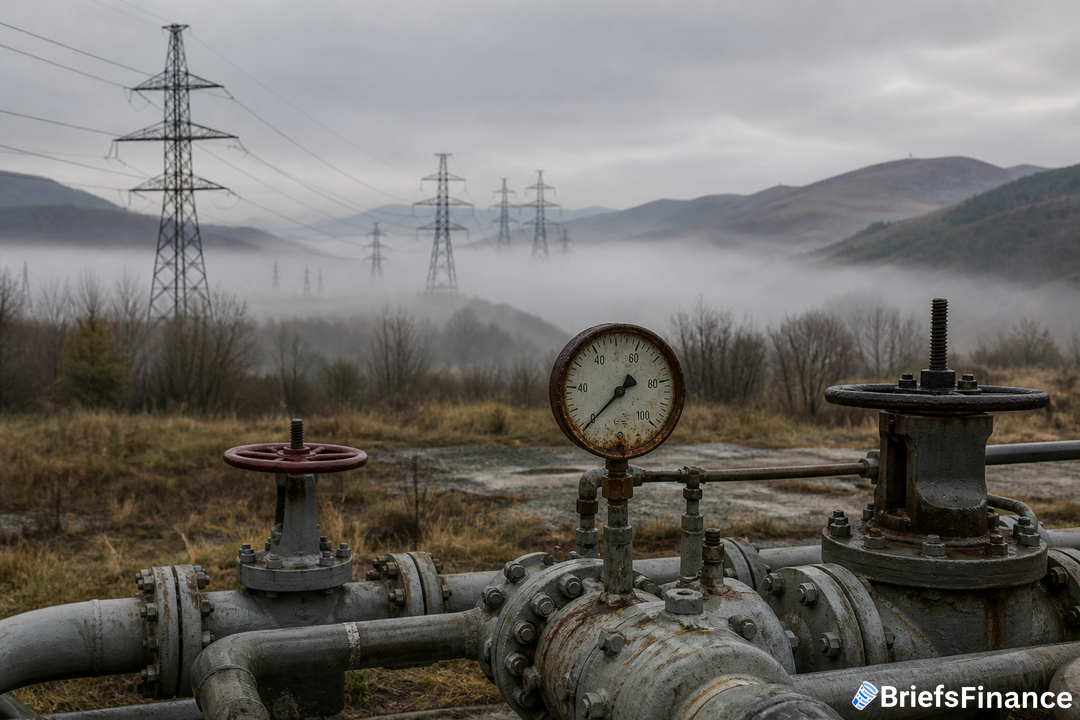
What happened
The UK's October bill to match electricity supply with demand cleared £561 million, roughly $753 million, per National Energy System Operator data aggregated by Bloomberg. The dataset runs through Oct. 29, 2026.
It was the second consecutive monthly peak, lifting the autumn tally above £1 billion. Those interventions feed into higher bills heading into winter.
Why costs jumped
Gas prices have climbed to their highest level since the 2022 energy crisis, so when the operator calls on gas-fired plants for extra generation, the tab rises.
At the same time, wind capacity is coming online faster than the grid can ferry that power to big demand centers. When it is particularly windy, the system operator can end up paying wind parks to turn off and gas plants near major cities to turn on instead, a pricey combination that flows through to consumers.
Energy markets shift in quiet ways that reward investors who use smarter tools. We're hosting our first ever investor livestream on 11/17 to show you how to use ChatGPT and Claude to invest like a pro, hosted by Briefs Finance CEO Jaspreet Singh. Save your seat.
Where the grid is pinched
Outages and constraints at key transmission pinch points limited flows from wind-heavy Scotland and northern England to the more power-hungry south. Near Liverpool, utilization at the GMSNOW boundary slid to only 14% between late September and the start of October.
Across Scotland, the B4/B5 boundary ran at roughly 43% of capacity over September and October, versus 55% during the same window a year ago. As Lisa Waters of Waters Wye Associates put it, "It's been windy and we haven't seriously increased transmission capacity and the cost of replacement energy has gone up because of the gas price." Her view: "Transmission investment to increase capacity hasn't kept pace with the quantity of wind connecting to the system."
Policy signals and the investor takeaway
The limits are now a political problem. Leaders have pitched renewables as the route away from costly imported gas, yet grid constraints are inflating the bill. Writing in The Times, Chancellor John Healey said the next government auction for new renewable power projects will only back proposals that cut bills, adding, "There's no sense building power that can't connect and then paying to switch it off."
The bottom line: record balancing costs reflect expensive gas and constrained transmission, and NESO's outlook suggests 2026's total could approach £4 billion. For portfolios exposed to UK power, watch grid capacity, gas price sensitivity, and siting risk for generators, network operators, and large energy buyers.
Incorporating AI can help investors uncover patterns others might easily overlook. On 11/17, our CEO Jaspreet Singh goes live for our first ever investor livestream on how to use ChatGPT and Claude to invest like a pro. Register to join him.