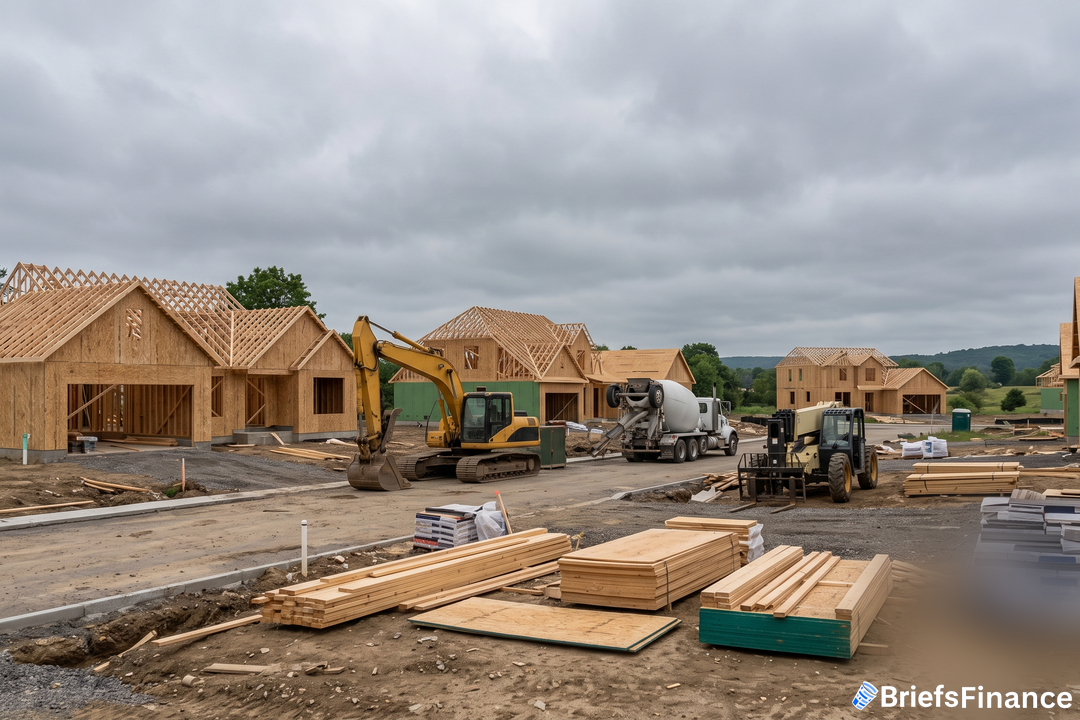
The details reveal where the weakness is concentrated and why it matters for the housing market.
A Narrow Decline That Tells a Big Story
The year-over-year figure is the one that matters most, according to Maor Greenberg, CEO and co‑founder of Spacial, a construction technology firm.
"The annual is the one that counts. And the decline is narrow, not broad. New single-family down 4.0 percent, manufacturing down 21.9 percent. Those two carry most of the decline. The rest is close to flat."
Why Housing Demand Is Shrinking
High interest rates and rising construction costs are at the center of the slowdown. "Rates and costs are thinning the buyer pool and the builder pipeline at once," Greenberg said.
Get your free investing masterclass bonus when you join Market Briefs, our free daily newsletter
Fewer people can afford to buy homes, and builders are reluctant to start new projects.
At the same time, fewer young adults are forming new households. "The slowdown in household growth reflects reduced household formation among young adults amid a weakened job market, burdensome student debt, and low consumer sentiment," the report says. "Many young adults cannot afford to form new households, instead doubling up or living with family."
The job market's weakness directly weighs on housing demand. With such scarce employment gains, wage growth remains insufficient to offset higher mortgage costs, leaving many potential buyers on the sidelines and further suppressing household formation.
Manufacturing Pullback and Ripple Effects
"Manufacturing rolling off says companies are pulling back on big bets," Greenberg said.
David Graff, a senior executive at Transwestern who oversees project services, told Inc. that "prolonged reduced construction spending can weaken certain aspects of the economy." He listed "building suppliers/manufacturing, distribution, labor, architects, engineers, furniture suppliers, logistics firms, and others" as industries that feel the pinch.
There's also a long-term risk. "We have seen an interesting phenomenon where these market slowdowns have resulted in older construction people retiring or leaving the industry and younger people staying away. That has a longer-term effect on the industry as a whole," Graff said.
The combination of elevated mortgage rates and sluggish employment growth has created a feedback loop that reinforces the spending decline. Without a meaningful drop in rates, builders remain hesitant to start new projects, and household formation stays suppressed, further dampening construction activity across multiple sectors.
What to Watch
Industry observers are focused on one thing: mortgage interest rates. "What turns the housing side is rates. Cheaper financing, and it breathes again. Until then, the pipeline keeps thinning," Greenberg said.
Subscribe to Market Briefs, our free daily newsletter, and claim your bonus investing masterclass