Free NewsletterPro Login

Warning: Undefined variable $stocks in /var/www/briefs.co/htdocs/wp-content/plugins/oxygen/component-framework/components/classes/code-block.class.php(133) : eval()'d code on line 448

Warning: foreach() argument must be of type array|object, null given in /var/www/briefs.co/htdocs/wp-content/plugins/oxygen/component-framework/components/classes/code-block.class.php(133) : eval()'d code on line 448

Warning: Undefined variable $funds in /var/www/briefs.co/htdocs/wp-content/plugins/oxygen/component-framework/components/classes/code-block.class.php(133) : eval()'d code on line 472

Warning: foreach() argument must be of type array|object, null given in /var/www/briefs.co/htdocs/wp-content/plugins/oxygen/component-framework/components/classes/code-block.class.php(133) : eval()'d code on line 472
/* the link was here */
×
Free investor livestream — Nov 17

How To Use ChatGPT & Claude To Research Stocks Like A Pro

01
The prompt we use to break down any stock
02
How to fact-check what AI tells you
03
How to compare two stocks in minutes

JPMorgan targets Europe's grid overhaul as a prime infrastructure play

Published Nov 3, 2026
Share:
Summary:
  • JPMorgan Chase is positioning to finance Europe's power-grid revamp, extending its push to lead U.S. grid financing.
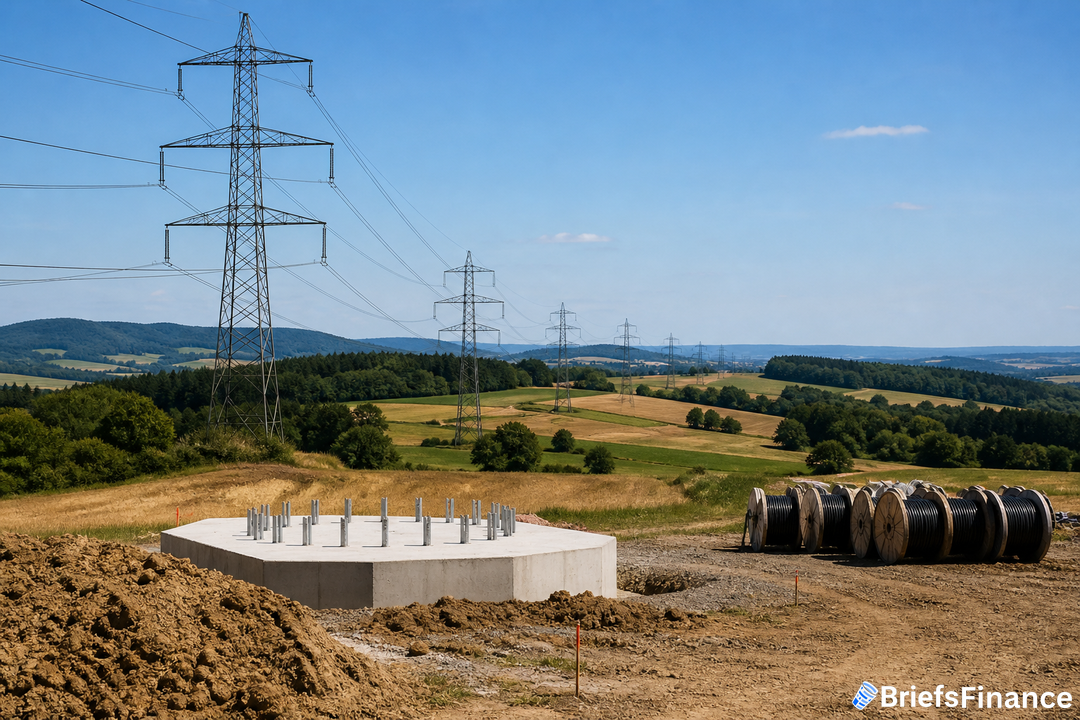
  • The European Commission estimates more than €1.2 trillion is needed for electricity networks by 2040, with some 500 gigawatts of renewable projects waiting to connect.
  • The effort aligns with JPMorgan's $1.5 trillion security and resiliency initiative, and the bank announced a grant to the Green Finance Institute to pilot new financing models.

What JPMorgan is betting on

JPMorgan Chase wants a front row seat in Europe's grid rebuild, pitching itself as a go to financier as the region retools how power moves across borders and into homes and factories. That echoes the bank's declared goal of leading grid financing in the U.S.

Daniel Rudnicki Schlumberger, who runs the bank's security and resiliency initiative in EMEA, called the upgrade "one of the biggest financing opportunities" in European infrastructure, adding, "Institutional capital will move quickly if Europe can stand up a proper framework for grid-operator revenues." The bank frames grid funding as essential national infrastructure, comparable to defense and critical minerals, to bolster resilience amid war, energy stress and rapid technological shifts.

The size of the gap

The push sits inside JPMorgan's $1.5 trillion security and resiliency program announced by CEO Jamie Dimon last year. Aging networks are constraining activity across sectors, including data centers and electric vehicles, and in Europe that drag also hampers decarbonization targets.

Europe often wastes wind and solar output because networks cannot carry power when it is windy, and sunny-day generation can outstrip demand with too few batteries to store the excess. After sunset, gas becomes costly. Across Europe, gas prices have risen to three times their earlier level so far this year amid the wars in Iran and Ukraine, and the region heads into winter with historically low levels of stored gas. Meanwhile, about 500 gigawatts of renewable energy projects remain queued for grid connections, according to JPMorgan.

Policy and private capital need to move together

The EU's Grids Package targets permitting delays and connection queues, seeks stronger cross-border links, and aims to modernize networks so more renewable electricity can be used instead of curtailed.

"I often see projects stall because there's no grid capacity to connect them," said Luke Nelson, who leads international sustainability at JPMorgan's Center for Energy and the Environment. Because Europe continues to import more than half of the energy it consumes, "each wind farm, solar park and battery built in Europe can help reduce that exposure, as long as it can connect to the grid." Nelson added that progress will depend on combining policy reforms with private financing that can supply capital, expertise and patient investment.

Big infrastructure shifts can reshape opportunities for patient, curious long term investors. We're hosting our first ever investor livestream on 11/17 to show you how to use ChatGPT and Claude to invest like a pro, hosted by Briefs Finance CEO Jaspreet Singh. Save your seat.

To help seed solutions, JPMorgan announced on Tuesday a grant to the Green Finance Institute, an organization that advises governments on climate and energy policy. The funding will support an independent effort to develop and trial new financing models for smaller distribution companies, cutting-edge grid technologies, and transmission that spans national borders, the bank said. "Modernizing Europe's electricity grids is one of the most important infrastructure challenges of the energy transition," said Rhian-Mari Thomas, GFI's CEO. "As electricity demand grows and networks come under increasing pressure, unlocking capital for grid infrastructure will be critical to supporting energy security, economic competitiveness and the transition to a low-carbon economy."

Why this matters for your portfolio

Rudnicki Schlumberger put it bluntly: "One of the lessons of Ukraine is that grid resilience is as much a security issue as it is an infrastructure investment opportunity." In plain English: this is a policy supported, long-cycle capex theme - more than €1.2 trillion through 2040 - with a large queue of projects and a push to clarify grid-operator revenues, which can make financing terms more bankable.

The bottom line: if EU reforms reduce red tape and stabilize revenue frameworks, institutional money can scale into transmission, distribution and enabling technologies. JPMorgan's grant to GFI is a small but telling step to build the financing toolkit that could turn today's connection backlog into investable deals.

New technology and policy changes reward investors who learn how to adapt. On 11/17, our CEO Jaspreet Singh goes live for our first ever investor livestream on how to use ChatGPT and Claude to invest like a pro. Register to join him.

Disclosure

Recent News

1 2 3 … 117

Get Market Briefs delivered to your inbox every morning for free!

No fluff. No noise. No politics. Just finance news you can read in 5 minutes.

Blogs

November 2, 2026
Credit Utilization: How Paying Down Cards Can Help Your Score
  • Credit utilization is your card balances divided by your credit limits, checked overall and card by card.
  • Lower is generally better, and Experian says the effect becomes more noticeable around 30%.
  • Paying down balances and keeping new charges off your cards are the main ways to lower it.
Read More
November 2, 2026
How to Calculate Your Net Worth, With a Worked Example
  • Net worth is what you own minus what you owe, and it can be negative early on.
  • Use today's value for your assets and today's payoff balances for your debts.
  • Recalculate on the same date each quarter or year, since the trend matters more than the starting number.
Read More
November 2, 2026
How to Get Out of Debt on a Low Income, Step by Step
  • List every debt with its balance, APR, minimum and due date, then pause new charges.
  • An extra $50 a month on a $3,000 card at 22% cuts the payoff from about 44 months to about 26.
  • If nothing is left over, call your lenders and a nonprofit credit counselor, and avoid anyone who charges fees before settling debt.
Read More
November 2, 2026
How to Save Money on a Low Income, With a Budget Example
  • Saving 10% of a $2,000 paycheck is $200 a month, which reaches a first $2,000 in 10 months.
  • Set the transfer for payday and keep the money in a separate savings account.
  • Lower your biggest bills, cancel unused subscriptions and check programs like Lifeline and the EITC.
Read More
November 2, 2026
How to Budget With an Irregular Income, Even in Lean Months
  • Build your budget on your lowest recent month, not your average, so slow months don't leave you short.
  • Pay yourself a fixed salary from a holding account, and keep extra from good months as a cushion.
  • If no one withholds tax from your pay, set tax money aside every month.
Read More
November 2, 2026
How to Track Your Spending in 15 Minutes a Week
  • Start with last month's bank and card statements, receipts and any cash purchases.
  • Sort every purchase into a few groups that match your budget, like groceries and eating out.
  • Spend about 15 minutes each week adding purchases, checking each group and picking one change.
Read More
November 2, 2026
Should You Invest or Pay Off Debt? How to Decide
  • Card interest is a cost you can see ahead of time, while investing returns can go up or down.
  • A $3,000 card balance at 24% costs about $60 in interest in the first month.
  • Check whether you have a cushion, how high your rate is, whether your employer offers a match and how you'd handle a market drop.
Read More
November 2, 2026
Pay Yourself First: What It Means and How to Automate It
  • Paying yourself first means moving money to savings and investing on payday, before bills and spending.
  • The 75/15/10 split puts at least 10% toward savings and at least 15% toward investing.
  • Start smaller if money is tight, and automate the transfers so you only make the decision once.
Read More
November 2, 2026
What Is a Good Credit Score? Ranges and What Moves Yours
  • On the FICO scale, a good credit score is 670 to 739, and very good starts at 740.
  • Payment history (35%) and amounts owed (30%) are the two biggest parts of your score.
  • Paying every bill on time and paying down card balances are the two best places to start.
Read More
November 2, 2026
How to Lower Your Credit Card Interest Rate, With a Call Script
  • Before you call, have your APR, balance, card history, on-time record and any lower-rate offers ready.
  • Use the script to ask for a lower rate, then ask for a temporary cut or a hardship program if the answer is no.
  • On a $5,000 balance paid at $200 a month, dropping from 26.99% to 23.99% saves about $430 in interest.
Read More
1 2 3 … 31
Share via
Copy link