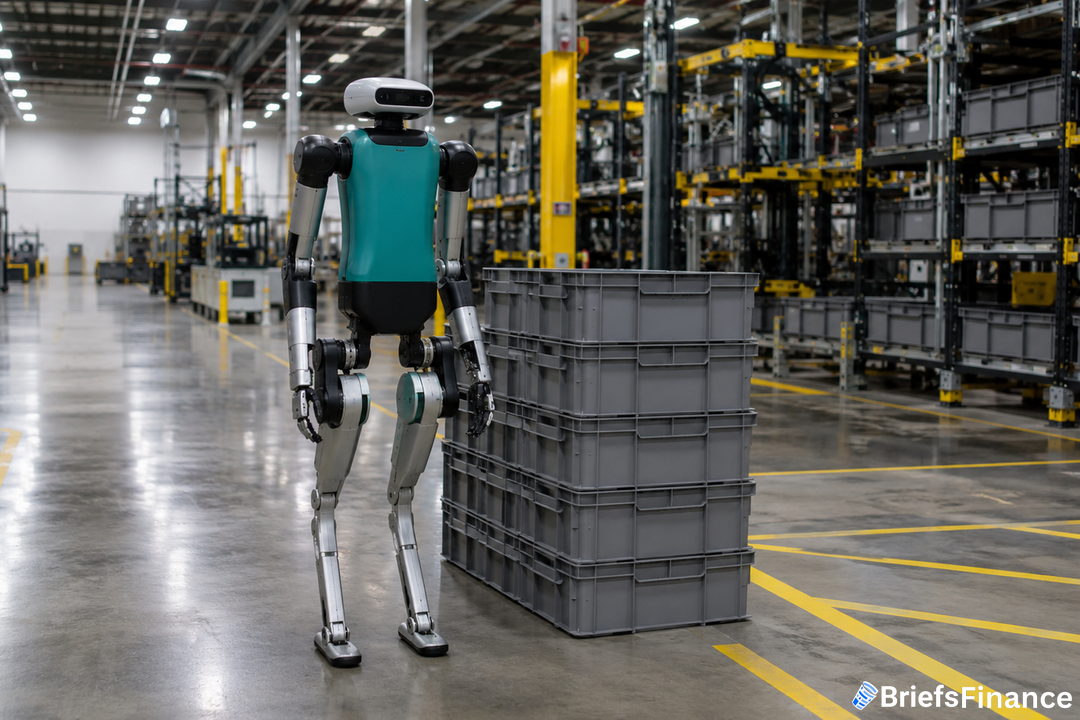
Opening: Agility Robotics has more than $300 million in booked revenue from roughly 1,000 robots. Yet its public-market valuation is only $2.5 billion - far less than rivals like Figure AI ($39 billion) or Apptronik ($5.5 billion). The company is racing to scale while competition piles in.
The SPAC Details
Agility Robotics is going public by merging with a blank-check company called Churchill Capital Corp XI. A SPAC - special-purpose acquisition company - is a shell company that raises money from investors and then finds a private firm to take public. Michael Klein is the sponsor of this SPAC.
The deal is expected to bring in gross proceeds of more than $620 million. That is the largest capital raise in humanoid-robot history. Agility will use the money to expand its 70,000-square-foot factory in Salem, Oregon, and deliver on its robot-as-a-service orders. In the robots-as-a-service model, customers pay a monthly fee instead of buying the robot upfront.
Peggy Johnson, Agility's CEO, called the move "an acceleration story and a timing story." She said the company wants to be the first pure-play humanoid-robot stock on public markets, giving regular investors a chance to own a piece of the sector.
Competition Heats Up
Agility is not the only player in humanoid robots. AI2 Robotics, a Shenzhen-based startup, raised roughly $735 million at a nearly $3 billion valuation. Apptronik, from Austin, closed a $935 million funding round earlier in 2026 at a more than $5.5 billion valuation. Figure AI, based in San Jose, raised $1 billion last fall at a $39 billion valuation.
Get your free investing masterclass bonus when you join Market Briefs, our free daily newsletter
But Agility has something its rivals may lack: real customers. The company already has booked multi-year revenue of more than $300 million, covering roughly 1,000 robots. Agility's customers include logistics firm GXO, retail giant Amazon, Toyota Motor Manufacturing Canada, automotive parts supplier Schaeffler, and e-commerce platform Mercado Libre. "Everybody on our list right now is already vetted, and they have deployment plans behind their proof of concepts," Johnson said.
She also noted that Agility is "LLM-agnostic" - meaning it uses multiple large language models rather than relying on one. The company's Digit robot stands about 5 feet 9 inches tall and weighs around 160 pounds. Johnson said Agility "may have the largest data lake of actual operating robotics data in real-world environments."
Focus on Warehouses, Not Homes
The company's strategy is clear: stay in warehouses and factories where labor shortages are severe. Johnson pointed out that "there's something like over a million jobs in the U.S. today in these areas that are unfilled. They're just very, very hard to hire for." Digit robots can help fill those roles.
Johnson is cautious about consumer robots. She said humanoids for homes are "10-plus years" away.
She compared the challenge to autonomous vehicles: "At least roads have some discipline to them. Most of the areas that humanoids will be operating in don't." Safety is a big reason.
"You can't build your robot and then make it safe. That's a redesign," she said.
Agility was spun off from Oregon State University in 2015. Johnson previously worked at Microsoft and served as CEO of Magic Leap. She said the biggest competitor is internal: "Our biggest competitor right now is just us. How quickly we can execute, how quickly we can continue to add new skills."
What to Watch
The deal requires shareholder approval and SEC review, with closing anticipated later in 2026. If it goes through, Agility will become the first humanoid-robot company on a public exchange. Whether it can keep delivering "customer by customer, robot by robot" - as Johnson put it - will determine if this SPAC avoids the volatility that has hurt other blank-check deals.
Subscribe to Market Briefs, our free daily newsletter, and claim your bonus investing masterclass