Free NewsletterPro Login
S&P 500 6,287 +0.42%
DOW 44,521 -0.18%
NASDAQ 21,103 +0.71%
S&P 500 +12.4%
Briefs Finance Fund +24.8%
JOIN THE FUND →

Agility Robotics Goes Public at $2.5 Billion Valuation

Published Jul 6, 2026
[tts_player]
Share:
Summary:
  • Agility Robotics will merge with a SPAC called Churchill Capital Corp XI to become a public company.
  • The deal is expected to raise more than $620 million, the largest capital raise in humanoid-robot history.
  • CEO Peggy Johnson says humanoid robots for homes are "10-plus years" away; the company will focus on warehouses and factories.

Opening: Agility Robotics has more than $300 million in booked revenue from roughly 1,000 robots. Yet its public-market valuation is only $2.5 billion - far less than rivals like Figure AI ($39 billion) or Apptronik ($5.5 billion). The company is racing to scale while competition piles in.

The SPAC Details

Agility Robotics is going public by merging with a blank-check company called Churchill Capital Corp XI. A SPAC - special-purpose acquisition company - is a shell company that raises money from investors and then finds a private firm to take public. Michael Klein is the sponsor of this SPAC.

The deal is expected to bring in gross proceeds of more than $620 million. That is the largest capital raise in humanoid-robot history. Agility will use the money to expand its 70,000-square-foot factory in Salem, Oregon, and deliver on its robot-as-a-service orders. In the robots-as-a-service model, customers pay a monthly fee instead of buying the robot upfront.

Peggy Johnson, Agility's CEO, called the move "an acceleration story and a timing story." She said the company wants to be the first pure-play humanoid-robot stock on public markets, giving regular investors a chance to own a piece of the sector.

Competition Heats Up

Agility is not the only player in humanoid robots. AI2 Robotics, a Shenzhen-based startup, raised roughly $735 million at a nearly $3 billion valuation. Apptronik, from Austin, closed a $935 million funding round earlier in 2026 at a more than $5.5 billion valuation. Figure AI, based in San Jose, raised $1 billion last fall at a $39 billion valuation.

Get your free investing masterclass bonus when you join Market Briefs, our free daily newsletter

But Agility has something its rivals may lack: real customers. The company already has booked multi-year revenue of more than $300 million, covering roughly 1,000 robots. Agility's customers include logistics firm GXO, retail giant Amazon, Toyota Motor Manufacturing Canada, automotive parts supplier Schaeffler, and e-commerce platform Mercado Libre. "Everybody on our list right now is already vetted, and they have deployment plans behind their proof of concepts," Johnson said.

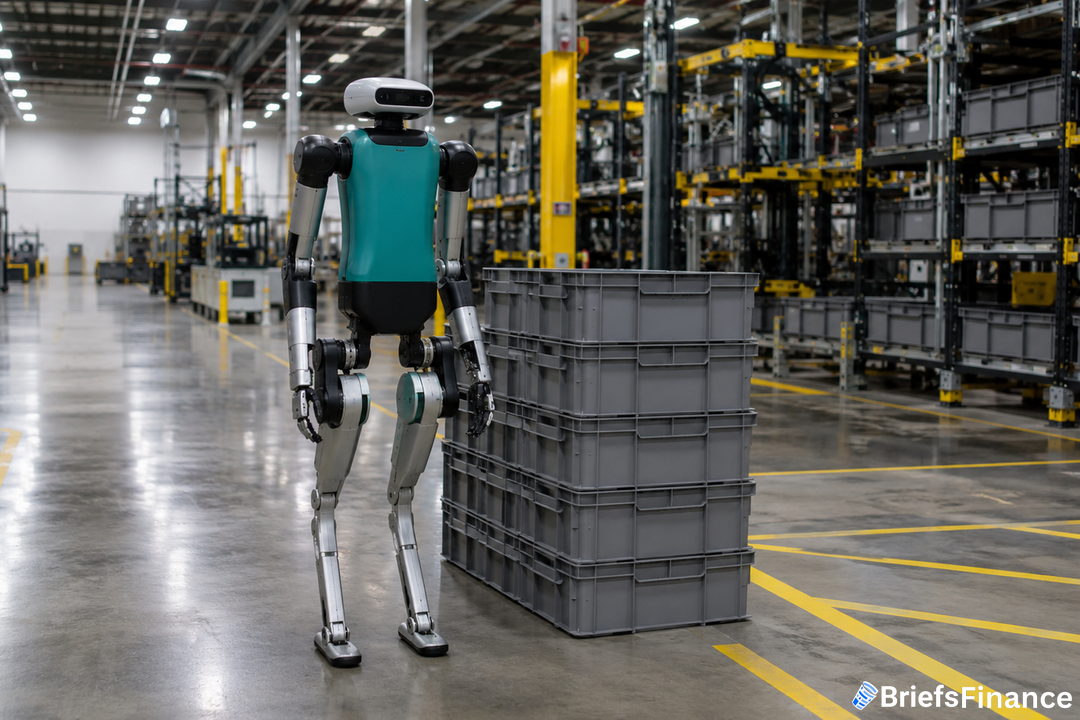
She also noted that Agility is "LLM-agnostic" - meaning it uses multiple large language models rather than relying on one. The company's Digit robot stands about 5 feet 9 inches tall and weighs around 160 pounds. Johnson said Agility "may have the largest data lake of actual operating robotics data in real-world environments."

Focus on Warehouses, Not Homes

The company's strategy is clear: stay in warehouses and factories where labor shortages are severe. Johnson pointed out that "there's something like over a million jobs in the U.S. today in these areas that are unfilled. They're just very, very hard to hire for." Digit robots can help fill those roles.

Johnson is cautious about consumer robots. She said humanoids for homes are "10-plus years" away.

She compared the challenge to autonomous vehicles: "At least roads have some discipline to them. Most of the areas that humanoids will be operating in don't." Safety is a big reason.

"You can't build your robot and then make it safe. That's a redesign," she said.

Agility was spun off from Oregon State University in 2015. Johnson previously worked at Microsoft and served as CEO of Magic Leap. She said the biggest competitor is internal: "Our biggest competitor right now is just us. How quickly we can execute, how quickly we can continue to add new skills."

What to Watch

The deal requires shareholder approval and SEC review, with closing anticipated later in 2026. If it goes through, Agility will become the first humanoid-robot company on a public exchange. Whether it can keep delivering "customer by customer, robot by robot" - as Johnson put it - will determine if this SPAC avoids the volatility that has hurt other blank-check deals.

Subscribe to Market Briefs, our free daily newsletter, and claim your bonus investing masterclass

Disclosure

Recent News

1 2 3 32

Get Market Briefs delivered to your inbox every morning for free!

No fluff. No noise. No politics. Just finance news you can read in 5 minutes.

Blogs

June 29, 2026
Portfolio Diversification: Why Putting All Your Eggs in One Basket Destroys Wealth
  • Real diversification means spreading investments across all 11 economic sectors plus bonds, alternatives, and cash so no single bet can sink the portfolio.
  • Different sectors perform at different times, so a diversified portfolio captures upswings while smoothing the brutal drawdowns that wipe out concentrated bets.
  • Total market index funds offer the simplest path to diversification, and annual rebalancing is what keeps the structure working over time.
Read More
June 29, 2026
Non Taxable Income: What It Is and Why It Matters
  • Non taxable income is money you receive that you don't owe income tax on.
  • The tax code treats workers, investors, and business owners very differently, and investors often come out ahead.
  • Learning how income is taxed is a quiet superpower for keeping more of what you earn.
Read More
June 29, 2026
Semiconductor Stocks: A Simple Guide for Investors
  • Semiconductor stocks are companies that design and make computer chips, the brains inside nearly every modern device.
  • The AI boom has turned chips into one of the market's most important and most watched groups.
  • They offer big growth potential, but come with high valuations and a notoriously cyclical history.
Read More
June 25, 2026
How Stocks Work: A Simple Guide for Beginners
  • A stock is a slice of ownership in a company - buy one, and you own a piece of the business.
  • You make money two ways: the share price rising over time, and dividends paid to shareholders.
  • The simplest path for most beginners is buying into the whole market through a low-cost index fund.
Read More
June 25, 2026
Stop Loss vs Stop Limit: What's the Difference?
  • A stop loss order sells your stock once it hits a trigger price, prioritizing getting you out.
  • A stop limit order only sells within a price range you set, prioritizing price over a guaranteed exit.
  • The trade-off: a stop loss almost always executes; a stop limit might not if the price moves too fast.
Read More
June 25, 2026
Energy Stocks: A Simple Guide for Investors
  • Energy stocks are companies that produce and supply the power the world runs on, from oil and gas to newer sources.
  • They make up one of the 11 sectors of the market and tend to move with energy prices and big-picture shifts.
  • Like any sector, the key is diversification and understanding the forces driving demand.
Read More
June 18, 2026
What Is a Stop Loss Order? A Simple Guide
  • A stop loss order automatically sells a stock once it falls to a price you set.
  • It's a tool to cap losses or lock in gains without watching the market all day.
  • It works best for active strategies, and can backfire if used carelessly on long-term holdings.
Read More
June 18, 2026
Best S&P 500 Index Fund: How to Choose One
  • The best S&P 500 index fund for most investors is simply the cheapest, most established one that tracks the index well.
  • Funds like VOO, IVV, and SPY all hold the same 500 companies, so the biggest difference is the fee.
  • Pick one, automate your buys, and let time do the heavy lifting.
Read More
June 17, 2026
What Are Penny Stocks? Risks and Rewards Explained
  • Penny stocks are very low-priced shares of very small companies, often trading for just a few dollars or less.
  • They promise huge gains but carry huge risks: low liquidity, high failure rates, and wild price swings.
  • Most investors are better served by quality companies and funds than by chasing cheap shares.
Read More
June 17, 2026
Best Stocks for Beginners With Little Money
  • The best stocks for beginners with little money usually aren't individual stocks at all - they're low-cost index funds.
  • You can start with $100 or less and use small, regular investments to build wealth over time.
  • Focus on diversification and consistency, not on picking the next big winner.
Read More
1 2 3 24
Share via
Copy link










