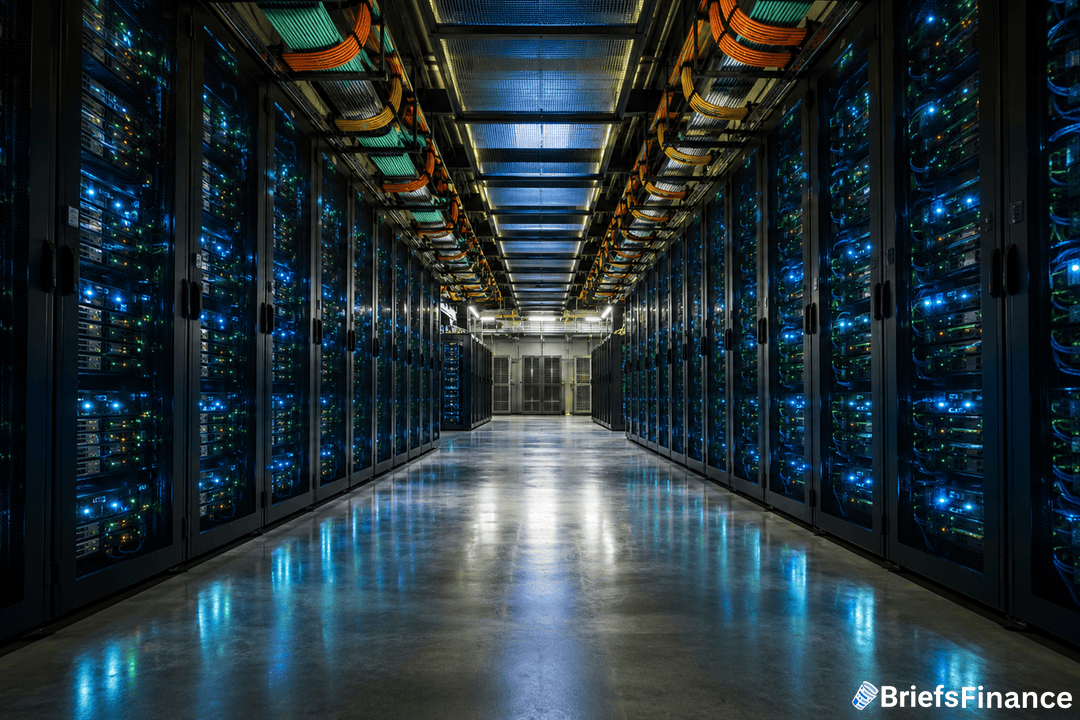
Meta is one of the safest companies on the planet to lend to.
S&P rates it AA-, and Moody's matches that with an Aa3. That is the fourth-highest level a firm can get.
So why is the cost to insure Meta's debt running higher than firms rated four notches below it?
Because every bank in the world is buying that cover at once.
The Setup
Hyperscalers have already borrowed more than $250 billion globally to feed their AI ambitions. The full build-out is set to cost $5 trillion by 2030.
Banks face hard limits on how much they can lend to one borrower. So as Meta, Alphabet, and others tap them for cash, banks are running into those caps.
The workaround is the credit default swap, or CDS. It is a contract that pays out if the borrower defaults on its debt.
Buy enough of those, and a bank can keep lending to one firm without breaking its limits.
Banks are hedging so they can keep underwriting Big Tech's debt. And they are buying a lot.
Want to know which moves on Wall Street actually matter for your money? Read Market Briefs every morning in five minutes, with a free masterclass on finding investments when you sign up.
The Trade That Opened Up
All that buying pushed prices up. Take Meta.
A 5-year CDS on the firm was trading Friday at 0.73 percentage points a year. That means anyone selling that cover on $10 million of Meta debt collects $73,000 a year.
By comparison, selling the same $10 million of cover on the broad investment-grade index pays just $52,000 a year. The index averages a BBB+ rating, which is four notches below Meta.
In plain terms: hedge funds get paid more to insure higher-rated credit than lower-rated credit. That is not how the math is supposed to work.
"It's the best opportunity in AA credit default swaps in a very long time," Andrew Weinberg of Saba Capital Management told Bloomberg. "You are dealing with an inefficient market."
The Volume Tells The Story
The numbers behind the trade are getting bigger fast:
- Hyperscaler CDS trading at Bank of America is up tenfold since the start of 2025, per BofA's head of US single-name CDS, Matt Mandell.
- S&P Dow Jones added Meta, Alphabet, and Microsoft to its CDX Investment-Grade Index.
- JPMorgan rolled out a CDS basket built to short five hyperscalers at once.
The trade has moved beyond hedge funds too. Equity investors are using CDS to hedge their stock positions, and asset managers and private credit funds are dipping in alongside them.
Worth Watching
Morgan Stanley flagged a real risk underneath all this. Too much investment-grade debt is now stacked on a small group of AI builders.
"Quality deterioration remains a risk," strategists Vishwas Patkar and Joyce Jiang wrote in a recent note.
The Wall Street consensus right now is that hyperscalers are too big to fail. The price of that bet is showing up in the derivatives market.
Sign up here and get the daily newsletter plus a 45-minute investing course as a sign-up bonus.