Free NewsletterPro Login
S&P 500 6,287 +0.42%
DOW 44,521 -0.18%
NASDAQ 21,103 +0.71%

Warning: Undefined variable $funds in /var/www/briefs.co/htdocs/wp-content/plugins/oxygen/component-framework/components/classes/code-block.class.php(133) : eval()'d code on line 491

Warning: foreach() argument must be of type array|object, null given in /var/www/briefs.co/htdocs/wp-content/plugins/oxygen/component-framework/components/classes/code-block.class.php(133) : eval()'d code on line 491
/* the link was here */

Drought-Stricken Rhine Forces Rerouting of European Cargo

Published Aug 11, 2026
[tts_player]
Share:
Summary:
  • At Kaub, Germany, the Rhine's water level has dropped to its lowest since 1880.
  • The river is impassable at that point, splitting the waterway in half.
  • Lanxess and Evonik are among companies switching to rail and road.

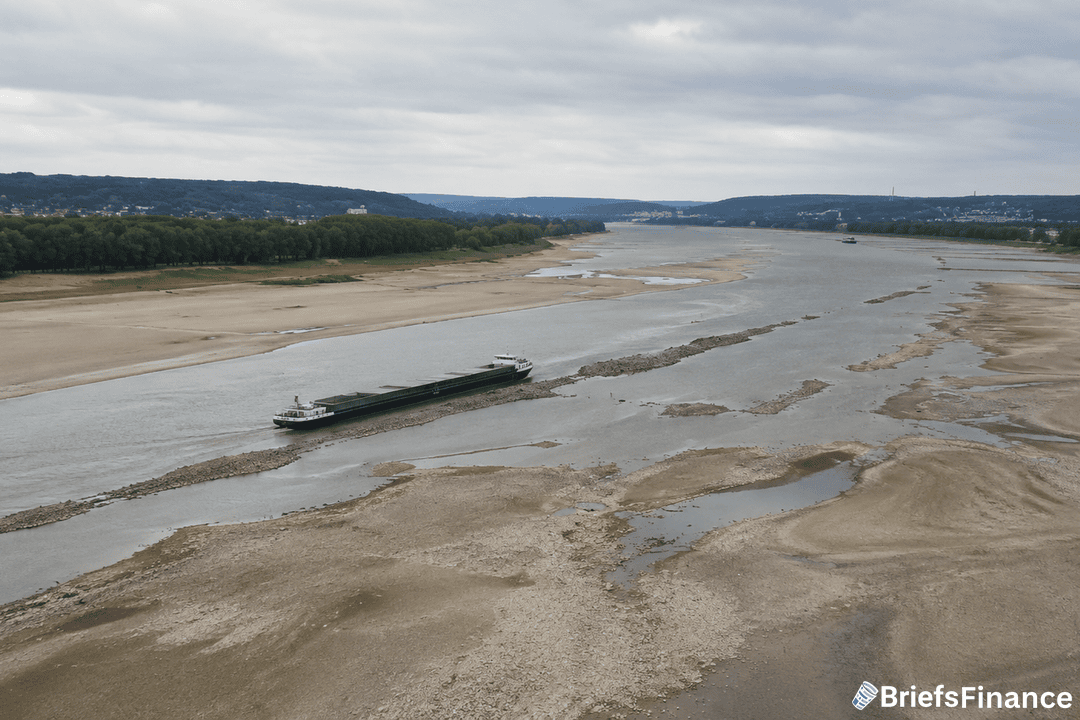
As Europe's most heavily used river, the Rhine transports goods ranging from coal to cocoa between Switzerland and the port of Rotterdam. Right now, it is barely moving.

The water level at Kaub, the river's shallowest point in Germany, just hit its lowest mark since records began in 1880. And forecasters say it could keep falling.

What's Happening on the River

Kaub is the bottleneck. When the water there gets too shallow, big barges simply cannot pass. Shipping broker Riverlake puts it bluntly: barges on the Upper Rhine cannot get down to the Antwerp-Rotterdam-Amsterdam hub, and barges from that hub cannot come up. At Kaub, the river becomes impassable, effectively splitting the waterway into two separate sections.

The outlook remains bleak. A fresh heat wave is sweeping across Europe this week, and meteorologists predict that only a prolonged period of heavy rainfall could restore the river to more typical depths. This disruption may persist well into October.

Get the free Always Be Buying eBook and learn the simple system for building wealth on any income

Why the Rhine Matters

When the river slows, the ripple effects hit supply chains across Europe. This slowdown threatens the availability of these goods. For instance, German utility EnBW typically depends on coal deliveries coming from Rotterdam, and Miro oil refinery ships its gasoline via barges. EnBW calculates that the disruption will shave a low double-digit million euros off its earnings.

Companies ranging from steelmaker Thyssenkrupp AG to BASF SE and Lanxess AG are facing supply chain challenges.

The Rhine's importance extends beyond individual companies. It serves as the backbone of European bulk logistics, and the current crisis underscores how vulnerable the region's trade networks are to climate-related disruptions.

The river links industrial regions in Germany, France, and Switzerland to the major seaports of Rotterdam and Antwerp. Its barges are essential for moving heavy goods that are impractical to transport by road or rail over long distances. When water levels fall, each barge must carry a lighter load, reducing efficiency and increasing costs for shippers.

How Companies Are Coping

The companies that depend on this river are scrambling. Lanxess, a specialty chemicals maker, says ship transport is severely restricted, with vessels carrying much lighter loads than usual. It is shifting to rail and road where possible, calling the situation "highly dynamic."

Evonik, another chemical giant, has also switched to alternative transport modes. An Evonik spokesperson said, "The Rhine's low water levels are restricting inland shipping capacities and posing major challenges for logistics and supply chains." The company is also moving some of its cargo to trains and trucks, while taking extensive precautionary measures.

BASF noted some isolated supply snags but has managed to continue river shipments by using more shallow-draft vessels. When needed, it turns to trucks and rail.

The situation is especially painful for bulk commodities like coal and heating oil, which are expensive to move by truck over long distances. As the Rhine's water level continues to fall, the pressure on Europe's already strained logistics network is only set to grow.

Download the free Always Be Buying eBook and start putting your money to work today
Disclosure

Recent News

1 2 3 53

Get Market Briefs delivered to your inbox every morning for free!

No fluff. No noise. No politics. Just finance news you can read in 5 minutes.

Blogs

June 29, 2026
Portfolio Diversification: Why Putting All Your Eggs in One Basket Destroys Wealth
  • Real diversification means spreading investments across all 11 economic sectors plus bonds, alternatives, and cash so no single bet can sink the portfolio.
  • Different sectors perform at different times, so a diversified portfolio captures upswings while smoothing the brutal drawdowns that wipe out concentrated bets.
  • Total market index funds offer the simplest path to diversification, and annual rebalancing is what keeps the structure working over time.
Read More
June 29, 2026
Non Taxable Income: What It Is and Why It Matters
  • Non taxable income is money you receive that you don't owe income tax on.
  • The tax code treats workers, investors, and business owners very differently, and investors often come out ahead.
  • Learning how income is taxed is a quiet superpower for keeping more of what you earn.
Read More
June 29, 2026
Semiconductor Stocks: A Simple Guide for Investors
  • Semiconductor stocks are companies that design and make computer chips, the brains inside nearly every modern device.
  • The AI boom has turned chips into one of the market's most important and most watched groups.
  • They offer big growth potential, but come with high valuations and a notoriously cyclical history.
Read More
June 25, 2026
How Stocks Work: A Simple Guide for Beginners
  • A stock is a slice of ownership in a company - buy one, and you own a piece of the business.
  • You make money two ways: the share price rising over time, and dividends paid to shareholders.
  • The simplest path for most beginners is buying into the whole market through a low-cost index fund.
Read More
June 25, 2026
Stop Loss vs Stop Limit: What's the Difference?
  • A stop loss order sells your stock once it hits a trigger price, prioritizing getting you out.
  • A stop limit order only sells within a price range you set, prioritizing price over a guaranteed exit.
  • The trade-off: a stop loss almost always executes; a stop limit might not if the price moves too fast.
Read More
June 25, 2026
Energy Stocks: A Simple Guide for Investors
  • Energy stocks are companies that produce and supply the power the world runs on, from oil and gas to newer sources.
  • They make up one of the 11 sectors of the market and tend to move with energy prices and big-picture shifts.
  • Like any sector, the key is diversification and understanding the forces driving demand.
Read More
June 18, 2026
What Is a Stop Loss Order? A Simple Guide
  • A stop loss order automatically sells a stock once it falls to a price you set.
  • It's a tool to cap losses or lock in gains without watching the market all day.
  • It works best for active strategies, and can backfire if used carelessly on long-term holdings.
Read More
June 18, 2026
Best S&P 500 Index Fund: How to Choose One
  • The best S&P 500 index fund for most investors is simply the cheapest, most established one that tracks the index well.
  • Funds like VOO, IVV, and SPY all hold the same 500 companies, so the biggest difference is the fee.
  • Pick one, automate your buys, and let time do the heavy lifting.
Read More
June 17, 2026
What Are Penny Stocks? Risks and Rewards Explained
  • Penny stocks are very low-priced shares of very small companies, often trading for just a few dollars or less.
  • They promise huge gains but carry huge risks: low liquidity, high failure rates, and wild price swings.
  • Most investors are better served by quality companies and funds than by chasing cheap shares.
Read More
June 17, 2026
Best Stocks for Beginners With Little Money
  • The best stocks for beginners with little money usually aren't individual stocks at all - they're low-cost index funds.
  • You can start with $100 or less and use small, regular investments to build wealth over time.
  • Focus on diversification and consistency, not on picking the next big winner.
Read More
1 2 3 24
Share via
Copy link













