Warning: Undefined variable $stocks in /var/www/briefs.co/htdocs/wp-content/plugins/oxygen/component-framework/components/classes/code-block.class.php(133) : eval()'d code on line 448
Warning: foreach() argument must be of type array|object, null given in /var/www/briefs.co/htdocs/wp-content/plugins/oxygen/component-framework/components/classes/code-block.class.php(133) : eval()'d code on line 448
Warning: Undefined variable $funds in /var/www/briefs.co/htdocs/wp-content/plugins/oxygen/component-framework/components/classes/code-block.class.php(133) : eval()'d code on line 472
Warning: foreach() argument must be of type array|object, null given in /var/www/briefs.co/htdocs/wp-content/plugins/oxygen/component-framework/components/classes/code-block.class.php(133) : eval()'d code on line 472
/* the link was here */
×
Free investor livestream — Nov 17
How To Use ChatGPT & Claude To Research Stocks Like A Pro
Pimco holds the biggest stake in the $368 million CMBS backed by Centre Square, the twin towers at 1500 Market St. in Philadelphia.
A judge approved a $70 million sale, down from a 2019 appraisal of $471 million, with closing expected in the coming weeks and proceeds set to be distributed to creditors.
After advances, fees and other claims, strategists estimate roughly 44 cents on the dollar will be recovered, wiping out seven junior tranches and hitting bonds that were once AAA.
What sold and why it matters
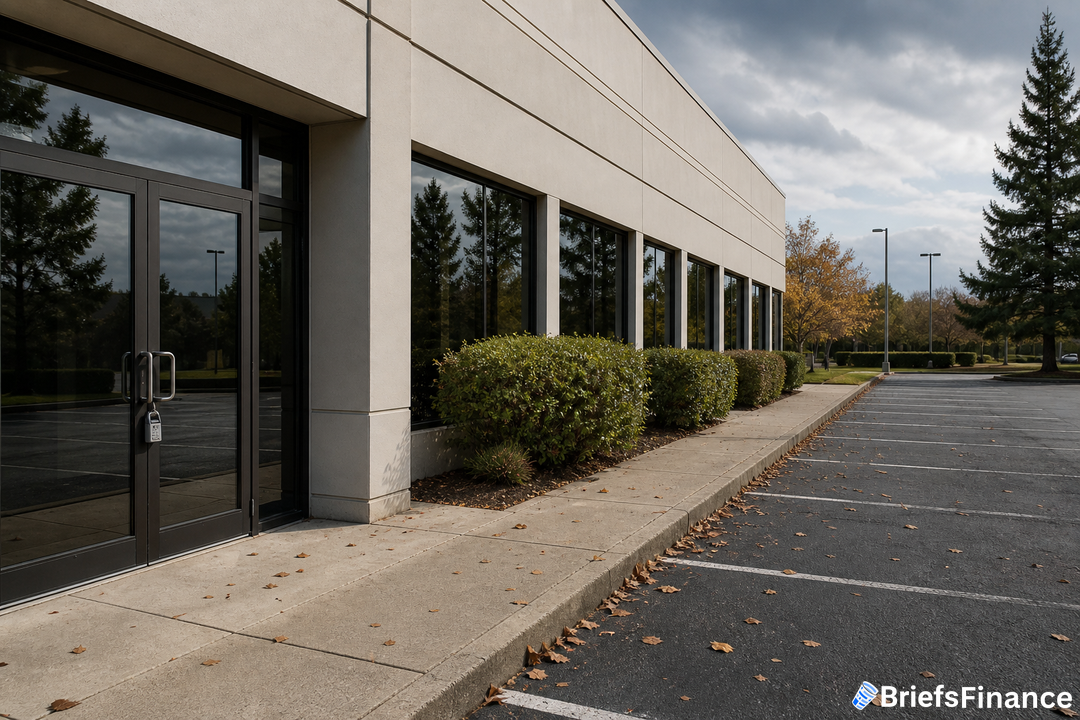
Centre Square is a pair of 43 and 36 story towers dating to 1974 that fill a full block across from Philadelphia's City Hall. Out front is a 45 foot stainless steel clothespin sculpture that makes the property hard to miss.
This deal is a single-asset, single-borrower CMBS, or SASB, secured by one mortgage on this complex. SASBs took off over the past decade, but with all the risk riding on a single property, a downturn can ripple through every layer of the bond.
How the numbers stack up
A joint venture of Nightingale Properties and InterVest Capital Partners bought the complex for $328 million in 2017, one of Philadelphia's largest commercial real estate deals. In 2020, the mortgage was refinanced and securitized into a CMBS that closed just weeks before Covid-19 scrambled the office market.
KBRA reported that, at the time, occupancy was roughly 93% across 56 tenants. The pandemic and remote work then undercut demand. By the end of June, servicer commentary put occupancy at 28%, with the University of Pennsylvania Health System and mortgage insurer Radian Guaranty among tenants still in place.
By mid 2022, servicing moved the loan to a special workout team when the borrower disclosed it couldn't refinance or pay off the debt at its maturity later that year. A modification or extension did not materialize, the property ultimately went through foreclosure, and it was subsequently offered for sale. In the prior month, a court signed off on a $70 million sale of the complex to PMC Property Group and developer Dean Adler; he has said the vision includes turning part of the property into a 300-room luxury hotel and up to 500 apartments. The approval clears a closing in the coming weeks, with proceeds to be paid out to creditors.
The drop from a 2019 appraisal of $471 million to a $70 million sale price is roughly an 85% decline in value, which means even the formerly AAA class is now expected to absorb losses. Once advances, fees and other claims are netted out, Wall Street strategists estimate recoveries close to 44 cents on the dollar.
Protecting your savings means steady planning, even when investment headlines offer surprises. Join Briefs Finance CEO Jaspreet Singh on September 29th for a FREE live investor workshop, How to Profit From A Dollar That's Losing its Value, where he shows how we're spotting investment opportunities as the dollar falls. Save your spot.
Who stands to lose and who is exposed
Pacific Investment Management Co. holds the biggest position in this CMBS, with roughly $58 million in face value spread across the deal, of which about half sits in the top-rated tranche. Given the projected recovery, its losses would exceed $35 million, calculated from purchase prices inferred from reported shifts in its holdings and contemporaneous bond levels. Holders of seven lower ranking tranches are expected to be wiped out. A Pimco spokesperson declined to comment.
If the AAA slice takes a hit, it would be only the third instance since the financial crisis of losses reaching the top tier of a CMBS. Last year, the most senior class of a bond linked to New York's Palisades Center mall suffered losses of more than $70 million, after an earlier roughly $40 million hit to senior holders in a CMBS backed by Manhattan's 1740 Broadway.
All three problem deals are SASBs. Unlike traditional CMBS that bundle many loans, SASBs typically hinge on one mortgage and have proved more vulnerable to losses despite AAA labels. SASBs are "a different shape of risk," said Nitin Bhasin, a CMBS analyst at KBRA. Some default, some don't. It's binary."
Where this leaves investors
Analysts say the pressure is not over as older offices face weak demand, lower values and looming maturities.
While New York and San Francisco have seen some leasing tailwinds tied to AI, plenty of markets may take years to claw back. Bloomberg data show more than 30 top rated SASB slices now trade below 85 cents on the dollar, with lower tranches marked at even deeper discounts. That list includes bonds linked to properties in Atlanta, Chicago and Denver.
The takeaway for regular investors: concentration cuts both ways. When a single property stumbles, even previously pristine bonds can take real damage, and Centre Square's roughly 44 cent recovery shows how fast that can filter into returns.
A clear strategy helps your money endure uncertainty and capture future opportunities. Our CEO Jaspreet Singh is hosting a FREE live investor workshop, How to Profit From A Dollar That's Losing its Value, on September 29th. Sign up free to join him live.
Anthropic has gone public at a valuation of about $1.5 trillion, while Amazon went public in 1997 at around $440 million. Anthropic has about $33 billion in revenue this year and no profit, and investors are paying more than 40 times its sales, against about 3 times for Amazon. Briefs Finance CEO Jaspreet Singh says nobody knows what comes next, and that long-term investors use downturns to buy instead of panic selling.
Tech stocks are selling off because investors don't know who will lead Nvidia, the company that has been funding the AI industry and selling it chips.
Inflation has the Federal Reserve planning to raise interest rates, with a hike expected in December, and that puts pressure on homebuyers, private equity and the $40 trillion national debt.
Briefs Finance CEO Jaspreet Singh says nobody has a crystal ball, so his rules are to buy when markets are low, hold long term and invest only what you're willing to lose.
The national debt is above $40 trillion, and the Federal Reserve has gone from sending Washington its profits to losing money.
President Trump's four-part plan leans on shorter-term debt, stablecoin companies buying Treasuries, a bigger balance sheet and government stakes in private companies.
The goal is to outgrow the debt, not pay it off, so Jaspreet Singh points investors to the seven industries where Washington wants growth.
The Fed makes its next rate decision on December 9 and is now talking about jumbo interest rate hikes of 0.5%, though one in December looks unlikely.
Washington will pay a record $1.05 trillion in interest this year on $40 trillion of debt, and that debt resets at higher rates as the Fed hikes.
Jaspreet Singh's five moves are to pay down variable-rate debt, earn interest on your savings, know which stocks feel the pressure, look at value and hedge.
Margin debt, the money investors borrow to buy stocks, is at a record of around 4.6% of GDP, up from 3.9% in 2021.
ETF money has more than tripled in five years to 7% of GDP, while corporate buybacks and 401(k) money sit below their earlier peaks.
Margin calls and panic selling can make the next downturn deeper, so Jaspreet Singh keeps buying broad market funds and says most investors should skip margin debt.
Jensen Huang is out at Nvidia over affairs with multiple people, and the company he founded has been the bank of American AI, with about $30 billion into OpenAI and $10 billion into Anthropic.
A hotter-than-expected inflation report has Fed officials talking about a possible 0.5% hike in December, and gold, silver, and bitcoin fell on the news.
President Trump said the US may not need a deal with Iran, keeping oil prices and inflation risk high. Jaspreet Singh breaks down what it all means for AI stocks and your portfolio.
Stocks are booming at the fastest pace in years, jobless claims just hit a 57-year low, and most investors still feel like nobody is hiring.
The Fed is protecting the dollar over the economy, oil swings on every Iran headline, and a few AI companies are carrying an S&P 500 where four of five stocks sit in a correction.
Jaspreet Singh explains why circular financing between Nvidia, OpenAI, Anthropic, and SpaceX rhymes with 2008's house of cards, and how his three investing pillars handle a stock market bubble.
The Fed has raised rates, cut them, then raised them again only twice in the last 60 years, and both times the economy fell into a recession and stocks crashed.
The same stop-and-go cycle is playing out now, with one big difference: US debt is 125% of GDP today versus about 30% in 1980.
In the 1970s gold rose roughly 24x, real estate 157%, stocks lagged, and cash lost half its value. Jaspreet Singh lays out five assets to consider before the next flip.
The IRS 2027 tax plan keeps the same seven rates but widens every bracket and lifts the married-filing-jointly standard deduction to $33,200.
The 0% long-term capital gains bracket rises to $102,100, so a household living on $135,300 of investment income could owe $0 in federal income tax.
C corporations still pay 21%, small businesses keep the 20% QBI deduction, and the 401(k) limit climbs to $25,500 with an $8,500 catch-up for investors over 50.
Make sure to check your inbox for the first email.
Before you go
We’re hosting our first ever livestream on how investors can use ChatGPT & Claude to invest like a pro. It’s on 11/17 and is hosted by our CEO Jaspreet Singh.