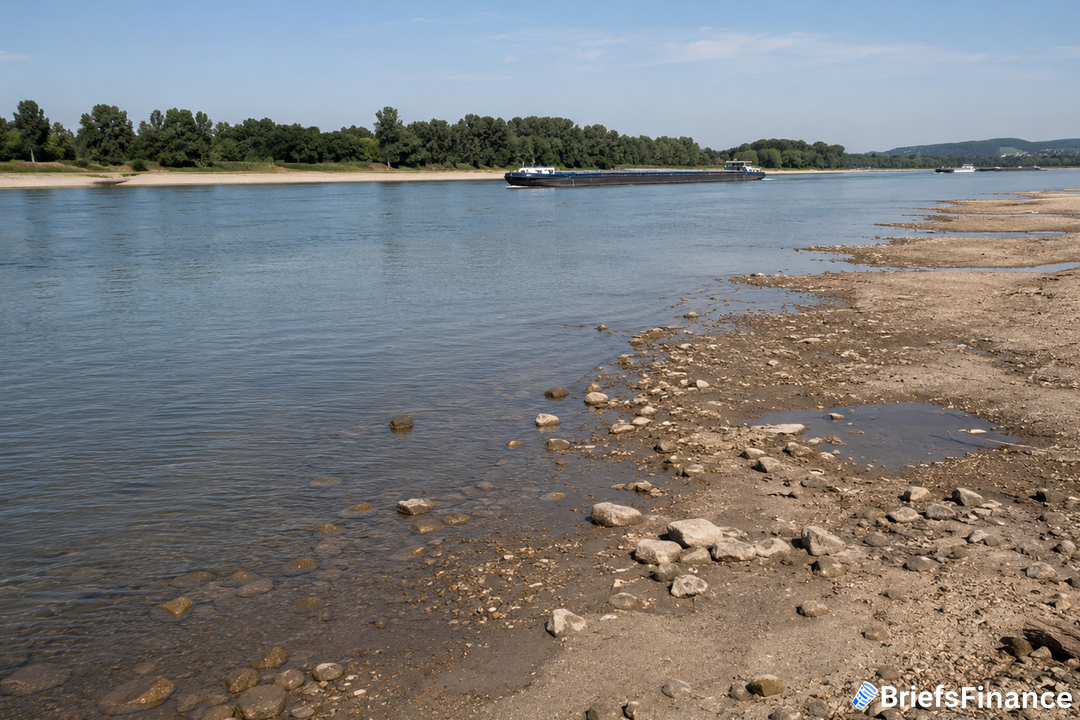
A Key Shipment Route Is Running Out of Water
The Rhine carries coal, fuel and industrial commodities across much of the continent, making it a crucial commercial artery.
Hot, dry weather is behind the problem. With Western Europe's fourth heat wave of the summer lingering into the start of this week, the river faces potential bottlenecks.
Originating in Switzerland's Alps, the Rhine runs about 1,290 kilometers and reaches the North Sea. Its barges haul petroleum products, chemical cargoes, coal, mineral ores, cereal grains and containerized freight.
Freight rates have surged as lower water forces barges to lighten their loads to pass over shallow stretches.
Those rising costs show how much Europe's industrial heartland depends on this one river. The Rhine connects Rotterdam's ports to factories and power plants in Germany and Switzerland, so when water levels fall, every load of diesel, coal, chemicals, iron ore or grain becomes more expensive to move.
Get the market news that matters in a five-minute read with Market Briefs, our free daily newsletter
Rail is an alternative for some cargoes. Last week, a spokesperson for DB Cargo said the rail firm is in regular contact with customers affected by the drought. Yet any switch to alternative transport will carry higher costs, and those extra costs may make European industry less competitive against Asian and North American rivals.
The Same Heat Is Hitting Other Rivers
Other major European waterways, such as the Danube, are also drying out under the same heat, which has disrupted power systems and caused huge wildfires.
Hungary's Paks nuclear power station is now short of cooling water because the river level has dropped.
Laszlo Nagy, the plant's deputy director, said historical readings indicate that the Danube's usual seasonal low comes in August or September. He added that once the river recovers, restarting the reactors takes roughly one more week. So Hungary could find itself without its largest single power source for several months.
Romania's navy blew up a rocky formation in the Danube to improve water flow toward the country's only nuclear power plant, an unusual step.
What It Means for Europe
Because Western Europe has already had several heat waves this summer, the region's rivers have had little time to recover between dry stretches, making these bottlenecks more persistent than a typical seasonal low. When the Rhine and Danube are both constrained, the pressure spreads from barge traffic to power plants that rely on river water for cooling.
Those pressures do not stop at the riverbank. The reading at Kaub is a closely watched gauge, because it is one of the shallow stretches that forces barges to lighten their loads. At 24 centimeters, passage has become especially difficult. When a major artery becomes unreliable, shippers have to delay deliveries or pay far more for alternate routes, layering extra costs onto an energy market already under strain.
The current stretch of hot, dry weather is thus testing both the transport networks and the power systems that keep goods moving and lights on.
Join Market Briefs, our free daily newsletter, for a quick daily rundown of the markets