What happened
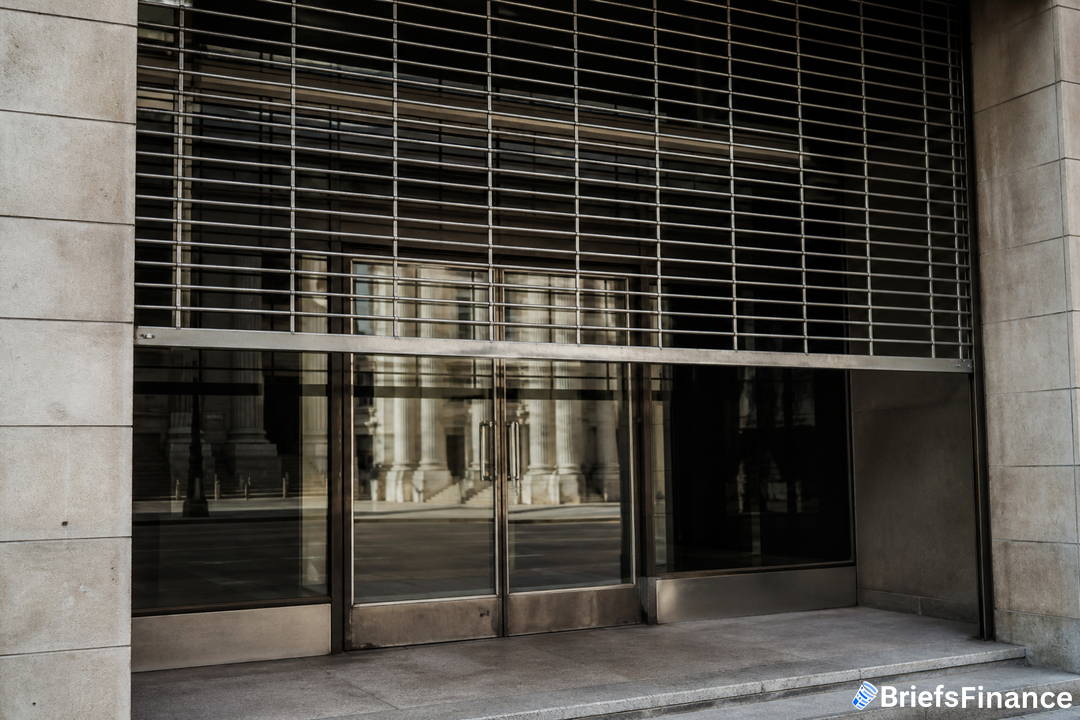
Ueno Bank SA was closed on Tuesday after it proved insolvent, freezing customer accounts and leaving millions in Paraguay unable to access cash. The lender's customer base topped 2.9 million across a country of roughly 6.1 million residents, holding deposits of 17 trillion guaraníes, or $2.8 billion, including about $355 million due to the IPS social security agency.
By Wednesday, lawmakers instructed the central bank to fast-track deposit insurance payouts to savers with funds trapped at Ueno. The monetary authority also pushed back on viral speculation, stating, "In response to reports circulating on social media about alleged interventions in the financial system, the Central Bank of Paraguay states that these claims are completely false," and reiterated that banks have adequate solvency and liquidity. S&P Global Ratings and Fitch cut Ueno's rating to default, and the central bank said Thursday it is arranging severance payments for Banco Ueno employees as operations wind down.
Financial ripple effects
Markets took the hit quickly. Sovereign dollar notes maturing in 2048 and 2055 each dropped by more than 1 cent per dollar, based on indicative Bloomberg pricing. The guaraní fell 4.5%, trading near 6,475 to the dollar.
Former Ueno customers rushed to open new accounts elsewhere, swamping branches and jamming mobile apps. Asoban, the banking association, said members are accommodating ex-Ueno depositors, while Banco Familiar SAECA, Banco Itau Paraguay SA, Banco Atlas SA and Banco Sudameris Paraguay SAECA reported intermittent mobile-app disruptions. Speaking to ABC TV, Alberto Acosta Garbarino - who serves as Asoban director and chairs Banco Familiar - said, "In these two days, Tuesday and Wednesday, we opened more than 50,000 new accounts," and added, "There is a lot of fear and any rumor making the rounds is like lighting a fire in a closed room."
Small businesses are front-lining the fallout. In Asuncion, construction supplier Horacio Barchello began advancing salaries to many of his 25 employees locked out of Ueno. With roughly $10,500 at the bank, he said he plans to shift more dealings to foreign banks.
"It's very unlikely that something like this would happen" at overseas banks, he said. Barchello started withdrawing funds in September when unusually rich deposit incentives raised red flags. "They built a client portfolio taking advantage of the ignorance of the Paraguayan people."
Political fallout and unrest
The bank failure detonated into politics. Horacio Cartes - former president and leader of the ruling Colorado Party - posted a letter on Thursday backing impeachment of President Santiago Peña. "We will not stand on the side of the plundering of public and private funds or retirees' savings," he wrote, later adding, "The Colorado flag represents a history of service to the nation: Honoring it also means acting valiantly when the homeland demands it." It is a sharp turn from a power broker who had strongly defended the bank, and a move that could deepen rifts inside a party that still holds a congressional majority.
Across Latin America, many view Peña as closely aligned with US President Donald Trump, and he now confronts impeachment petitions claiming his relationships with Ueno's owners allowed the bank to grow without adequate oversight. Until last year, he held an investment in Ueno's parent company. For months he waved off scrutiny despite naming Carlos Carvallo - formerly Ueno's top executive - to run the central bank; Carvallo resigned this week.
Market shocks remind investors that better tools can make decisions clearer. We're hosting our first ever investor livestream on 11/17 to show you how to use ChatGPT and Claude to invest like a pro, hosted by Briefs Finance CEO Jaspreet Singh. Save your seat.
Lawmakers set back-to-back sessions Thursday to debate launching impeachment of Peña and Vice President Pedro Alliana. Starting the process in the lower house needs a two-thirds vote, and removal in the Senate needs another two-thirds.
The tensions spilled into the streets overnight in Asuncion, where police in riot gear broke up protests with tear gas and water cannons as thousands of Ueno account holders went without access to savings. ABC TV interviewed a young woman in a wheelchair who said, "They fired directly at me. We weren't causing trouble or throwing firecrackers or insulting them. We were peacefully protesting."
The U.S. has taken notice. Secretary of State Marco Rubio has highlighted Paraguay as a model for allies in the region, and last month his deputy, Chris Landau, traveled to Asuncion and praised Peña. The State Department did not immediately comment.
What this means for your portfolio
In plain English: one bank's collapse is moving everything from bond prices to politics. Paraguay's 2048s and 2055s slipped, the guaraní weakened, and depositors rushed to reestablish accounts as rating agencies marked Ueno as default. Meanwhile, impeachment momentum picked up after Cartes' Thursday letter, with procedural votes requiring two-thirds majorities in both chambers.
If you have exposure to Paraguay - sovereigns, local lenders, or companies relying on smooth payments - the near term hinges on three fronts: deposit reimbursements advancing under the new law, currency stability after the 4.5% slide, and the impeachment path now on the legislative calendar. Protests add another variable to watch.
Adapting how you analyze risk and opportunity helps maintain a long term edge. On 11/17, our CEO Jaspreet Singh goes live for our first ever investor livestream on how to use ChatGPT and Claude to invest like a pro. Register to join him.