Free NewsletterPro Login
Free Live Investors Workshop
Seats limited
Tue, Sep 29.
The dollar is losing value.
Here’s how investors can still profit.
Hosted By
Jaspreet Singh
Founder, Briefs Finance
X

Warning: Undefined variable $stocks in /var/www/briefs.co/htdocs/wp-content/plugins/oxygen/component-framework/components/classes/code-block.class.php(133) : eval()'d code on line 448

Warning: foreach() argument must be of type array|object, null given in /var/www/briefs.co/htdocs/wp-content/plugins/oxygen/component-framework/components/classes/code-block.class.php(133) : eval()'d code on line 448

Warning: Undefined variable $funds in /var/www/briefs.co/htdocs/wp-content/plugins/oxygen/component-framework/components/classes/code-block.class.php(133) : eval()'d code on line 472

Warning: foreach() argument must be of type array|object, null given in /var/www/briefs.co/htdocs/wp-content/plugins/oxygen/component-framework/components/classes/code-block.class.php(133) : eval()'d code on line 472
/* the link was here */

German Parliament Approves Three-Month Fuel Tax Cut Worth €2.5 Billion

Published Sep 25, 2026
Share:
Summary:
  • Lawmakers signed off on a €2.5 billion ($2.8 billion) fuel-tax break that kicks in Oct. 1 and runs for three months.
  • The measure lowers per-liter costs for gasoline and diesel by up to 17 euro cents ($0.19) and is projected to reduce sales-tax intake by about €293 million.
  • The move lands after Chancellor Friedrich Merz's CDU took three hits in state elections while the AfD advanced.

What the policy does

Both chambers of parliament approved a three-month fuel-tax reduction, with implementation set for Oct. 1. The discount is capped at 17 euro cents per liter - an amount the government equates to $0.19 - and it covers both gasoline and diesel.

Berlin values the package at €2.5 billion and projects a roughly €293 million dip in sales-tax revenue. Officials expect that loss to be made up as households redirect savings at the pump to other purchases.

Politics and pressure behind the move

Chancellor Friedrich Merz and his coalition pitched the tax break as consumer relief in the face of rising prices, with Merz calling the rebate "no small matter at a time of tight budgets," while arguing it is necessary for consumers. His Christian Democrats lost three state contests this month and, in a first for the conservatives since 1949, failed to clear the 5% bar to enter a regional assembly.

Manuela Schwesig, the Social Democrat premier of Mecklenburg-Western Pomerania, said record fuel costs dominated voter worries. Her SPD finished second to the AfD in her state, though it will likely be able to reassemble a governing coalition. "In recent weeks, the only topic was people saying: Frau Schwesig, we can't cope anymore with €2.50 at the pump," she told Bundesrat delegates Friday. "And the people showed us that in the election," she added, while warning the rebate alone will not fully soothe consumers.

Short term policy changes remind investors to focus on steady growth and capital protection. Join Briefs Finance CEO Jaspreet Singh on September 29th for a FREE live investor workshop, How to Profit From A Dollar That's Losing its Value, where he shows how we're spotting investment opportunities as the dollar falls. Save your spot.

Financing and other measures

Finance Minister and SPD co-leader Lars Klingbeil said his ministry will draw from budget money left unused this year and pay for the rest via a "mix of financing measures." The CDU blocked a Social Democrat plan for a windfall tax on oil companies, and Klingbeil said he will keep pushing for that at the European Union level.

Separately, the coalition signed off on a short term ceiling for pump prices that is slated to be in place by Jan. 1. Details are still being worked out, including a possible model that links a maximum retail price to oil-market moves, similar to systems in Belgium and Luxembourg.

Prices and the near-term picture

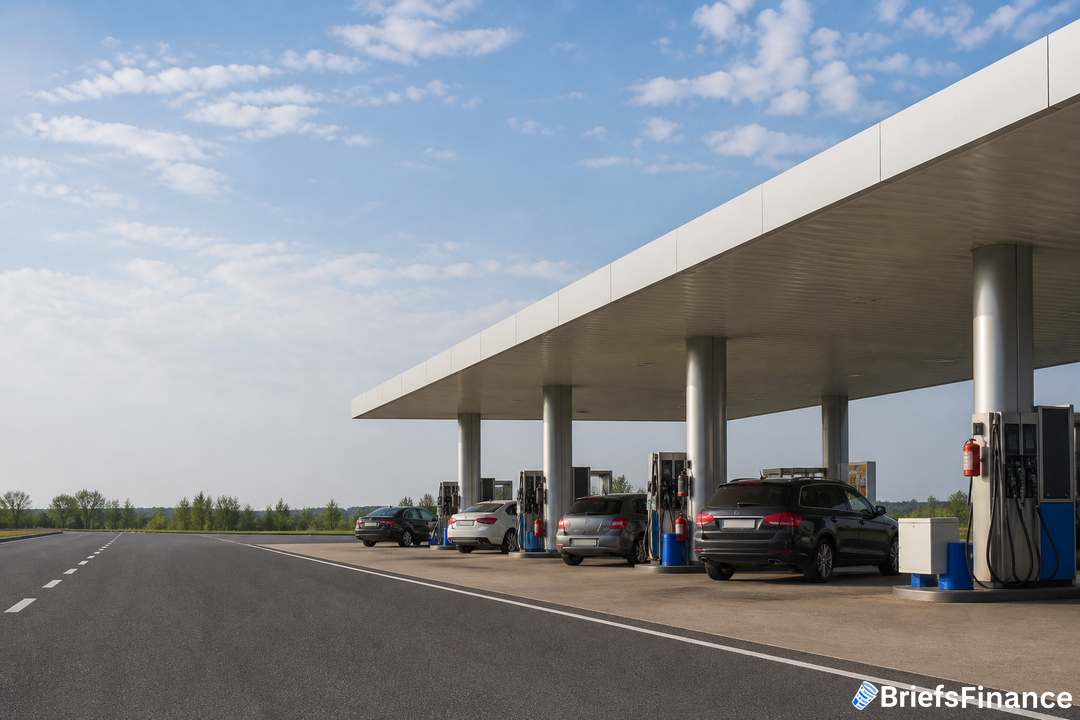
Prices at the pump edged lower in the past week. Automobile club ADAC reported Super E10 gasoline slipped 3.3 cents to €2.267 per liter, while diesel was little changed at €2.248. The new rebate follows criticism that a €1.6 billion fuel-tax cut was allowed to lapse in July, and it is intended to take some pressure off drivers now.

For your wallet, this is about whether relief at the pump frees up a bit of cash for everything else. If consumers do spend the savings elsewhere, that could soften the blow from higher prices without changing your day to day budgeting game.

Small shifts in public policy reinforce the value of a calm, diversified savings approach. Our CEO Jaspreet Singh is hosting a FREE live investor workshop, How to Profit From A Dollar That's Losing its Value, on September 29th. Sign up free to join him live.

Disclosure

Recent News

1 2 3 … 86

Get Market Briefs delivered to your inbox every morning for free!

No fluff. No noise. No politics. Just finance news you can read in 5 minutes.

Blogs

September 25, 2026
BRIEFS EXCLUSIVE: 43% Of Respondents Say Bills Outran Their Income Over Past Two Years
  • 43% of the 494 Market Briefs readers surveyed said their bills grew faster than their income over the past two years, even though 79% could cover a surprise $5,000 expense tomorrow.
  • Half of readers own gold or crypto, the two classic bets against a weaker dollar, and only 13% bought nothing at all in the last 12 months.
  • The median reader says it takes $150,000 a year to feel financially secure, about $62,000 above the U.S. median household income.
Read More
September 24, 2026
The 2026 Economic Reset Is Starting: Are We in a Recession, or Is the Pain Still Ahead?
  • The Federal Reserve has flipped from stimulating the economy to fighting inflation with higher interest rates, while the White House still wants growth at almost any cost.
  • The national debt tops $40 trillion, has outgrown the entire U.S. economy, and its interest payments are now the government's fastest-growing expense.
  • Higher rates bring pain for private equity, private credit, and speculative assets, but they open opportunities for investors holding cash, treasuries, and value assets.
Read More
September 23, 2026
Are We in a Recession? Without AI, America Might Already Be in One - and Washington Knows It
  • The White House attributes about three quarters of U.S. economic growth to AI, and many believe the economy would already be in a recession without it.
  • Washington has three reasons it cannot let the AI boom slow down: staying the world's superpower, outgrowing $40 trillion in national debt, and protecting a government stock portfolio worth billions.
  • Every market goes through booms and busts, and investors who understand the cycle get to buy the downturn instead of panic-selling with the crowd.
Read More
September 22, 2026
Will Interest Rates Go Down in 2026? Where the Money Moves Either Way
  • The Fed is leaning toward higher rates to fight 4% inflation, while the White House and a cracking job market push the other way.
  • If rates rise, money has tended to move toward short-term Treasuries, floating-rate loans, energy, banks and dividend payers.
  • If rates fall, it has tended to move toward gold, silver and Bitcoin, real estate, small caps, the S&P 500 and speculative bets.
Read More
September 21, 2026
How the Federal Reserve Makes Money - and Why It Just Posted Its Biggest Loss Ever
  • For 109 years the Federal Reserve created money, lent it to the U.S. government and handed the interest it collected back to Washington - almost $1 trillion in the decade starting in 2011.
  • Pandemic-era lending locked the Fed into earning about 2% on trillions of dollars while it now pays banks around 4%, producing a record loss of hundreds of billions in 2026.
  • The Fed covers its losses by creating money and the government covers its lost revenue by borrowing, and both feed the inflation that eats at the dollars in your account.
Read More
September 18, 2026
Kevin Warsh Just Defied Trump: What the Fed Rate Hike Means for Your Money
  • The Fed raised rates for the first time since 2023 in a unanimous vote led by Kevin Warsh, the chairman President Trump appointed to cut them.
  • Higher rates make the $40 trillion national debt, business loan resets and mortgages more expensive, but they strengthen the dollar and pay investors holding cash.
  • The war with Iran is pushing up oil, grocery and chip prices, another hike is likely in 2026, and recession talk is about to get louder.
Read More
September 17, 2026
Why America Bailed Out the Yen: The Japan Carry Trade, the Dollar and Your Mortgage Rate
  • In July 2026 the US sent money to steady the yen because Japan is the largest foreign owner of US debt, and Washington needs Japan to keep lending.
  • For decades the Japan carry trade let Wall Street borrow yen at essentially 0% and pour it into US stocks, real estate and Treasuries, and rising Japanese rates are shutting that off.
  • A weaker yen means fewer buyers for the dollar and for US debt, which pushes Treasury rates up and drags mortgage, car loan and credit card rates up with them.
Read More
September 16, 2026
Treasury Yields Are Spiking Because Lenders Are Backing Away From U.S. Debt
  • The U.S. is paying its highest 30-year borrowing rate in about two decades because its biggest lenders, the Fed, foreign governments, and banks, are all pulling back from Treasuries.
  • Every mortgage, car loan, credit card, and business loan is priced off the 10-year Treasury yield, so when Washington pays more to borrow, so do you.
  • With about $40 trillion of debt against a $32 trillion economy, the country either outgrows its debt or slides into a doom loop, and investors need a plan for both.
Read More
September 15, 2026
Fiat Currency Runs on Trust, and the World Just Stopped Trusting the Dollar
  • Gold has overtaken US treasuries as the world's top reserve asset, and central banks are now buying less US debt and more gold.
  • The US dollar is a fiat currency, meaning it's backed by a promise rather than gold, so it loses value when fewer countries want to hold it.
  • Whether the US economy or its national debt grows faster from here decides which assets stand to benefit next.
Read More
September 14, 2026
Why RAM Prices Are Soaring - and Where the Money Is Moving
  • Memory chips - the RAM inside phones, laptops, fridges, and trucks - are in a shortage Tim Cook called a 100-year flood, and some memory prices have climbed about 90% in a single quarter.
  • Four forces hit at once: AI demand, a production shutdown in 2023, build times that push any fix to 2028 at the earliest, and a bombed helium plant in Qatar.
  • The last two supply shocks ended in aggressive Fed rate hikes and market drops of around 45% and 20%, and this time Washington is spending heavily to bring memory production home.
Read More
1 2 3 … 27
Share via
Copy link












