Free NewsletterPro Login
Free Live Investors Workshop
Seats limited
Tue, Sep 29.
The dollar is losing value.
Here’s how investors can still profit.
Hosted By
Jaspreet Singh
Founder, Briefs Finance
X

Warning: Undefined variable $stocks in /var/www/briefs.co/htdocs/wp-content/plugins/oxygen/component-framework/components/classes/code-block.class.php(133) : eval()'d code on line 448

Warning: foreach() argument must be of type array|object, null given in /var/www/briefs.co/htdocs/wp-content/plugins/oxygen/component-framework/components/classes/code-block.class.php(133) : eval()'d code on line 448

Warning: Undefined variable $funds in /var/www/briefs.co/htdocs/wp-content/plugins/oxygen/component-framework/components/classes/code-block.class.php(133) : eval()'d code on line 472

Warning: foreach() argument must be of type array|object, null given in /var/www/briefs.co/htdocs/wp-content/plugins/oxygen/component-framework/components/classes/code-block.class.php(133) : eval()'d code on line 472
/* the link was here */

Low Rhine Levels Squeeze Europe's Supply Chain as Costs Spike and Output Slows

Published Sep 26, 2026
Share:
Summary:
  • Rhine gauges sank to a record this week, stretching a shipping crunch that began after Europe's parched summer.
  • Transport has gotten pricier as barges haul less per trip, pushing freight costs to about five times their early-summer level and nudging cargo onto costlier rail and road.
  • Firms that prepped after 2018 are coping better, but Germany counts only 13 low-draft barges, nine run by HGK, leaving many shippers vulnerable.

Record lows and a river under pressure

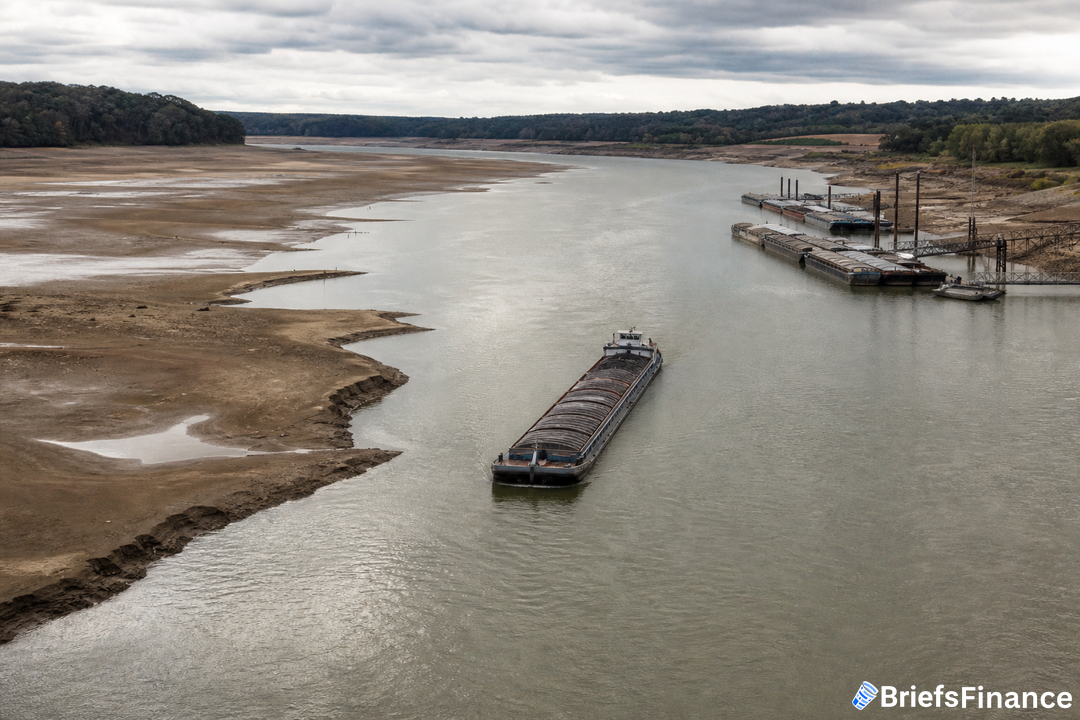
Water on the Rhine fell to a fresh low this week, extending months of disruption after Europe's drought-filled summer. In some spots, levels are the lowest seen in data going back to the 1880s, raising doubts that river access can be counted on.

At Kaub, a key pinch point, operators use a gauge reading to decide safe cargo loads. Forecasts show that clearance level could hover near the lows into the weekend. The dry spell has already stretched beyond two months and could last into October, said Rico Luman, who covers transport and logistics as a senior sector economist at ING Groep NV. The gauge is not a depth reading, but it guides how much ships can carry.

What low water means for moving stuff and what it costs

With barges forced to sail lighter, it takes more trips to move the same tonnage, which has driven freight rates to around five times what they were at the start of summer. Some consignments have been moved onto rail and road by Lanxess AG and Shell plc, although these alternatives also carry high costs.

After shipping nearly ground to a halt in 2018, some players spent on shallow-water vessels and backup rail and road links. That head start is paying off now while conventional barges struggle. Still, turning over the broader fleet is slow going. River ships often run for about half a century, and the market is splintered across many small, often family-run owners.

Industry fallout and who is coping

The Rhine is Europe's industrial superhighway, linking factories to world markets. Chemical, steel, and refining complexes line the river, operated by Covestro AG, BASF SE, Shell plc and Bayer. The prolonged low water has forced chemical makers to trim output or declare force majeure on certain products, revealing a split between firms that shored up resilience after earlier dry spells and rivals that never did.

Europe's chemical sector was already facing soft demand, stubbornly high energy bills, and tougher rivals in China and elsewhere. "The chemical industry is already fighting for survival, so I understand why many companies haven't made the necessary investments to protect themselves," said Ruirui Zong-Rühe, a partner at Roland Berger. "The disruption has exposed a divide between companies that invested in resilience after the severe low-water episode of 2018 and those that did not."

When resources become constrained, steady investing and risk planning protect your long term gains. Join Briefs Finance CEO Jaspreet Singh on September 29th for a FREE live investor workshop, How to Profit From A Dollar That's Losing its Value, where he shows how we're spotting investment opportunities as the dollar falls. Save your spot.

BASF and logistics provider HGK Group co-developed a new low-water barge that can haul notably more cargo in shallow conditions than standard vessels. BASF is also reinforcing alternate links at Ludwigshafen and said it does not expect any "acute, major economic damage" from this year's river levels.

The tech fixes, fleet bottlenecks, and what to watch next

In Duisburg, the Development Center for Ship Technology and Transport Systems is filled with scale models of potential Rhine workhorses. This year the team is zeroing in on how to deal with fresh constraints, including designing for shallower drafts with smaller propellers and side-mounted wheels. "Suddenly the Rhine becomes a source of uncertainty," said DST's Cyril Alias.

Capacity is a hurdle. Germany counts only 13 low-draft vessels, and HGK owns nine of them. The sector's ownership is scattered across many small operators, which complicates a rapid upgrade. "If we want to modernize the fleet, we must enable small and medium-sized enterprises and individual shipowners in particular to invest in the next generation of vessels," said HGK chief executive Steffen Bauer, calling for government support.

Companies have already rerouted where they can, Luman said, but fresh production cuts are still possible if levels stay extreme. For your wallet, here is the takeaway: when shipping gets tighter and pricier, manufacturers with robust backup logistics can protect margins better than peers, and that performance gap can widen the longer the river stays low.

Practical steps today help preserve capital and position your portfolio for future opportunities. Our CEO Jaspreet Singh is hosting a FREE live investor workshop, How to Profit From A Dollar That's Losing its Value, on September 29th. Sign up free to join him live.

Disclosure

Recent News

1 2 3 … 86

Get Market Briefs delivered to your inbox every morning for free!

No fluff. No noise. No politics. Just finance news you can read in 5 minutes.

Blogs

September 25, 2026
BRIEFS EXCLUSIVE: 43% Of Respondents Say Bills Outran Their Income Over Past Two Years
  • 43% of the 494 Market Briefs readers surveyed said their bills grew faster than their income over the past two years, even though 79% could cover a surprise $5,000 expense tomorrow.
  • Half of readers own gold or crypto, the two classic bets against a weaker dollar, and only 13% bought nothing at all in the last 12 months.
  • The median reader says it takes $150,000 a year to feel financially secure, about $62,000 above the U.S. median household income.
Read More
September 25, 2026
The Economy Is Booming. So Why Did Stocks and Bonds Fall Together?
  • S&P Global says the US economy is growing at its fastest rate since 2021, with corporate profits up 28.9% in a year, almost four times the historical average.
  • Stocks and bonds fell at the same time, which is not how the two markets normally behave, because Treasury yields above 5% now compete with stocks for investors' money.
  • Jaspreet Singh lays out three ways to invest through a shift like this: always be buying, buy the crash, or follow the money before it hits the headlines.
Read More
September 24, 2026
The 2026 Economic Reset Is Starting: Are We in a Recession, or Is the Pain Still Ahead?
  • The Federal Reserve has flipped from stimulating the economy to fighting inflation with higher interest rates, while the White House still wants growth at almost any cost.
  • The national debt tops $40 trillion, has outgrown the entire U.S. economy, and its interest payments are now the government's fastest-growing expense.
  • Higher rates bring pain for private equity, private credit, and speculative assets, but they open opportunities for investors holding cash, treasuries, and value assets.
Read More
September 23, 2026
Are We in a Recession? Without AI, America Might Already Be in One - and Washington Knows It
  • The White House attributes about three quarters of U.S. economic growth to AI, and many believe the economy would already be in a recession without it.
  • Washington has three reasons it cannot let the AI boom slow down: staying the world's superpower, outgrowing $40 trillion in national debt, and protecting a government stock portfolio worth billions.
  • Every market goes through booms and busts, and investors who understand the cycle get to buy the downturn instead of panic-selling with the crowd.
Read More
September 22, 2026
Will Interest Rates Go Down in 2026? Where the Money Moves Either Way
  • The Fed is leaning toward higher rates to fight 4% inflation, while the White House and a cracking job market push the other way.
  • If rates rise, money has tended to move toward short-term Treasuries, floating-rate loans, energy, banks and dividend payers.
  • If rates fall, it has tended to move toward gold, silver and Bitcoin, real estate, small caps, the S&P 500 and speculative bets.
Read More
September 21, 2026
How the Federal Reserve Makes Money - and Why It Just Posted Its Biggest Loss Ever
  • For 109 years the Federal Reserve created money, lent it to the U.S. government and handed the interest it collected back to Washington - almost $1 trillion in the decade starting in 2011.
  • Pandemic-era lending locked the Fed into earning about 2% on trillions of dollars while it now pays banks around 4%, producing a record loss of hundreds of billions in 2026.
  • The Fed covers its losses by creating money and the government covers its lost revenue by borrowing, and both feed the inflation that eats at the dollars in your account.
Read More
September 18, 2026
Kevin Warsh Just Defied Trump: What the Fed Rate Hike Means for Your Money
  • The Fed raised rates for the first time since 2023 in a unanimous vote led by Kevin Warsh, the chairman President Trump appointed to cut them.
  • Higher rates make the $40 trillion national debt, business loan resets and mortgages more expensive, but they strengthen the dollar and pay investors holding cash.
  • The war with Iran is pushing up oil, grocery and chip prices, another hike is likely in 2026, and recession talk is about to get louder.
Read More
September 17, 2026
Why America Bailed Out the Yen: The Japan Carry Trade, the Dollar and Your Mortgage Rate
  • In July 2026 the US sent money to steady the yen because Japan is the largest foreign owner of US debt, and Washington needs Japan to keep lending.
  • For decades the Japan carry trade let Wall Street borrow yen at essentially 0% and pour it into US stocks, real estate and Treasuries, and rising Japanese rates are shutting that off.
  • A weaker yen means fewer buyers for the dollar and for US debt, which pushes Treasury rates up and drags mortgage, car loan and credit card rates up with them.
Read More
September 16, 2026
Treasury Yields Are Spiking Because Lenders Are Backing Away From U.S. Debt
  • The U.S. is paying its highest 30-year borrowing rate in about two decades because its biggest lenders, the Fed, foreign governments, and banks, are all pulling back from Treasuries.
  • Every mortgage, car loan, credit card, and business loan is priced off the 10-year Treasury yield, so when Washington pays more to borrow, so do you.
  • With about $40 trillion of debt against a $32 trillion economy, the country either outgrows its debt or slides into a doom loop, and investors need a plan for both.
Read More
September 15, 2026
Fiat Currency Runs on Trust, and the World Just Stopped Trusting the Dollar
  • Gold has overtaken US treasuries as the world's top reserve asset, and central banks are now buying less US debt and more gold.
  • The US dollar is a fiat currency, meaning it's backed by a promise rather than gold, so it loses value when fewer countries want to hold it.
  • Whether the US economy or its national debt grows faster from here decides which assets stand to benefit next.
Read More
1 2 3 … 27
Share via
Copy link












