A Heat Dome Pushes Temperatures Toward 40°C
Europe is now enduring its fifth big heat wave of the year, and this one is parked over the rivers, power grids, and farms that investors watch most.
Météo-France expects a high-pressure dome to drive temperatures in northern France to almost 40°C (104°F) on Tuesday.
Southern England could see mid-30s this week.
Frankfurt is forecast to reach 38°C on Friday, based on data from the European Centre for Medium-Range Weather Forecasts.
Red heat warnings are in effect for Italy and Croatia, while amber alerts stretch across southeastern France, Switzerland's north, Poland's west, and large parts of southeastern Europe.
Most of England is under an amber heat health alert.
The European Commission's Joint Research Centre sees a high risk of fire across the UK, Spain, France, Germany, and Italy this week.
Roughly 200 Greek firefighters are battling a wildfire near Agios Stylianos in Attica, where evacuations have been ordered.
A Key Shipping Chokepoint Is Running Out of Water
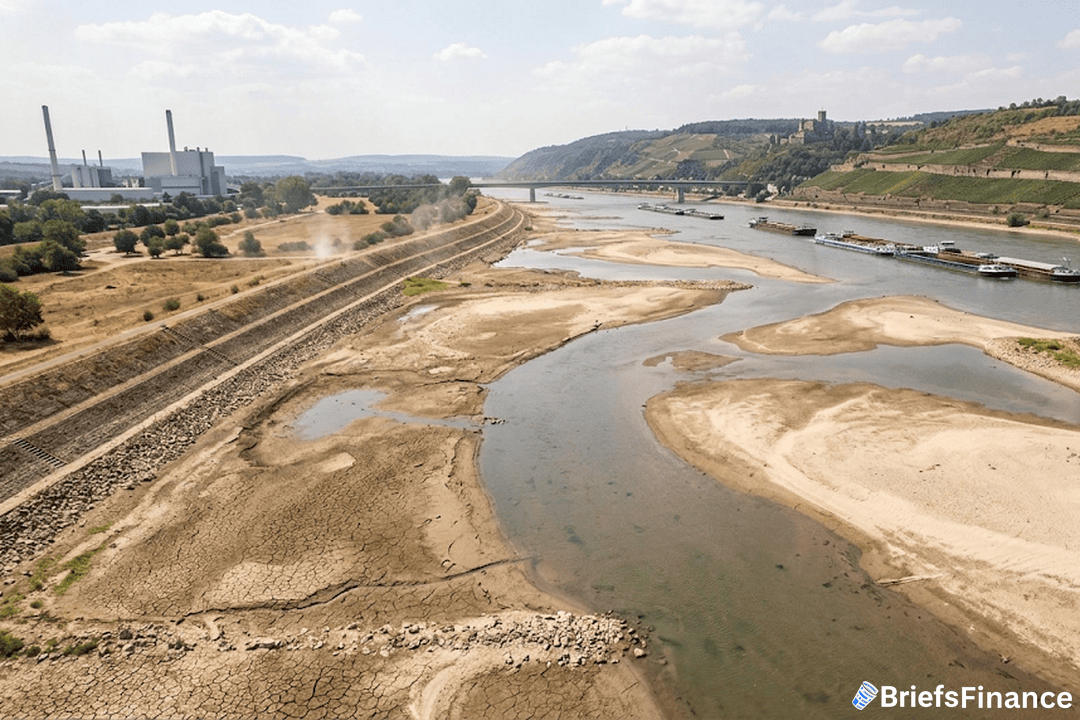
The heat dome is doing more than pushing up thermometers. It is also blocking the moisture-carrying clouds that usually refill Europe's big rivers, and the Rhine, Po, and Danube are at record-low water levels.
Get the free Always Be Buying eBook and learn the simple system for building wealth on any income
That has already disrupted shipping and power generation, and the Rhine shows the problem most clearly.
The Rhine is one of Europe's busiest freight routes, and power stations along its banks use its water for cooling. When the river drops, both of those things suffer at once.
When the river is that shallow, barges either travel lighter or do not sail at all.
Loaded barges sit lower in the water, so a few centimeters can be the difference between a profitable run and a canceled one.
Fuel, grain, and other goods move along these rivers. Every canceled trip adds cost somewhere down the line.
The forecast does not offer much relief.
Some thunderstorms are possible this week, mainly in the Alps and areas south of them, but MetDesk's Daniel Gardner-Declaudure says the rain is "unlikely to make a large difference on downstream flows."
Power Prices Jump When Solar Fades
The price of electricity bought and sold during the day itself (known as intraday power) shows the strain in France and Germany.
Many plants rely on river water for cooling, so shallow rivers can force them to dial back output right when demand is highest.
Europe is the world's fastest-warming continent, and climate change is loading extra heat onto it.
Each stretch like this stresses power grids, water supplies, and farms, which is how a weather story becomes a portfolio story.
Farming is feeling the same pressure, and that is the kind of strain that eventually shows up in food prices.
What It Means for Investors
So what does that mean for your money?
A swing that wide does not stay inside the power market. It shows up in what manufacturers pay, what grocers charge, and what it costs to keep homes cool.
From there, those costs reach the companies in your portfolio.
Download the free Always Be Buying eBook and start putting your money to work today