Free NewsletterPro Login

Warning: Undefined variable $stocks in /var/www/briefs.co/htdocs/wp-content/plugins/oxygen/component-framework/components/classes/code-block.class.php(133) : eval()'d code on line 448

Warning: foreach() argument must be of type array|object, null given in /var/www/briefs.co/htdocs/wp-content/plugins/oxygen/component-framework/components/classes/code-block.class.php(133) : eval()'d code on line 448

Warning: Undefined variable $funds in /var/www/briefs.co/htdocs/wp-content/plugins/oxygen/component-framework/components/classes/code-block.class.php(133) : eval()'d code on line 472

Warning: foreach() argument must be of type array|object, null given in /var/www/briefs.co/htdocs/wp-content/plugins/oxygen/component-framework/components/classes/code-block.class.php(133) : eval()'d code on line 472
/* the link was here */
×
Free investor livestream — Nov 17

How To Use ChatGPT & Claude To Research Stocks Like A Pro

01
The prompt we use to break down any stock
02
How to fact-check what AI tells you
03
How to compare two stocks in minutes

Ex-Insurance Boss Bronek Masojada Becomes Lord Mayor, plans to push pensions into private assets

Published Nov 13, 2026
Share:
Summary:
  • Bronek Masojada, a tough-minded former Hiscox chief, is stepping into the largely ceremonial one-year role of Lord Mayor of the City of London and plans to push to boost UK competitiveness while pitching Britain as the "land of opportunity."
  • A key initiative is to redirect part of the UK's pension pot - roughly £3.2 trillion - into private assets and startups, a phased push that will require buy-in from corporate chiefs and trustees.
  • He backs stability on fiscal policy, supports letting the City keep more of the business taxes it raises, and is weighing in on national plans to reduce police forces that could threaten the City of London Police's independence.

From insurer to Lord Mayor

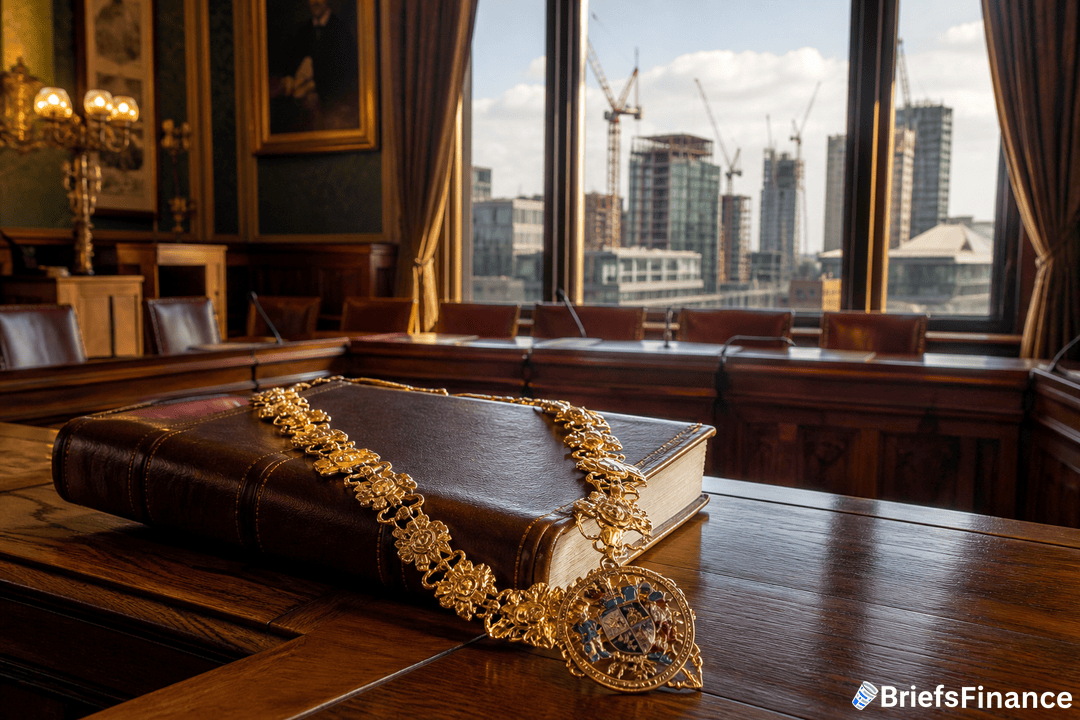
Bronek Masojada brings three decades in insurance to the Mansion House, including 21 years leading Hiscox Ltd. He plans to use that experience to lobby for the City as the UK searches for ways to lift growth, a central target for Prime Minister Andy Burnham's agenda. The Lord Mayor's job dates back to the 12th century and, while ceremonial, it promotes UK financial services globally and anchors civic leadership locally, making him a de facto ambassador for London's banking, insurance and broader finance industry.

His track record is steep. Masojada joined Hiscox in 1993, became chief executive in 2000, and left the role at the end of 2021. In that time, staff expanded from 200 to 3,500 and the share price climbed from about 33 pence to around £8.60, or $11.37.

"That's the value of staying and scaling," he said. Now 64, he relocated from South Africa to the UK in 1985 as a Rhodes Scholar at the University of Oxford, and subsequently worked at McKinsey.

Pensions, private assets and competitiveness

Masojada wants more pension money deployed into private markets, and he intends to broadcast that the UK is the "land of opportunity." Previous Lord Mayors tried to move the needle, but progress has been slow, and some insurers and asset managers have hesitated to make bigger changes even after prior pledges organized by former Lord Mayor Nick Lyons. That means Masojada must win backing from executives who oversee company pension plans as well as the managers supervising funds, and he is ready to press the case. In an interview, Masojada said, "I don't want to hear from them that there is not enough British capital and British opportunities, when they don't know where their own capital, that they have influence over, is going."

He aims as well to dispute the notion that pension fund trustees are unable to direct capital toward British opportunities and private-market holdings, on the basis that their fiduciary obligations require allocating money wherever they judge returns to be strongest. With private assets booming globally, his question is pointed: "Tell me how you are living up to your fiduciary duty by not investing in these assets."

Shifts in how capital is deployed can open fresh opportunities for patient investors. We're hosting our first ever investor livestream on 11/17 to show you how to use ChatGPT and Claude to invest like a pro, hosted by Briefs Finance CEO Jaspreet Singh. Save your seat.

City finance, policing and the pitch for stability

The City remains a heavyweight. The City's clout is evident: financial and professional services generate 12% of UK tax receipts, and roughly 700,000 commuters now enter the Square Mile daily - exceeding levels seen before the pandemic and Brexit. Funding is a live issue, though.

Under the government's so-called fair funding reforms, resources would be shifted from wealthier districts to poorer ones, potentially cutting the City's allocation. Masojada argued that allowing the City to retain a larger share of business taxes would bolster its position.

Policing is another pressure point. Proposals by the government to shrink police forces nationwide have prompted doubts about the City of London Police remaining independent. Critics argue that losing that independence could weaken a specialist capability in prosecuting fraud. "The City believes there is value in keeping" the police force independent, Masojada said. "We want the Square Mile to be the safest place to be."

Community, hiring and fixing what is in front of you

For five years, Masojada has led the East End Community Foundation, a charity working to tackle inequality in many of London's most deprived neighborhoods. As Lord Mayor, he plans to champion young people and disadvantaged communities by widening access to work experience and training. He also wants hiring processes to improve, noting that applicants too often experience a "black hole," an observation shaped in part by watching his five children apply for jobs.

He is directing tough messaging internally too. The charity that oversees the City's bridges is on his list. He crosses London Bridge every day and points out that the temporary barriers are still up, despite it being nine years since the 2017 terrorist attacks. "The City Bridge Foundation should fix that in my view and I have told them," he said. "Where we have the muscle to do something, I believe we should."

The bottom line: Masojada is trying to channel pension capital into private assets, keep the City's finances resilient, maintain a specialist police force, and widen the talent pipeline. For your portfolio, watch whether trustees and executives shift allocations toward private and UK assets, whether past pledges turn into actual deals, and how policy stability and City governance shape capital flow.

Considering different asset pathways can help investors refine their long term edge. On 11/17, our CEO Jaspreet Singh goes live for our first ever investor livestream on how to use ChatGPT and Claude to invest like a pro. Register to join him.

Disclosure

Recent News

1 2 3 … 126

Get Market Briefs delivered to your inbox every morning for free!

No fluff. No noise. No politics. Just finance news you can read in 5 minutes.

Blogs

November 3, 2026
How to Budget Every Payday: 5 Moves So You Never Worry About Money
  • A median earner could make about $4.7 million over a career, yet most retire with closer to $13,000 in the bank because of a keeping problem, not an income problem.
  • Audit your money, save $2,000, pay off credit card debt, then automate a 75/15/10 split across three bank accounts.
  • Earn more only after your system is in place, then protect what you build with an accountant, attorneys, the right insurance, and an estate plan.
Read More
November 3, 2026
How to Invest in Stocks: 5 Things to Do Before You Invest Your First Dollar
  • Paying off credit card debt at around 22% interest beats the stock market's roughly 10% average, and even Warren Buffett's 19%.
  • Save $2,000 in a separate emergency fund, learn to research with AI, and decide whether you're a growth, income, or wealth preservation investor.
  • Write down a plan for buying during market crashes, which have happened 25 times in the last 100 years.
Read More
November 3, 2026
Best ETFs to Buy: 5 Three-ETF Portfolios for Every Investing Goal
  • An ETF is a basket of stocks, so one purchase spreads your money across many companies instead of riding on just one.
  • Jaspreet Singh laid out five portfolios of three ETFs each, built for kids, cash flow, growth, slow and steady growth, and protection from a weaker dollar.
  • Based on 10-year average returns, $500 a month could grow to between about $660,000 and $3.1 million over 30 years, though past returns never guarantee future ones.
Read More
November 3, 2026
Best Investments of a Generation: 5 Market Shifts Backed by Your Tax Dollars
  • Private companies are about to spend $1 trillion a year on AI, and the Trump administration is putting tax dollars behind the same industries.
  • The five shifts are AI and its supply chain, robotics, rare earths, energy, and defense.
  • Each comes with real risk, from an AI bubble to wars ending or a new Congress, so these are ideas to research, not sure things.
Read More
November 3, 2026
How to Get Ahead Financially: 10 Moves to Make While Everyone Else Falls Behind
  • Learning a high-income AI skill, or building AI tools for tradespeople, can raise your earning power in a tough job market.
  • Higher interest rates, the 2025 tax cuts, Trump accounts, and stacked cash back can put more money back in your pocket.
  • Following where government money is moving, keeping cash ready for market crashes, and investing in your own education can speed up your wealth.
Read More
November 3, 2026
National Debt at $40 Trillion: Why Inflation Is the Hidden Tax, and Who Profits From It
  • Time magazine asked President Trump how he'd tackle the $40 trillion national debt, and he suggested inflation could help pay it off, a cost that lands on everyday Americans.
  • From 1971 to 2025, cars, houses, and college outpaced both inflation and incomes, while the S&P 500 grew more than 33,000% with dividends reinvested.
  • The U.S. can default, inflate, or outgrow its debt, and history shows each path rewards different assets.
Read More
November 3, 2026
FOMC Meeting: Why the Fed Is Getting Nervous, and Why AI Stocks Feel It
  • At its latest meeting, the Fed held rates steady but warned it may raise them again, because inflation is running near 3.5% against a 2% target.
  • Oil prices, tariffs, AI's hunger for energy, and government spending are all pushing prices higher, and gold, silver, and bitcoin fell on the Fed's news.
  • Chinese AI stocks are down about 40% in a few months and Google fell more than 10% in a day, raising fears that higher rates could pop an AI bubble.
Read More
November 3, 2026
Midterm Elections: Where the Money Could Move if Republicans or Democrats Win
  • The U.S. government spent about $7.5 trillion last year, and the midterm elections could change which industries get more of that money.
  • A Republican win could favor manufacturing, fossil fuels, banks, and defense.
  • A Democratic win could favor healthcare, weight-loss drugs, clean energy, and infrastructure.
Read More
November 3, 2026
Brazil Stock Market Crash: Why Lula's Win Matters to U.S. Investors
  • Brazil's stock market fell more than 20% in a few days, and its currency dropped 8%, after Lula won a presidential election investors expected him to lose.
  • The shock reaches U.S. investors through coffee and beef prices, the BRICS push away from the dollar, and a market that had become an investor favorite.
  • The last time Lula first won, in 2002, Brazil's stock market fell more than 20% and then grew 12x by 2008, though nobody knows if that will repeat.
Read More
November 2, 2026
Credit Utilization: How Paying Down Cards Can Help Your Score
  • Credit utilization is your card balances divided by your credit limits, checked overall and card by card.
  • Lower is generally better, and Experian says the effect becomes more noticeable around 30%.
  • Paying down balances and keeping new charges off your cards are the main ways to lower it.
Read More
1 2 3 … 32
Share via
Copy link










