Free NewsletterPro Login
S&P 500 6,287 +0.42%
DOW 44,521 -0.18%
NASDAQ 21,103 +0.71%
S&P 500 +12.4%
Briefs Finance Fund +24.8%
JOIN THE FUND →

Drone Attacks Slash Russian Fuel Production to Lowest Since 2005

Published Jul 13, 2026
[tts_player]
Share:
Summary:
  • Russian crude oil processing averaged 3.91 million barrels per day in July 2026, the lowest since March 2005.
  • Ukrainian forces launched about 50 attacks on Russian fuel facilities in the past 100 days, hitting at least 24 of 34 large refineries.
  • Searches for "how to make gasoline" on Russian search engine Yandex exceeded 17,000 last month, a record since the start of the 2022 war.

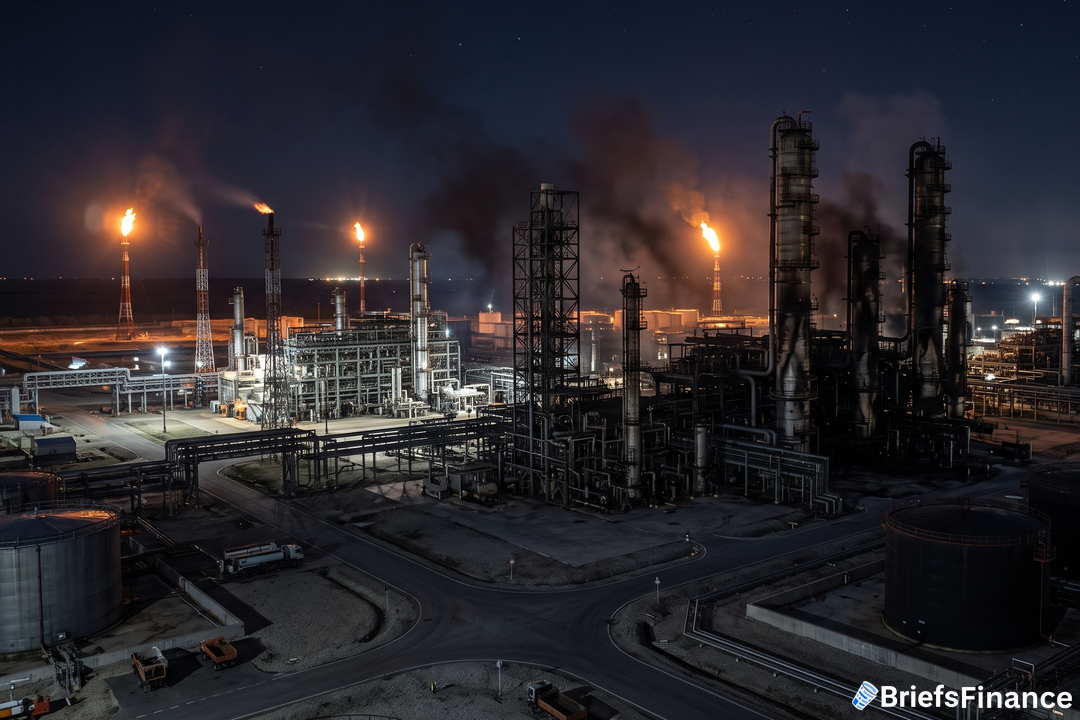
Russia's oil refineries are supposed to turn crude into gasoline, diesel, and jet fuel. But a wave of drone strikes has broken that system.

Ukraine is hitting processing plants deep inside Russia. The result: fuel lines at home and a global diesel shortage abroad.

The Collapse in Processing

Russian refineries are running at their slowest pace in more than 21 years. That is a drop of more than 1.4 million barrels per day compared with the same period last year.

The International Energy Agency called the attacks "a blistering wave of Ukrainian assaults" in a report on Friday. The agency estimates that Russian processing fell to 3.8 million barrels per day in June, down 1.6 million barrels from a year earlier.

According to the IEA, more than half of Russia's refinery infrastructure is either damaged or offline.

Get the market news that matters in a five-minute read with Market Briefs, our free daily newsletter

Drones Reaching Deep Into Russia

Ukraine's unmanned aircraft now possess a striking range exceeding 1,500 miles from the border, enabling them to hit the Omsk refinery far inside Russia.

The attacks are designed to pressure the Kremlin into negotiations. Russia's Deputy Prime Minister Alexander Novak said, "There are problems and shortages, which is why we see queues or sometimes gas stations don't work stably."

The Russian Energy Ministry did not respond to a request for comment.

The result on the ground is a domestic fuel crunch. Gas station queues have grown, pump costs have climbed, and several regions now enforce a short-term rationing scheme that depends on license plates. Some local authorities advised businesses to bring back work-from-home policies to cut fuel usage. The desperation shows up in search data:

Global Diesel Market Feels the Pain

Russia is a key supplier of diesel to world markets. With its refineries hobbled, global diesel supplies have tightened. Prices are at multiyear highs.

To keep what fuel it has at home, Russia banned most diesel exports through the end of July. Earlier restrictions on gasoline and jet fuel remain in place. Those bans squeeze the global market further and hurt Russia's own export revenue.

The data firm EA Analytics, a division of Energy Aspects Ltd., provided the crude-processing rate numbers. Bloomberg News first reported the story with the headline "Russian Refinery Runs Plunge to Lowest in More Than Two Decades."

Worth Noting

The domestic fuel crisis has forced emergency measures across several Russian regions. Motorists face long lines at gas stations, and some areas have adopted license-plate-based rationing. Local authorities have even recommended remote work to cut fuel consumption. The Kremlin's ban on diesel exports, extended through July, further strains international markets and reduces Russia's export earnings.

Join Market Briefs, our free daily newsletter, for a quick daily rundown of the markets
Disclosure

Recent News

1 2 3 34

Get Market Briefs delivered to your inbox every morning for free!

No fluff. No noise. No politics. Just finance news you can read in 5 minutes.

Blogs

June 29, 2026
Portfolio Diversification: Why Putting All Your Eggs in One Basket Destroys Wealth
  • Real diversification means spreading investments across all 11 economic sectors plus bonds, alternatives, and cash so no single bet can sink the portfolio.
  • Different sectors perform at different times, so a diversified portfolio captures upswings while smoothing the brutal drawdowns that wipe out concentrated bets.
  • Total market index funds offer the simplest path to diversification, and annual rebalancing is what keeps the structure working over time.
Read More
June 29, 2026
Non Taxable Income: What It Is and Why It Matters
  • Non taxable income is money you receive that you don't owe income tax on.
  • The tax code treats workers, investors, and business owners very differently, and investors often come out ahead.
  • Learning how income is taxed is a quiet superpower for keeping more of what you earn.
Read More
June 29, 2026
Semiconductor Stocks: A Simple Guide for Investors
  • Semiconductor stocks are companies that design and make computer chips, the brains inside nearly every modern device.
  • The AI boom has turned chips into one of the market's most important and most watched groups.
  • They offer big growth potential, but come with high valuations and a notoriously cyclical history.
Read More
June 25, 2026
How Stocks Work: A Simple Guide for Beginners
  • A stock is a slice of ownership in a company - buy one, and you own a piece of the business.
  • You make money two ways: the share price rising over time, and dividends paid to shareholders.
  • The simplest path for most beginners is buying into the whole market through a low-cost index fund.
Read More
June 25, 2026
Stop Loss vs Stop Limit: What's the Difference?
  • A stop loss order sells your stock once it hits a trigger price, prioritizing getting you out.
  • A stop limit order only sells within a price range you set, prioritizing price over a guaranteed exit.
  • The trade-off: a stop loss almost always executes; a stop limit might not if the price moves too fast.
Read More
June 25, 2026
Energy Stocks: A Simple Guide for Investors
  • Energy stocks are companies that produce and supply the power the world runs on, from oil and gas to newer sources.
  • They make up one of the 11 sectors of the market and tend to move with energy prices and big-picture shifts.
  • Like any sector, the key is diversification and understanding the forces driving demand.
Read More
June 18, 2026
What Is a Stop Loss Order? A Simple Guide
  • A stop loss order automatically sells a stock once it falls to a price you set.
  • It's a tool to cap losses or lock in gains without watching the market all day.
  • It works best for active strategies, and can backfire if used carelessly on long-term holdings.
Read More
June 18, 2026
Best S&P 500 Index Fund: How to Choose One
  • The best S&P 500 index fund for most investors is simply the cheapest, most established one that tracks the index well.
  • Funds like VOO, IVV, and SPY all hold the same 500 companies, so the biggest difference is the fee.
  • Pick one, automate your buys, and let time do the heavy lifting.
Read More
June 17, 2026
What Are Penny Stocks? Risks and Rewards Explained
  • Penny stocks are very low-priced shares of very small companies, often trading for just a few dollars or less.
  • They promise huge gains but carry huge risks: low liquidity, high failure rates, and wild price swings.
  • Most investors are better served by quality companies and funds than by chasing cheap shares.
Read More
June 17, 2026
Best Stocks for Beginners With Little Money
  • The best stocks for beginners with little money usually aren't individual stocks at all - they're low-cost index funds.
  • You can start with $100 or less and use small, regular investments to build wealth over time.
  • Focus on diversification and consistency, not on picking the next big winner.
Read More
1 2 3 24
Share via
Copy link











