Free NewsletterPro Login

Warning: Undefined variable $stocks in /var/www/briefs.co/htdocs/wp-content/plugins/oxygen/component-framework/components/classes/code-block.class.php(133) : eval()'d code on line 448

Warning: foreach() argument must be of type array|object, null given in /var/www/briefs.co/htdocs/wp-content/plugins/oxygen/component-framework/components/classes/code-block.class.php(133) : eval()'d code on line 448

Warning: Undefined variable $funds in /var/www/briefs.co/htdocs/wp-content/plugins/oxygen/component-framework/components/classes/code-block.class.php(133) : eval()'d code on line 472

Warning: foreach() argument must be of type array|object, null given in /var/www/briefs.co/htdocs/wp-content/plugins/oxygen/component-framework/components/classes/code-block.class.php(133) : eval()'d code on line 472
/* the link was here */

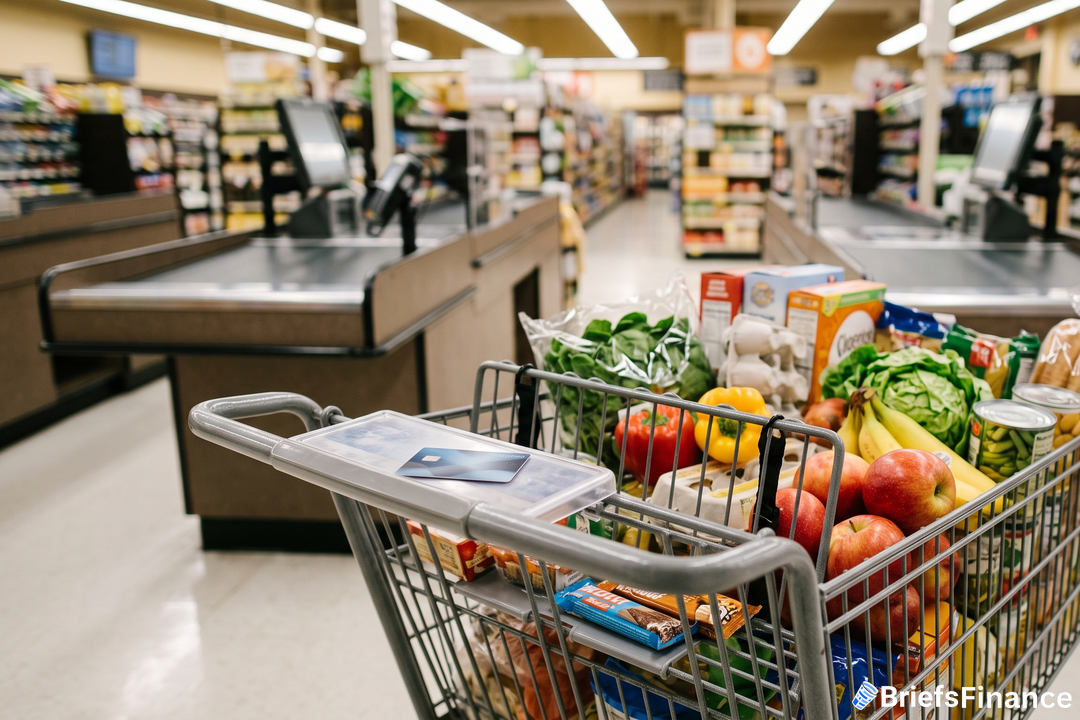
Higher Grocery Costs Prompt Over 25% of Adults to Swipe Credit Cards at the Store

Published Jul 13, 2026
[tts_player]
Share:
Summary:
  • More than one in four working-age adults who used credit cards for groceries carried debt specifically for those purchases.
  • The rate of missed minimum payments for grocery credit cards increased to 8.7% in 2025, up from 7.1% in 2023.
  • Among households earning two to four times the federal poverty line, the missed payment rate jumped from 9.3% to 12.3%.

The Growing Burden of Grocery Debt

A quarter of working-age adults now find themselves turning to credit cards just to afford groceries, reflecting the stress of surging food prices/).

Food prices have risen 32% over five years. According to the Urban Institute report released Monday, "Groceries are one of the largest household budget items for families. Over the past five years, food costs have increased substantially."

The study found that 63.2% of working-age adults ages 18-64 used a credit card to buy groceries last year. "This means that families today face persistently higher prices when they go to the grocery store, and food affordability remains a key concern for many," the report stated.

The persistent rise in food costs stems from ongoing supply chain disruptions, global trade tensions, and geopolitical shocks, according to economists. Dana M. Peterson of The Conference Board noted that these factors will keep prices elevated for years, with inflation not reaching the Federal Reserve's 2% target until at least 2028. Meanwhile, the Personal Consumption Expenditures index shows a 3.8% year-over-year increase as of April, and monthly data rose 0.4% that month.

Get the market news that matters in a five-minute read with Market Briefs, our free daily newsletter

When families cannot pay their grocery credit card bills, it points to deeper financial stress. The Urban Institute report states: "Between 2023 and 2025, the share of working-age adults who paid for groceries with a credit card and did not make the minimum payment increased, signaling worsening financial distress among families."

The data backs that up.

Meanwhile, 8.9% of adults used "buy now, pay later" installment plans to buy food. Among this group, 34.8% missed or made late payments on their installment plans.

The report cautions that leaning on credit can backfire. "Although access to credit and savings can provide a lifeline for families struggling to meet basic needs, relying too much on these strategies may lead to financial instability if they have a hard time keeping up with debt or do not recover financially after drawing down savings."

What This Means for Households

The growing share of missed payments among middle-income households - those earning two to four times the federal poverty line - signals that even families with moderate incomes are finding it harder to cover basic food costs without falling behind on debt.

The report also noted that 8.9% of adults used "buy now, pay later" plans for food, with over a third missing payments - a sign that alternative credit is also straining household budgets. These trends reflect a broader erosion of financial stability as food prices remain 32% higher than five years ago, driven by ongoing supply chain issues and global trade tensions that economists say will keep inflation elevated for years.

The Urban Institute's findings underscore that while credit cards offer temporary relief, persistent high prices risk trapping more Americans in cycles of debt.

Join Market Briefs, our free daily newsletter, for a quick daily rundown of the markets
Disclosure

Recent News

1 2 3 68

Get Market Briefs delivered to your inbox every morning for free!

No fluff. No noise. No politics. Just finance news you can read in 5 minutes.

Blogs

September 4, 2026
An Interest Rate Hike in 2026? The Fed Just Broke Its Own Script
  • The Federal Reserve spent a year signaling cheaper money, and its new chairman just warned that an interest rate hike may be coming instead.
  • The Fed is stuck between high inflation and a weak job market, and fixing one makes the other worse.
  • Higher rates also reprice roughly a third of America's $40 trillion national debt this year, which is why Washington wants cuts so badly.
Read More
September 3, 2026
5 Passive Income Ideas That Pay You Whether You Work or Not
  • School teaches one formula: work, earn, spend. Stop working and the money stops, so the wheel never ends.
  • Five assets pay you without your labor - dividends, rent, interest, royalties, and the things you already own.
  • $80,000 a year of cash flow takes about $1 million invested at 8%, or roughly 20 years of $1,000 a month.
Read More
September 2, 2026
The Best Way to Invest 10k: Three Options To Transform 10K into 10 Million
  • Passive investing in stocks or real estate targets around 10% a year, and time in the market matters more than the price you get in at.
  • Active investing means putting your time in alongside your money, which raises the target to roughly 20% a year and raises the risk of losing it all.
  • Investing in yourself has no ceiling, because a new skill can create a new income that no market return can match.
Read More
September 1, 2026
The Tax Write Offs the Rich Are Using in 2026 While the IRS Shrinks
  • The 2026 tax brackets landed lower than they were headed, and the standard deduction jumped from a planned $8,350 to $16,100 for single filers.
  • New write offs for overtime, tips, seniors and car loan interest are live now, and most of them are written to expire in 2028.
  • About a third of IRS auditors have been fired, and four assets do most of the work for people who want income without a matching tax bill.
Read More
August 31, 2026
America Is Running Out of Debt Buyers. Treasury Bills Are the Government's Fix
  • The government took in about $5 trillion in taxes in 2025 and spent about $7 trillion, and the national debt is now over $40 trillion.
  • Investors, banks, and foreign countries are all lending less to the U.S., so starting September 9 the government plans to sell more short-term treasury bills and use that cash to buy back its long-term debt.
  • Government interest rates set the floor for your mortgage, your car loan, and your credit card, and short-term Treasury ETFs like SGOV are one way investors are playing it.
Read More
August 23, 2026
How to Get the Most From Your Guideline 401k
  • Guideline is a company that provides low-cost 401k plans, popular with small businesses and their employees.
  • A "Guideline 401k" follows the same core rules as any 401k: tax-advantaged growth, contribution limits, and often an employer match.
  • The biggest results come from capturing the full match, choosing low-cost funds, and picking Roth or traditional to fit your situation.
Read More
August 23, 2026
Principal 401k: What to Know About Your Plan
  • Principal is one of many companies that manage workplace 401k plans, so a "Principal 401k" is simply a 401k where Principal is the provider.
  • The rules of a 401k are the same no matter who runs it: pre-tax or Roth contributions, tax-advantaged growth, and often an employer match.
  • The biggest wins come from grabbing the full match, picking low-cost funds, and knowing whether Roth or traditional fits you.
Read More
August 23, 2026
What a Tariff Dividend Means for Your Money
  • A "tariff dividend" is the idea of taking money the government collects from tariffs and paying some of it back to citizens.
  • To judge the idea, you first need to know what a tariff is: a tax on imported goods, usually paid by the companies bringing them in.
  • Tariffs ripple through prices, businesses, and your investments, so the smart move is understanding those ripples, not just the headline.
Read More
August 23, 2026
No Tax on Overtime: How Overtime Pay Is Taxed
  • "No tax on overtime" refers to a tax break that lets certain workers deduct some overtime pay, lowering the income they get taxed on.
  • A deduction does not mean overtime is truly tax-free. It means part of that pay is subtracted before your tax is figured.
  • The bigger money lesson: how you earn money changes how it is taxed, and investors often get the friendliest treatment of all.
Read More
August 23, 2026
Reading the Silver Price Forecast for 2026
  • Nobody can honestly promise a specific silver price for 2026. Any exact number is a guess, so treat forecasts as opinions, not facts.
  • Silver is unusual because it is both a precious metal and an industrial metal, so its price answers to two very different forces.
  • Instead of chasing a forecast, learn the drivers - inflation, interest rates, recession fear, and industrial demand - so you can judge any prediction yourself.
Read More
1 2 3 26
Share via
Copy link











