Free NewsletterPro Login

Warning: Undefined variable $stocks in /var/www/briefs.co/htdocs/wp-content/plugins/oxygen/component-framework/components/classes/code-block.class.php(133) : eval()'d code on line 448

Warning: foreach() argument must be of type array|object, null given in /var/www/briefs.co/htdocs/wp-content/plugins/oxygen/component-framework/components/classes/code-block.class.php(133) : eval()'d code on line 448

Warning: Undefined variable $funds in /var/www/briefs.co/htdocs/wp-content/plugins/oxygen/component-framework/components/classes/code-block.class.php(133) : eval()'d code on line 472

Warning: foreach() argument must be of type array|object, null given in /var/www/briefs.co/htdocs/wp-content/plugins/oxygen/component-framework/components/classes/code-block.class.php(133) : eval()'d code on line 472
/* the link was here */
BREAKING
×

U.S. Launches Third Wave of Strikes on Iran After Tanker Hit

Published Jul 13, 2026
[tts_player]
Share:
Summary:
  • The United States carried out its third round of airstrikes against Iran on July 11, 2026, after Iran attacked a commercial container ship.
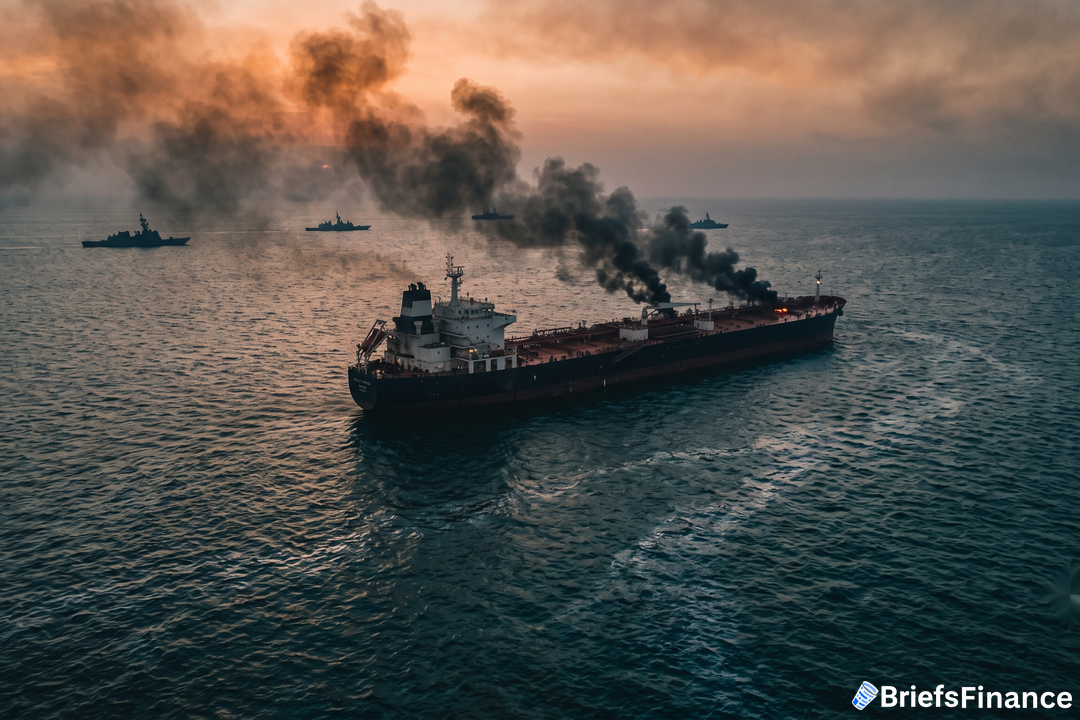
  • The Cypriot-flagged vessel M/V GFS Galaxy was hit in the Strait of Hormuz, leaving one civilian crew member missing.
  • Iran's Revolutionary Guard announced the Strait of Hormuz is closed to all ship traffic until further notice.

A June agreement to reopen the Strait of Hormuz was supposed to calm tensions. Instead, the U.S. is now bombing Iran for the third time in a single week.

The Latest Attack

Defense Secretary Pete Hegseth issued a public statement, declaring: "Iran made a poor choice. Now they pay."

Centcom added: "In response, the United States is imposing a heavy cost by continuing to degrade Iran's ability to attack civilian mariners and commercial ships freely transiting the strait."

The Failed Agreement

The current crisis stems from a memorandum of understanding signed on June 17, 2026, between the U.S. and Iran. Under that deal, Iran agreed not to charge a toll for ships using the strait for 60 days. However, the accord lacked a clear definition of how vessel traffic should be managed.

Get the market news that matters in a five-minute read with Market Briefs, our free daily newsletter

This ambiguity created a dangerous vacuum. Without a clear framework, both sides interpreted the terms differently, and Iran soon resumed aggressive actions in the strait. Former U.S. State Department special envoy David Goldwyn said: "The underlying problem here is that the memorandum of understanding did not reach an understanding with respect to the management of ship traffic through the strait. It essentially punted that issue."

Energy Secretary Chris Wright, speaking on June 24, 2026, said: "Iran will not have the ability to close the Strait of Hormuz going forward. That's their key leverage and we're taking that leverage away from them."

Approximately one-fifth of the world's daily petroleum supply moves through the Strait of Hormuz, making it a vital maritime chokepoint for global oil shipments. Previous U.S. administrations worked to keep the waterway open, but tensions escalated after Iran began imposing tolls on transiting vessels earlier this year. The June memorandum was an attempt to de-escalate, but the lack of a detailed traffic management plan undermined the effort.

The dispute over tolls and transit rights had been simmering for months, with Iran arguing that it had a sovereign right to charge for passage through its territorial waters, while the U.S. and its allies maintained that the strait is an international waterway that must remain free and open. This fundamental disagreement over legal principles set the stage for the breakdown of the June accord and the subsequent military escalation.

Diplomatic Moves and What's Next

Diplomats are scrambling. Iran's Foreign Minister Abbas Araghchi met in Oman with his counterpart, Sayyid Badr bin Hamad Al Busaidi. France and the United Kingdom are examining proposals for voluntary navigational fees in the strait, subject to approval from the UN's International Maritime Organization.

For now, the strait remains closed, and the U.S. continues its airstrikes.

Join Market Briefs, our free daily newsletter, for a quick daily rundown of the markets
Disclosure

Recent News

1 2 3 63

Get Market Briefs delivered to your inbox every morning for free!

No fluff. No noise. No politics. Just finance news you can read in 5 minutes.

Blogs

August 23, 2026
How to Get the Most From Your Guideline 401k
  • Guideline is a company that provides low-cost 401k plans, popular with small businesses and their employees.
  • A "Guideline 401k" follows the same core rules as any 401k: tax-advantaged growth, contribution limits, and often an employer match.
  • The biggest results come from capturing the full match, choosing low-cost funds, and picking Roth or traditional to fit your situation.
Read More
August 23, 2026
Principal 401k: What to Know About Your Plan
  • Principal is one of many companies that manage workplace 401k plans, so a "Principal 401k" is simply a 401k where Principal is the provider.
  • The rules of a 401k are the same no matter who runs it: pre-tax or Roth contributions, tax-advantaged growth, and often an employer match.
  • The biggest wins come from grabbing the full match, picking low-cost funds, and knowing whether Roth or traditional fits you.
Read More
August 23, 2026
What a Tariff Dividend Means for Your Money
  • A "tariff dividend" is the idea of taking money the government collects from tariffs and paying some of it back to citizens.
  • To judge the idea, you first need to know what a tariff is: a tax on imported goods, usually paid by the companies bringing them in.
  • Tariffs ripple through prices, businesses, and your investments, so the smart move is understanding those ripples, not just the headline.
Read More
August 23, 2026
No Tax on Overtime: How Overtime Pay Is Taxed
  • "No tax on overtime" refers to a tax break that lets certain workers deduct some overtime pay, lowering the income they get taxed on.
  • A deduction does not mean overtime is truly tax-free. It means part of that pay is subtracted before your tax is figured.
  • The bigger money lesson: how you earn money changes how it is taxed, and investors often get the friendliest treatment of all.
Read More
August 23, 2026
Reading the Silver Price Forecast for 2026
  • Nobody can honestly promise a specific silver price for 2026. Any exact number is a guess, so treat forecasts as opinions, not facts.
  • Silver is unusual because it is both a precious metal and an industrial metal, so its price answers to two very different forces.
  • Instead of chasing a forecast, learn the drivers - inflation, interest rates, recession fear, and industrial demand - so you can judge any prediction yourself.
Read More
August 23, 2026
What to Do When Reddit Stocks Go Viral
  • "Reddit stocks" usually means stocks getting hyped in online communities, where crowds can send a price soaring or crashing fast.
  • These tips can be entertaining and sometimes useful, but they are opinions, not research, and often come loaded with hype.
  • The safe move is to treat every online tip as a starting point, then do your own homework before risking a dollar.
Read More
August 23, 2026
Why Is Bitcoin Dropping Right Now?
  • Bitcoin drops for a mix of reasons: interest rates, big-picture money policy, regulation news, and simple shifts in how much risk investors want to take.
  • Bitcoin has a fixed supply and no earnings, so its price runs almost entirely on supply, demand, and sentiment.
  • Sharp drops are normal for bitcoin. Understanding the drivers matters more than reacting to any single day.
Read More
August 23, 2026
The Fidelity 500 Index Fund, Made Simple for Beginners
  • The Fidelity 500 Index Fund is a low-cost fund that tracks the S&P 500, an index of 500 large U.S. companies.
  • Buying it means owning a tiny slice of 500 businesses at once, which spreads your risk in a single purchase.
  • Index funds like this win over time mostly by keeping fees low and letting compounding do the work.
Read More
August 23, 2026
USA Penny Stocks: Risks and Rewards Explained
  • USA penny stocks are very low-priced shares of very small companies, often trading under $5 and sometimes under $1.
  • They dangle the dream of huge, fast gains, but carry brutal risks: low liquidity, wild swings, and high failure rates.
  • Most investors build wealth faster with quality companies and funds than by chasing cheap shares.
Read More
August 23, 2026
Finding Cheap Stocks to Buy Now Without Getting Burned
  • A low share price does not mean a stock is cheap. Real value compares the price to what the business is actually worth.
  • The best cheap stocks to buy now are quality companies trading below their true value, not the tiniest, riskiest shares on the market.
  • For most beginners, a low-cost index fund is the simplest "cheap" way to own great companies at once.
Read More
1 2 3 25
Share via
Copy link











