Free NewsletterPro Login

Warning: Undefined variable $stocks in /var/www/briefs.co/htdocs/wp-content/plugins/oxygen/component-framework/components/classes/code-block.class.php(133) : eval()'d code on line 448

Warning: foreach() argument must be of type array|object, null given in /var/www/briefs.co/htdocs/wp-content/plugins/oxygen/component-framework/components/classes/code-block.class.php(133) : eval()'d code on line 448

Warning: Undefined variable $funds in /var/www/briefs.co/htdocs/wp-content/plugins/oxygen/component-framework/components/classes/code-block.class.php(133) : eval()'d code on line 472

Warning: foreach() argument must be of type array|object, null given in /var/www/briefs.co/htdocs/wp-content/plugins/oxygen/component-framework/components/classes/code-block.class.php(133) : eval()'d code on line 472
/* the link was here */

Fast-Food Lawsuit and Grocery AI Raise Questions About Personalized Prices

Published Oct 11, 2026
Share:
Summary:
  • A federal antitrust suit claims McDonald's uses an AI "pricing engine" to set menu prices and overcharged U.S. customers for Big Macs and fries, a claim the company disputes.
  • Retailers are rolling out tools like digital shelf labels, facial recognition checkout, and AI list builders, from Kroger's FlashFood to Sainsbury's new SmartLists.
  • Economists warn smarter tech could make prices move more often and become more individualized, complicating inflation readings and reshaping how shoppers compare deals.

Why this is showing up on your receipt

This week a federal antitrust complaint landed on McDonald's doorstep, alleging the chain relies on an AI driven "pricing engine" to establish menus across its U.S. outlets and that customers paid more for Big Macs and fries. McDonald's pushed back, saying it is not deploying AI to figure out what any particular customer is willing to pay, and that it provides its franchisees with "tools, resources, research and recommendations to help them make informed decisions."

The AI now in your aisle

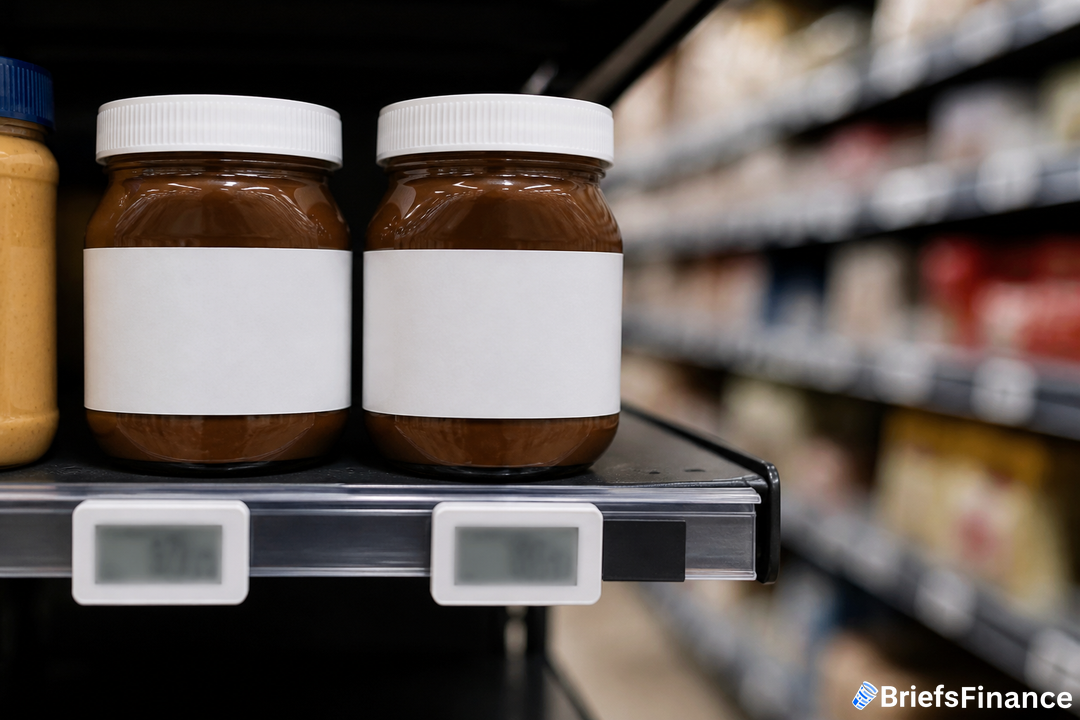
Grocers are wiring up their stores with data tools. Earlier this year, Kroger said it uses an AI tool called FlashFood to mark down perishable goods nearing expiration and to advertise those deals in its app. Electronic shelf labels are spreading at chains like Kroger, Amazon Fresh, Walmart, and Whole Foods, making it easier to update prices in stores.

The trend is global. U.K. supermarkets including Tesco, Morrisons, and Asda are adopting electronic shelf labels, and Revolut recently piloted pay-by-face checkout in certain coffee shops so customers could pay with a glance. On Wednesday, Sainsbury's rolled out SmartLists, an AI feature that builds shopping lists and helps customers find products from uploaded photos or typed meal ideas. CNBC contacted Amazon Fresh, Whole Foods, Tesco, Morrisons, Asda and Revolut about their AI use and did not receive immediate responses.

Walmart and Kroger have publicly said in recent years they steer clear of dynamic or surge pricing and do not set person-specific prices, describing their tools as focused on streamlining operations.

Pricing algorithms are drawing legal scrutiny across whole industries. Market Briefs covers that risk free every morning.

What experts say happens next

As retailers normalize AI, experts see a greater risk of dynamic pricing, where prices change quickly and frequently in response to conditions. "Dynamic pricing means changing prices in response to changing market conditions, such as demand, timing, capacity or competitors' prices," said Miroslava Marinova, a senior lecturer at the University of East London in commercial law. "It is not new. Airlines, hotels, and ride-hailing services have used it for years."

In April, Bank of England economists Clare Lombardelli and Rupal Patel observed that advances in technology are making prices adjust more frequently and become more tailored to individuals, which could lead to more firms charging "as close to the maximum price a consumer is willing to pay for a good or service," which they defined as "perfect price discrimination."

That shift also complicates inflation tracking. They noted that it becomes harder to "measure and interpret" month to month inflation when the CPI relies on a representative basket. "That works well when prices mostly move slowly and uniformly. But when prices shift continually - and differently for each shopper - the idea of a 'representative' price becomes strained," they said.

Data, rules and what it means for your wallet

AI and digital tools expand what companies can learn about you, from purchase histories and browsing behavior to location and shopping patterns. Marinova said this helps blur lines between pricing approaches. "This is also why the traditional distinction between dynamic and personalised pricing is becoming less clear in practice," she explained. "Dynamic pricing responds primarily to market conditions, whereas personalised pricing uses information about the consumer to estimate willingness to pay." As firms mix market level data with granular customer information, "the boundary between dynamic and personalised pricing becomes thinner," she added.

Some U.S. regulators are trying to get ahead of this. New York now obliges most businesses that leverage customers' personal data for pricing to make that use plainly disclosed. Maryland has restricted food sellers and delivery apps from using personalised, data driven pricing to levy higher prices on certain food, and New Jersey and Connecticut have put in place rules aimed at "surveillance pricing."

For shoppers, the impact is mixed. Marinova noted that dynamic and personalised pricing can make some goods cheaper for some people. The risk is transparency. "That makes it much harder to compare prices and to know whether another consumer is being offered a different price for the same product," she said. If consumers cannot tell why they got a price, cannot compare it to others, and cannot easily switch, "the normal disciplining effect of consumer choice becomes weaker."

The BOE economists warned that personalized pricing "splinters the consumer experience," so households may see increasingly different inflation rates. "And when prices differ for the same thing, inflation becomes even more personalised - and aggregate measures may no longer reflect households' experience," they said.

Bottom line for your budget: more prices could update in the background, and the sticker you see might not be the sticker your neighbor sees. Keep an eye on how stores present prices and disclosures, because the way prices are set may matter as much as the number on the tag.

How courts treat algorithmic pricing will reach your grocery bill. Get the free Market Briefs daily newsletter and follow the cases.

Disclosure

Recent News

1 2 3 … 98

Get Market Briefs delivered to your inbox every morning for free!

No fluff. No noise. No politics. Just finance news you can read in 5 minutes.

Blogs

October 5, 2026
What Is the Briefs Connector? A Simple Guide
  • The Briefs Connector lets your favorite AI read Briefs research, like Pro reports and the Briefs Score.
  • Without it, an AI asked about investing can give answers that sound right but aren't backed by that research.
  • It explains the research, but it won't tell you what to buy or sell.
Read More
October 5, 2026
Is a Recession Coming? What the Last Five Rate Hiking Cycles Say
  • The Fed has started raising rates again, and in the last five hiking cycles going back to 1994, a recession never started while the hikes were underway.
  • The pain showed up where there was a bubble to pop - housing in 2008, dot-coms in 2000, the pandemic money-printing boom in 2022 - and usually after the hikes ended.
  • Private equity and private credit are feeling this cycle first, and how far the pain spreads depends on how high rates go and how long they stay there.
Read More
October 2, 2026
Fed Interest Rates May Rise Again in 2026 - and the Newest Culprit Is AI
  • Fed Governor Barr told a meeting our head of investing research attended that higher rates are likely in 2026, lower inflation may not come soon, and AI is now pushing prices up.
  • The same week, President Trump asked the biggest AI companies to police themselves under an accord that's morally but not legally binding, because the White House sees AI as a race with China.
  • Higher rates put downward pressure on asset prices and squeeze borrowers, but the way through hasn't changed: own investments, buy on a schedule, and treat downturns as discounts.
Read More
October 1, 2026
Housing Market 2026: Why Office Buildings Are Cracking Before Houses Do
  • Office buildings are selling for 80% to 95% off because their five-year loans are resetting at much higher rates while half-empty floors have gutted the income those buildings are valued on.
  • Housing is under pressure, not cracking: a $400,000 mortgage costs $975 more a month than at 3%, but six of every seven mortgages are still under 6% and those owners are staying put.
  • Whether pressure turns into cracks is a race between unaffordability and the economy, and either way Jaspreet's rule is to treat your house as a liability and buy only what you can afford.
Read More
September 30, 2026
Dividend Investing vs. Growth Investing: Why the Slower Portfolio Can End Up Bigger
  • "What stock should I buy?" is the wrong first question. Growth, income, or wealth preservation comes first, and the goal changes which stocks even make sense.
  • At $500 a month for 30 years, 13% growth builds about $1.75 million. 10% growth plus a reinvested 4% dividend builds a little more than $2.2 million and pays a little more than $80,000 a year.
  • Income investors have US dividend ETFs, REITs, and international dividend funds to study. Growth investors have the Nasdaq 100, AI and chip funds, and small caps. None of it is a recommendation.
Read More
September 29, 2026
Why Is Gold Going Down? A 5.2% Treasury Yield Just Took Its Job
  • President Trump rejected Iran's deal to reopen the Strait of Hormuz, oil prices jumped back up, and gold fell instead of rising.
  • Treasury yields hit their highest level in more than 20 years, so investors sold gold and bought Treasuries that pay interest.
  • Higher Treasury yields make the national debt, mortgages, car loans, and credit cards more expensive, with the Fed's next rate decision due October 28.
Read More
September 28, 2026
The Strategic Bitcoin Reserve: Why the Government Wants Bitcoin to Explode
  • The US government holds about 328,000 Bitcoin, worth roughly $25 billion, and since a 2025 executive order it keeps seized coins instead of selling them.
  • Washington wants a bigger pile of assets so its $40 trillion national debt looks smaller next to them, which lets it keep borrowing and spending.
  • Bitcoin's wild price swings, and a government holding a coin built to escape governments, are the two risks investors need to watch.
Read More
September 25, 2026
BRIEFS EXCLUSIVE: 43% Of Respondents Say Bills Outran Their Income Over Past Two Years
  • 43% of the 494 Market Briefs readers surveyed said their bills grew faster than their income over the past two years, even though 79% could cover a surprise $5,000 expense tomorrow.
  • Half of readers own gold or crypto, the two classic bets against a weaker dollar, and only 13% bought nothing at all in the last 12 months.
  • The median reader says it takes $150,000 a year to feel financially secure, about $62,000 above the U.S. median household income.
Read More
September 25, 2026
The Economy Is Booming. So Why Did Stocks and Bonds Fall Together?
  • S&P Global says the US economy is growing at its fastest rate since 2021, with corporate profits up 28.9% in a year, almost four times the historical average.
  • Stocks and bonds fell at the same time, which is not how the two markets normally behave, because Treasury yields above 5% now compete with stocks for investors' money.
  • Jaspreet Singh lays out three ways to invest through a shift like this: always be buying, buy the crash, or follow the money before it hits the headlines.
Read More
September 24, 2026
The 2026 Economic Reset Is Starting: Are We in a Recession, or Is the Pain Still Ahead?
  • The Federal Reserve has flipped from stimulating the economy to fighting inflation with higher interest rates, while the White House still wants growth at almost any cost.
  • The national debt tops $40 trillion, has outgrown the entire U.S. economy, and its interest payments are now the government's fastest-growing expense.
  • Higher rates bring pain for private equity, private credit, and speculative assets, but they open opportunities for investors holding cash, treasuries, and value assets.
Read More
1 2 3 … 28
Share via
Copy link










