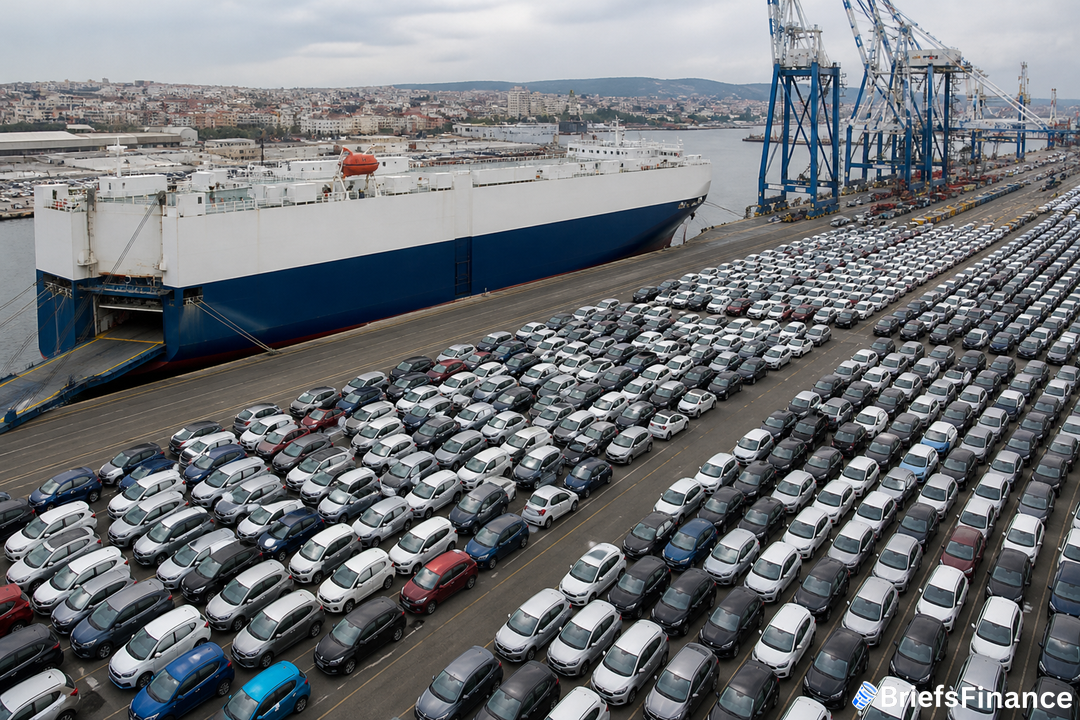
Brussels plans a four-year safeguard that starts with a 350,000-vehicle ceiling for the first year, then grows 6% a year beginning in year two.
China will temporarily drop some auto-parts tariffs and cut duties in half on shoes, ice-cream and olive oil, covering roughly €4 billion of exports.
The package spans WTO commitments, exemptions for select countries, talks on easing export controls and licensing, and fresh data showing Chinese-made cars surged in Europe and took roughly one in four hybrid sales in August.
What is being capped, and when it kicks in
The EU is moving to curb hybrid car inflows with a safeguard that could begin as early as Dec. 1. The plan limits hybrid imports tied to China to 350,000 vehicles in the first year, and from year two the cap would rise 6% each year thereafter. The measure would be in place for four years, with both sides pledging to follow World Trade Organization rules during that period.
To comply with WTO non-discrimination, the restriction is structured to cover all hybrid imports, not only those built in China. Under the approach, China's allowance cannot be smaller than the quota granted to any other import source. The sweep includes countries that have free-trade deals with the EU.
Carve-outs would cover European Economic Area countries, plus Ukraine, Kenya, and developing WTO members that account for only a small slice of imports. It is not specified whether volumes beyond the quotas would face extra duties or whether the limit functions as a hard stop. A European Commission spokesperson did not immediately provide comment.
The broader give-and-take with Beijing
Alongside the cap, China plans to remove certain tariffs on automotive parts and temporarily cut in half duties on items like shoes, ice-cream and olive oil. All told, those steps would cover about €4 billion in exports. Brussels and Beijing will also look at simplifying export controls and licenses, with a focus on supplies of rare earths and permanent magnets, and they intend to share more detail on their respective export limits.
EU trade chief Maros Sefcovic sat down with Commerce Minister Wang Wentao in Beijing over the past week, with the bloc aiming to whittle down a daily trade shortfall exceeding €1 billion ($1.1 billion). "The trade deficit is a mountain of a challenge for the EU, felt in every member state. It is unsustainable and it demands a credible path to rebalancing," Sefcovic told reporters in Beijing Friday.
"We must defend our industries and restore a level playing field that has been distorted by global overcapacity." EU ambassadors who received a Sunday briefing from Sefcovic were largely positive on the outcome, but emphasized it is only an initial step toward rebalancing, according to people familiar with the discussions. Early in the new year, Sefcovic plans another meeting with his Chinese counterparts to review the agreements and set out the next steps.
Imports of vehicles from China into the EU climbed by nearly three quarters through August this year. In the same month, Chinese-built cars represented roughly one in four hybrid purchases in Europe. Chinese hybrid sales have been buoyed in part because they were not caught by the EU's tariffs on electric vehicles that took effect in 2024. Dataforce also notes that BYD set a new high for European market share in August.
Its breakdown covers the EU, EFTA and the UK, and counts both plug-in and non-plug-in hybrids. Chinese brand coverage includes Polestar, DR, Evo, Chery-Ebro and Stellantis-Leapmotor tie-ups.
Chinese manufacturers, including Chery Automobile Co., have accelerated deliveries to Europe as their domestic market cooled, piling pressure on European incumbents. Mercedes-Benz Group AG reported an 8% drop in third-quarter car sales, Volkswagen AG cut its profit outlook last month, and BMW AG issued a profit warning in June. Europe's trade deficit with China hit €360 billion last year.
What it means for your money
EU leaders will meet in Brussels on Thursday to chew over the hybrid cap and wider steps to stem imports of subsidized, lower-priced goods that undercut local producers. If this safeguard holds, officials may test similar tools in other industries. The European Commission aims to roll out a menu of measures by year end to diversify supplies and confront the China imbalance. Translation for your wallet: who can sell into Europe, and on what terms, may shift in the coming months - which can ripple into autos, parts, commodities like rare earths and even consumer goods.
Anthropic has gone public at a valuation of about $1.5 trillion, while Amazon went public in 1997 at around $440 million. Anthropic has about $33 billion in revenue this year and no profit, and investors are paying more than 40 times its sales, against about 3 times for Amazon. Briefs Finance CEO Jaspreet Singh says nobody knows what comes next, and that long-term investors use downturns to buy instead of panic selling.
Tech stocks are selling off because investors don't know who will lead Nvidia, the company that has been funding the AI industry and selling it chips.
Inflation has the Federal Reserve planning to raise interest rates, with a hike expected in December, and that puts pressure on homebuyers, private equity and the $40 trillion national debt.
Briefs Finance CEO Jaspreet Singh says nobody has a crystal ball, so his rules are to buy when markets are low, hold long term and invest only what you're willing to lose.
The national debt is above $40 trillion, and the Federal Reserve has gone from sending Washington its profits to losing money.
President Trump's four-part plan leans on shorter-term debt, stablecoin companies buying Treasuries, a bigger balance sheet and government stakes in private companies.
The goal is to outgrow the debt, not pay it off, so Jaspreet Singh points investors to the seven industries where Washington wants growth.
The Fed makes its next rate decision on December 9 and is now talking about jumbo interest rate hikes of 0.5%, though one in December looks unlikely.
Washington will pay a record $1.05 trillion in interest this year on $40 trillion of debt, and that debt resets at higher rates as the Fed hikes.
Jaspreet Singh's five moves are to pay down variable-rate debt, earn interest on your savings, know which stocks feel the pressure, look at value and hedge.
Margin debt, the money investors borrow to buy stocks, is at a record of around 4.6% of GDP, up from 3.9% in 2021.
ETF money has more than tripled in five years to 7% of GDP, while corporate buybacks and 401(k) money sit below their earlier peaks.
Margin calls and panic selling can make the next downturn deeper, so Jaspreet Singh keeps buying broad market funds and says most investors should skip margin debt.
Jensen Huang is out at Nvidia over affairs with multiple people, and the company he founded has been the bank of American AI, with about $30 billion into OpenAI and $10 billion into Anthropic.
A hotter-than-expected inflation report has Fed officials talking about a possible 0.5% hike in December, and gold, silver, and bitcoin fell on the news.
President Trump said the US may not need a deal with Iran, keeping oil prices and inflation risk high. Jaspreet Singh breaks down what it all means for AI stocks and your portfolio.
Stocks are booming at the fastest pace in years, jobless claims just hit a 57-year low, and most investors still feel like nobody is hiring.
The Fed is protecting the dollar over the economy, oil swings on every Iran headline, and a few AI companies are carrying an S&P 500 where four of five stocks sit in a correction.
Jaspreet Singh explains why circular financing between Nvidia, OpenAI, Anthropic, and SpaceX rhymes with 2008's house of cards, and how his three investing pillars handle a stock market bubble.
The Fed has raised rates, cut them, then raised them again only twice in the last 60 years, and both times the economy fell into a recession and stocks crashed.
The same stop-and-go cycle is playing out now, with one big difference: US debt is 125% of GDP today versus about 30% in 1980.
In the 1970s gold rose roughly 24x, real estate 157%, stocks lagged, and cash lost half its value. Jaspreet Singh lays out five assets to consider before the next flip.
The IRS 2027 tax plan keeps the same seven rates but widens every bracket and lifts the married-filing-jointly standard deduction to $33,200.
The 0% long-term capital gains bracket rises to $102,100, so a household living on $135,300 of investment income could owe $0 in federal income tax.
C corporations still pay 21%, small businesses keep the 20% QBI deduction, and the 401(k) limit climbs to $25,500 with an $8,500 catch-up for investors over 50.
Make sure to check your inbox for the first email.
Before you go
We’re hosting our first ever livestream on how investors can use ChatGPT & Claude to invest like a pro. It’s on 11/17 and is hosted by our CEO Jaspreet Singh.