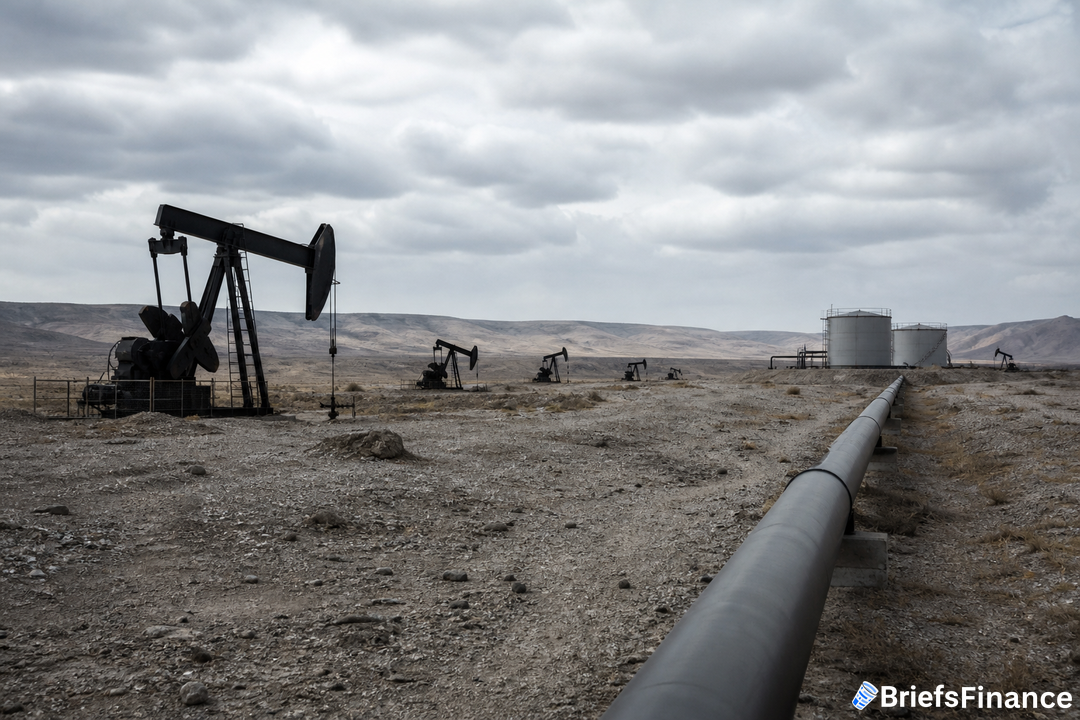
Chevron and Shell are stepping up purchases of Utah's Uinta Basin crude to tap its diesel, heating oil and lubricant yields.
Transport hurdles keep Uinta barrels priced well under WTI, averaging nearly $15 lower over the year's first eight months, per a Bloomberg read of recent EIA data.
Production has more than doubled since 2019 to above 200,000 barrels a day, with fresh drilling and multibillion-dollar deals accelerating.
Why buyers are suddenly interested
A once-local specialty barrel is getting national attention. Crude from the Uinta Basin in Utah's high desert is valued for yielding more diesel, heating oil, and high-margin base oils than many grades, and, unlike other extra-thick oils from Alberta or Venezuela, it contains little sulfur and few impurities, which makes it cheaper and easier to process. War-related snags in global crude flows have also nudged refiners to line up alternatives, even as Persian Gulf shipments move back toward pre-conflict levels.
That has drawn in the heavyweights. Andy Walz, Chevron's president for downstream, midstream and chemicals, put it this way: "It's American crude into American railroads into an American refinery for Americans." Chevron began purchasing Uinta barrels for its Pascagoula, Mississippi, refinery in July and is currently running up to 10,000 barrels a day there, with plans to lift that to as much as 15,000 barrels a day in the coming months, Walz said. Shell, meanwhile, has been sourcing Utah oil for its Norco facility just west of New Orleans.
The wax problem, the workarounds and the discount
There is a catch: Uinta's wax content is so high that when temperatures drop below roughly 105F (41C), the crude firms up to a ChapStick-like consistency. That rules out normal pipelines, so producers rely on heated railcars or trucks to move it. Those logistics are why a Bloomberg analysis of the latest available EIA figures shows Uinta barrels averaged almost fifteen dollars under West Texas Intermediate futures during the first eight months of the year.
The refining math can still win.
Output, deals and drilling step on the gas
For years, demand sat close to home, mostly at smaller Salt Lake City area plants, and basin volumes drifted down to levels that barely moved the national needle. Oil has deep roots in the region: natural seeps were noted in 1850, and close to 100 years after that Ashley Valley No. 1 became the first commercial well, but moving the crude to market remained difficult. A presentation by Plains All American Pipeline at a waxy crude summit reported output reaching 44,000 barrels a day in 1985 before sliding to roughly 20,000 in the early 2000s.
That has flipped. With Gulf Coast refiners leaning in and shale-era techniques pushing productivity, government data show Uinta output has more than doubled since 2019 to above 200,000 barrels a day, roughly on par with OPEC member Gabon. The ramp is fueling big checks: SM Energy in 2024 closed a $2.1 billion purchase of XCL Resources, and FourPoint in 2025 completed a $2 billion acquisition of Ovintiv's Uinta assets. SM is drilling laterals in the basin that approach three miles, and aims to add about a third more length before year-end, Blake McKenna, the Chief Operating Officer, told investors this month.
When energy and commodity trends affect everyday costs, stay informed with the free Market Briefs newsletter that explains it simply
Acreage is changing hands too. Uinta Wax LLC hired Jefferies to market drilling rights across 188,000 net acres, with documents seen by Bloomberg News putting the target value at more than $1 billion. Separately, Scout Energy Partners is in early-stage sale considerations, according to people familiar. Some sellers and advisers did not respond to requests for comment, and Jefferies, CIBC and Stephens said they would not comment. As Indigo Energy Advisors' director of geology Clint Barnette put it: "The Uinta checks all those boxes."
How refiners are making it pencil out
Chevron, the second-largest North American oil company, is buying Uinta from FourPoint Resources, and those trains take about three to four days to reach Pascagoula, Walz said. A key draw is base oils - the building blocks for lubricants - where Uinta shines. Chevron's Pascagoula plant is a major base-oil producer and can help fill the gap following damage to Shell's Pearl GTL plant in Qatar by Iranian strikes.
What this means for your portfolio: discounted feedstock plus high-value product yields are a margin cocktail refiners like, and Uinta's growth has also lit a fire under deals and drilling. Exposure to Gulf Coast refiners configured for waxy crudes, producers growing in northeastern Utah, or midstream players solving rail logistics puts you closer to where these dollars are moving.
When headlines touch many sectors, keep a calm view by subscribing to the free Market Briefs for concise daily context
Anthropic has gone public at a valuation of about $1.5 trillion, while Amazon went public in 1997 at around $440 million. Anthropic has about $33 billion in revenue this year and no profit, and investors are paying more than 40 times its sales, against about 3 times for Amazon. Briefs Finance CEO Jaspreet Singh says nobody knows what comes next, and that long-term investors use downturns to buy instead of panic selling.
Tech stocks are selling off because investors don't know who will lead Nvidia, the company that has been funding the AI industry and selling it chips.
Inflation has the Federal Reserve planning to raise interest rates, with a hike expected in December, and that puts pressure on homebuyers, private equity and the $40 trillion national debt.
Briefs Finance CEO Jaspreet Singh says nobody has a crystal ball, so his rules are to buy when markets are low, hold long term and invest only what you're willing to lose.
The national debt is above $40 trillion, and the Federal Reserve has gone from sending Washington its profits to losing money.
President Trump's four-part plan leans on shorter-term debt, stablecoin companies buying Treasuries, a bigger balance sheet and government stakes in private companies.
The goal is to outgrow the debt, not pay it off, so Jaspreet Singh points investors to the seven industries where Washington wants growth.
The Fed makes its next rate decision on December 9 and is now talking about jumbo interest rate hikes of 0.5%, though one in December looks unlikely.
Washington will pay a record $1.05 trillion in interest this year on $40 trillion of debt, and that debt resets at higher rates as the Fed hikes.
Jaspreet Singh's five moves are to pay down variable-rate debt, earn interest on your savings, know which stocks feel the pressure, look at value and hedge.
Margin debt, the money investors borrow to buy stocks, is at a record of around 4.6% of GDP, up from 3.9% in 2021.
ETF money has more than tripled in five years to 7% of GDP, while corporate buybacks and 401(k) money sit below their earlier peaks.
Margin calls and panic selling can make the next downturn deeper, so Jaspreet Singh keeps buying broad market funds and says most investors should skip margin debt.
Jensen Huang is out at Nvidia over affairs with multiple people, and the company he founded has been the bank of American AI, with about $30 billion into OpenAI and $10 billion into Anthropic.
A hotter-than-expected inflation report has Fed officials talking about a possible 0.5% hike in December, and gold, silver, and bitcoin fell on the news.
President Trump said the US may not need a deal with Iran, keeping oil prices and inflation risk high. Jaspreet Singh breaks down what it all means for AI stocks and your portfolio.
Stocks are booming at the fastest pace in years, jobless claims just hit a 57-year low, and most investors still feel like nobody is hiring.
The Fed is protecting the dollar over the economy, oil swings on every Iran headline, and a few AI companies are carrying an S&P 500 where four of five stocks sit in a correction.
Jaspreet Singh explains why circular financing between Nvidia, OpenAI, Anthropic, and SpaceX rhymes with 2008's house of cards, and how his three investing pillars handle a stock market bubble.
The Fed has raised rates, cut them, then raised them again only twice in the last 60 years, and both times the economy fell into a recession and stocks crashed.
The same stop-and-go cycle is playing out now, with one big difference: US debt is 125% of GDP today versus about 30% in 1980.
In the 1970s gold rose roughly 24x, real estate 157%, stocks lagged, and cash lost half its value. Jaspreet Singh lays out five assets to consider before the next flip.
The IRS 2027 tax plan keeps the same seven rates but widens every bracket and lifts the married-filing-jointly standard deduction to $33,200.
The 0% long-term capital gains bracket rises to $102,100, so a household living on $135,300 of investment income could owe $0 in federal income tax.
C corporations still pay 21%, small businesses keep the 20% QBI deduction, and the 401(k) limit climbs to $25,500 with an $8,500 catch-up for investors over 50.
Make sure to check your inbox for the first email.
Before you go
We’re hosting our first ever livestream on how investors can use ChatGPT & Claude to invest like a pro. It’s on 11/17 and is hosted by our CEO Jaspreet Singh.