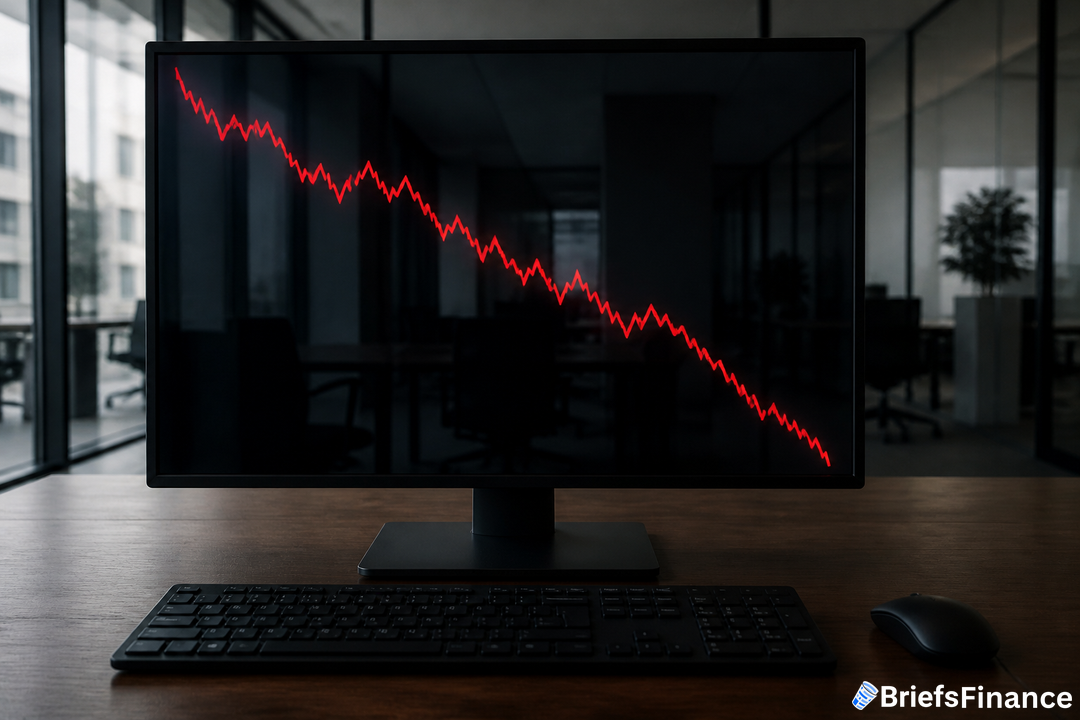
Nasdaq 100 fell 4.5% by 11:20 a.m. in New York and briefly hit the 20% off-peak mark that defines a bear market before trimming losses.
S&P 500 slid 2.9% as the VIX topped 33, a chipmakers ETF dropped more than 7%, and a Magnificent Seven basket fell nearly 4%.
Core PCE - the Fed's preferred inflation gauge - rose 0.3% in October and 3.3% year over year, keeping a December rate hike in play.
What moved markets
Selling hit megacap tech for a second straight day, with the Nasdaq 100 down 4.5% by late morning and briefly 20% below its closing high before bouncing a bit. The S&P 500 fell 2.9% while the VIX climbed above 33, a level that signals mounting stress.
AI-linked leaders led the slide. A Magnificent Seven basket shed nearly 4%, paced by Nvidia's 7.8% drop, while Tesla, Microsoft, Meta and Apple also fell. The Nasdaq 100 is now down year to date, and the S&P 500 is on pace for the bleakest November since the peak of the 2008 financial crisis.
The AI pop tied to Jensen Huang's return to Nvidia's helm on Monday faded fast as investors homed in on the costs, risks and profit math of artificial intelligence - concerns that outweigh any single executive's influence. The US listing of Taiwan Semiconductor Manufacturing - Nvidia's primary foundry partner - declined 6.6%, while memory maker SK Hynix dropped 7.1%.
Defensives found some footing. Out of the 11 S&P 500 groups, three advanced, led by consumer staples, although the equal-weighted S&P 500 still fell about 1%.
Why the air came out of AI
Investors are questioning whether AI spending is running ahead of returns, with heavy funding needs and capital outlays weighing on earnings prospects. He cited volatility in Nvidia, ongoing Fed tightening, and concern that tech earnings growth may have peaked, and he noted that lenders still doubt the near-term payoff from AI. Panmure Liberum strategist Joachim Klement echoed that "Markets remain mired in concerns about the sustainability of the AI boom."
Holiday timing is compounding the swings. Thinner-than-usual liquidity into a shortened US week can magnify moves, and markets are closed Thursday for Thanksgiving with an early 1 p.m. close on Friday in New York.
When markets feel uncertain, stay calmly informed with our free Market Briefs newsletter that summarizes economy, stocks, crypto, and real estate
Systematic selling may add fuel. Goldman Sachs estimates commodity trading advisors will offload about 68 billion dollars of equities globally over the next five sessions, mirroring the wave seen during the prior five-day stretch ending Friday, when stocks suffered their most severe week since the Covid-19 pandemic. Allocations across these strategies have already been cut to multi-year lows.
Inflation, tariffs and the company tape
New data indicated that core PCE - the Fed's preferred gauge that excludes food and energy - increased 0.3% in October and 3.3% from a year earlier, while overall PCE ran at 3.8%. That keeps policymakers aligned with another rate hike next month. Jed Ellerbroek, a portfolio manager at Argent Capital Management, said, "Fed officials have expressed determination to solve the problem of sticky inflation, which raises concerns that another rate hike may be coming in December." He added that traders are debating whether the selloff is effectively doing part of the Fed's job and could lead to a pullback.
Trade policy is another headwind. "Reports of new US tariff plans add further pressure on markets," wrote Tom Essaye, founder of The Sevens Report. "The Trump administration is preparing new tariffs on imports from more than a dozen major trading partners following a probe into excess industrial capacity, reigniting trade tensions."
Corporate news showed how uneven the AI ripple is. Dell raised its fiscal year revenue outlook for the third time as AI data center buildouts boost server demand, yet the stock fell alongside tech. HP said profit for the current year will likely top analysts' estimates, signaling better management of higher memory costs, and its shares jumped as much as 15%.
The bottom line: AI enthusiasm is colliding with cost math, inflation is still running hot, tariff risks are back on the table, and mechanical sellers are active. Expect choppier trading, with AI and chip supply chains most exposed.
Because signals can change quickly, sign up for Market Briefs to get a five minute daily roundup of key market developments
Anthropic has gone public at a valuation of about $1.5 trillion, while Amazon went public in 1997 at around $440 million. Anthropic has about $33 billion in revenue this year and no profit, and investors are paying more than 40 times its sales, against about 3 times for Amazon. Briefs Finance CEO Jaspreet Singh says nobody knows what comes next, and that long-term investors use downturns to buy instead of panic selling.
Tech stocks are selling off because investors don't know who will lead Nvidia, the company that has been funding the AI industry and selling it chips.
Inflation has the Federal Reserve planning to raise interest rates, with a hike expected in December, and that puts pressure on homebuyers, private equity and the $40 trillion national debt.
Briefs Finance CEO Jaspreet Singh says nobody has a crystal ball, so his rules are to buy when markets are low, hold long term and invest only what you're willing to lose.
The national debt is above $40 trillion, and the Federal Reserve has gone from sending Washington its profits to losing money.
President Trump's four-part plan leans on shorter-term debt, stablecoin companies buying Treasuries, a bigger balance sheet and government stakes in private companies.
The goal is to outgrow the debt, not pay it off, so Jaspreet Singh points investors to the seven industries where Washington wants growth.
The Fed makes its next rate decision on December 9 and is now talking about jumbo interest rate hikes of 0.5%, though one in December looks unlikely.
Washington will pay a record $1.05 trillion in interest this year on $40 trillion of debt, and that debt resets at higher rates as the Fed hikes.
Jaspreet Singh's five moves are to pay down variable-rate debt, earn interest on your savings, know which stocks feel the pressure, look at value and hedge.
Margin debt, the money investors borrow to buy stocks, is at a record of around 4.6% of GDP, up from 3.9% in 2021.
ETF money has more than tripled in five years to 7% of GDP, while corporate buybacks and 401(k) money sit below their earlier peaks.
Margin calls and panic selling can make the next downturn deeper, so Jaspreet Singh keeps buying broad market funds and says most investors should skip margin debt.
Jensen Huang is out at Nvidia over affairs with multiple people, and the company he founded has been the bank of American AI, with about $30 billion into OpenAI and $10 billion into Anthropic.
A hotter-than-expected inflation report has Fed officials talking about a possible 0.5% hike in December, and gold, silver, and bitcoin fell on the news.
President Trump said the US may not need a deal with Iran, keeping oil prices and inflation risk high. Jaspreet Singh breaks down what it all means for AI stocks and your portfolio.
Stocks are booming at the fastest pace in years, jobless claims just hit a 57-year low, and most investors still feel like nobody is hiring.
The Fed is protecting the dollar over the economy, oil swings on every Iran headline, and a few AI companies are carrying an S&P 500 where four of five stocks sit in a correction.
Jaspreet Singh explains why circular financing between Nvidia, OpenAI, Anthropic, and SpaceX rhymes with 2008's house of cards, and how his three investing pillars handle a stock market bubble.
The Fed has raised rates, cut them, then raised them again only twice in the last 60 years, and both times the economy fell into a recession and stocks crashed.
The same stop-and-go cycle is playing out now, with one big difference: US debt is 125% of GDP today versus about 30% in 1980.
In the 1970s gold rose roughly 24x, real estate 157%, stocks lagged, and cash lost half its value. Jaspreet Singh lays out five assets to consider before the next flip.
The IRS 2027 tax plan keeps the same seven rates but widens every bracket and lifts the married-filing-jointly standard deduction to $33,200.
The 0% long-term capital gains bracket rises to $102,100, so a household living on $135,300 of investment income could owe $0 in federal income tax.
C corporations still pay 21%, small businesses keep the 20% QBI deduction, and the 401(k) limit climbs to $25,500 with an $8,500 catch-up for investors over 50.
Make sure to check your inbox for the first email.
Before you go
We’re hosting our first ever livestream on how investors can use ChatGPT & Claude to invest like a pro. It’s on 11/17 and is hosted by our CEO Jaspreet Singh.