Free NewsletterPro Login

Warning: Undefined variable $stocks in /var/www/briefs.co/htdocs/wp-content/plugins/oxygen/component-framework/components/classes/code-block.class.php(133) : eval()'d code on line 448

Warning: foreach() argument must be of type array|object, null given in /var/www/briefs.co/htdocs/wp-content/plugins/oxygen/component-framework/components/classes/code-block.class.php(133) : eval()'d code on line 448

Warning: Undefined variable $funds in /var/www/briefs.co/htdocs/wp-content/plugins/oxygen/component-framework/components/classes/code-block.class.php(133) : eval()'d code on line 472

Warning: foreach() argument must be of type array|object, null given in /var/www/briefs.co/htdocs/wp-content/plugins/oxygen/component-framework/components/classes/code-block.class.php(133) : eval()'d code on line 472
/* the link was here */

Pokémon Card Sale Fuels Surge in Non-Sports and TCG Collectibles

Published Oct 11, 2026
Share:
Summary:
  • A 1998 Pikachu Illustrator card sold for $16.5 million; seller Logan Paul said he paid $5.3 million plus a trade in 2021.
  • Heritage's TCG unit is now a $50 million business; total sales at the house topped $2.1 billion in 2025, with about $10 million from non-sports.
  • PSA's output in 2025 surpassed 19 million cards, and parent company Collectors is putting $200 million into expanding PSA.

The sale that turned heads

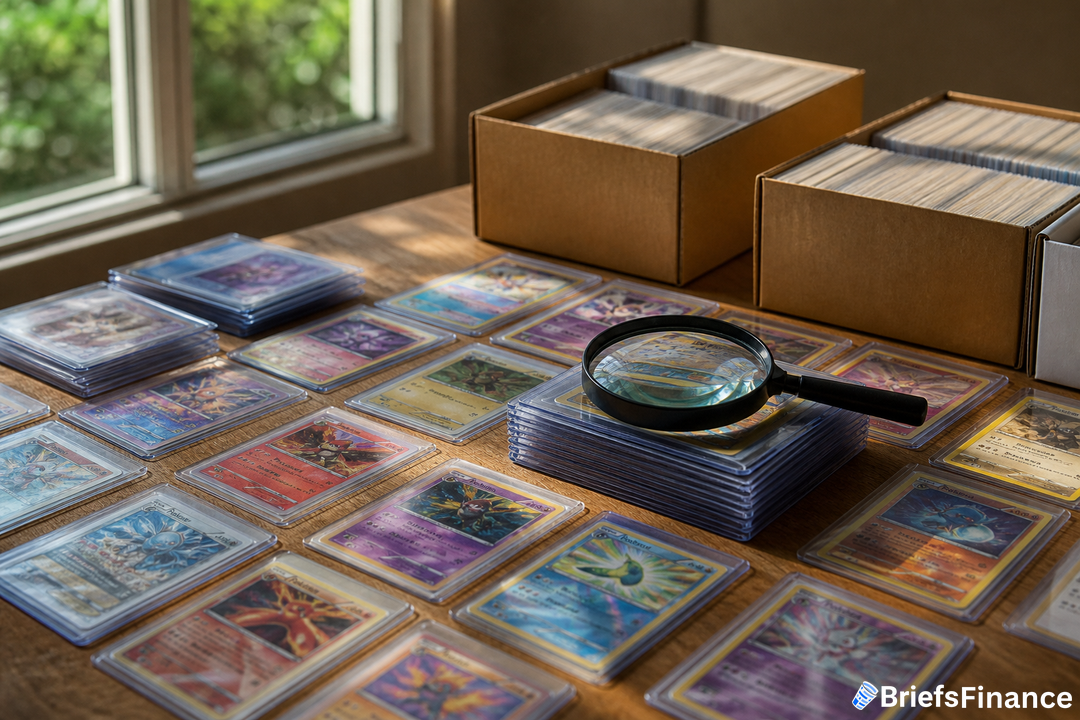
A 1998 Pikachu Illustrator Pokémon card changed hands for $16.5 million earlier this year. The seller was Logan Paul, who said he originally acquired it in 2021 for $5.3 million plus a trade. That eyebrow-raising price point follows the 2022 sale of a Topps 1952 Mickey Mantle baseball card for $12.6 million and underscores how trading card games - think Pokémon, Magic: The Gathering and Yu-Gi-Oh - and broader non-sports cards are muscling into a sports-card market many see as overstuffed.

For collectors and speculators alike, the draw is clear. Outside the playing field, non-sports cards span everything from historical sets to pop culture icons like Luke Skywalker, with values hinging on rarity, authenticity and condition.

Where the money is flowing

Demand is rising on the biggest marketplaces. "It is one of our fastest-growing categories that we've seen and one of the largest contributors to [our] growth over the last number of quarters," said Adam Ireland, who leads eBay's collectibles business as VP and GM; the marketplace also verifies items and provides pricing tools for TCGs and non-sports cards. "From an investment point of view, you start with Pokémon," he said, noting it ranked as the top search on eBay's collectibles platform during the first six months of the year.

Auction houses are leaning in too. Six years back, Heritage set up an in-house department focused on TCG. "Now it's a $50-million category," said executive vice president Joe Maddalena.

That figure is just for TCGs. He noted that non-sports also contributed around $10 million to Heritage's 2025 haul, which totaled more than $2.1 billion.

Headline sales continue to stack up. Heritage now pegs a first-edition Pokémon Charizard that was worth $20,000 before Covid at $500,000. On eBay, a Tyler the Great Warrior Yu-Gi-Oh!

card fetched $311,211, and Magic's Black Lotus has sold for $500,000. In May, a 1977 Luke Skywalker card realized $687,500 at Heritage.

On the retail side, ICv2 reported that sales of newly released TCG products hit $2.5 billion in 2025. Editor-in-chief Milton Griepp said the tally this year is on track to be close to $5 billion, helped by excitement around Pokémon's 30th anniversary. He also flagged that resale volumes from platforms such as eBay and TCGplayer are harder to pin down, so the estimates come with some air in the numbers.

Collectibles markets move on scarcity and sentiment in equal measure. Market Briefs covers alternative assets free every weekday.

Grading is the gatekeeper

Pricing power in this corner of collectibles rides on how cards grade out. PSA, founded in 1991, starts by confirming a card is genuine, then rates condition on a 1 to 10 scale where 10 is gem mint. Populations of PSA 10s for the most chased cards tend to be tiny, which is why top grades can command huge premiums.

Since it began, PSA has evaluated non-sports cards. "But with more people viewing it as a potential asset class or thing they want to potentially invest in or speculate in, you're seeing more demand for grading services in the last seven years," said PSA president Ryan Hoge. PSA's 2025 output topped 19 million cards, up from two million in 2020.

By last May, the company's tally exceeded eight million graded cards, with January through April production up 39% year over year. Hoge said TCGs now represent 50% of PSA's business, more than all sports cards combined.

To keep pace, PSA's parent, Collectors, is committing $200 million to the operation. The plan is to double PSA's physical footprint, roll out new logistics tech and hire 1,000 additional employees, including hundreds of graders. Collectors additionally holds a portfolio of vertically integrated businesses - among them Beckett, SGC and Card Ladder.

Beyond sports: who's buying and why

Trading cards have been around for over a century, but the mix is changing. Sports cards traditionally featured baseball, football, basketball and hockey stars from brands like Topps, Upper Deck, Fleer and Donruss, with Topps acquired by Fanatics in 2022. Baby boomers helped build the sports card boom, and the market saw big waves in the early 1990s and again during the pandemic, when stimulus-fueled consumers poured in. Today the action has tilted toward rare vintage icons and high-end inserts, while modern base sets have been produced in volume.

As prices climbed in sports, collectors started looking elsewhere. "The sports side of the hobby has gotten so expensive," said Jeff Copeland, an emeritus professor at the University of Northern Iowa and longtime collector who writes for The Wrapper. "In some cases, cards that sold 10 years ago for $20 are now $1,000. So collectors feeling the pinch in sports cards looked across the aisle at non-sports cards, remembered collecting them in their childhood and saw the value on the prices." He estimates that about 95% of non-sports collectors today aren't in it primarily for investment.

New money is showing up too. Non-sports dealer Alex Tymchuk said some newcomers "weren't really into baseball or basketball [card] collecting, but they can relate to Mickey Mouse, Spider-Man or Captain America." Veteran dealer Kit Young has noticed "younger folks coming in with money. People think [the cards] are going to go up in value, so they're buying on the come based on the future."

For your wallet, the takeaway is simple enough. Prices can climb fast when supply is thin, grading populations are low and demand is hot. But this market lives and dies on authenticity, condition and verifiable sales, not hype. If you're tracking collectibles alongside your other assets, the trends to watch are where buyers are flocking, how many top-grade copies exist and how quickly the big platforms can certify and move inventory.

Record sales tend to pull the whole category up with them. Join Market Briefs free and follow the trend.

Disclosure

Recent News

1 2 3 … 98

Get Market Briefs delivered to your inbox every morning for free!

No fluff. No noise. No politics. Just finance news you can read in 5 minutes.

Blogs

October 5, 2026
What Is the Briefs Connector? A Simple Guide
  • The Briefs Connector lets your favorite AI read Briefs research, like Pro reports and the Briefs Score.
  • Without it, an AI asked about investing can give answers that sound right but aren't backed by that research.
  • It explains the research, but it won't tell you what to buy or sell.
Read More
October 5, 2026
Is a Recession Coming? What the Last Five Rate Hiking Cycles Say
  • The Fed has started raising rates again, and in the last five hiking cycles going back to 1994, a recession never started while the hikes were underway.
  • The pain showed up where there was a bubble to pop - housing in 2008, dot-coms in 2000, the pandemic money-printing boom in 2022 - and usually after the hikes ended.
  • Private equity and private credit are feeling this cycle first, and how far the pain spreads depends on how high rates go and how long they stay there.
Read More
October 2, 2026
Fed Interest Rates May Rise Again in 2026 - and the Newest Culprit Is AI
  • Fed Governor Barr told a meeting our head of investing research attended that higher rates are likely in 2026, lower inflation may not come soon, and AI is now pushing prices up.
  • The same week, President Trump asked the biggest AI companies to police themselves under an accord that's morally but not legally binding, because the White House sees AI as a race with China.
  • Higher rates put downward pressure on asset prices and squeeze borrowers, but the way through hasn't changed: own investments, buy on a schedule, and treat downturns as discounts.
Read More
October 1, 2026
Housing Market 2026: Why Office Buildings Are Cracking Before Houses Do
  • Office buildings are selling for 80% to 95% off because their five-year loans are resetting at much higher rates while half-empty floors have gutted the income those buildings are valued on.
  • Housing is under pressure, not cracking: a $400,000 mortgage costs $975 more a month than at 3%, but six of every seven mortgages are still under 6% and those owners are staying put.
  • Whether pressure turns into cracks is a race between unaffordability and the economy, and either way Jaspreet's rule is to treat your house as a liability and buy only what you can afford.
Read More
September 30, 2026
Dividend Investing vs. Growth Investing: Why the Slower Portfolio Can End Up Bigger
  • "What stock should I buy?" is the wrong first question. Growth, income, or wealth preservation comes first, and the goal changes which stocks even make sense.
  • At $500 a month for 30 years, 13% growth builds about $1.75 million. 10% growth plus a reinvested 4% dividend builds a little more than $2.2 million and pays a little more than $80,000 a year.
  • Income investors have US dividend ETFs, REITs, and international dividend funds to study. Growth investors have the Nasdaq 100, AI and chip funds, and small caps. None of it is a recommendation.
Read More
September 29, 2026
Why Is Gold Going Down? A 5.2% Treasury Yield Just Took Its Job
  • President Trump rejected Iran's deal to reopen the Strait of Hormuz, oil prices jumped back up, and gold fell instead of rising.
  • Treasury yields hit their highest level in more than 20 years, so investors sold gold and bought Treasuries that pay interest.
  • Higher Treasury yields make the national debt, mortgages, car loans, and credit cards more expensive, with the Fed's next rate decision due October 28.
Read More
September 28, 2026
The Strategic Bitcoin Reserve: Why the Government Wants Bitcoin to Explode
  • The US government holds about 328,000 Bitcoin, worth roughly $25 billion, and since a 2025 executive order it keeps seized coins instead of selling them.
  • Washington wants a bigger pile of assets so its $40 trillion national debt looks smaller next to them, which lets it keep borrowing and spending.
  • Bitcoin's wild price swings, and a government holding a coin built to escape governments, are the two risks investors need to watch.
Read More
September 25, 2026
BRIEFS EXCLUSIVE: 43% Of Respondents Say Bills Outran Their Income Over Past Two Years
  • 43% of the 494 Market Briefs readers surveyed said their bills grew faster than their income over the past two years, even though 79% could cover a surprise $5,000 expense tomorrow.
  • Half of readers own gold or crypto, the two classic bets against a weaker dollar, and only 13% bought nothing at all in the last 12 months.
  • The median reader says it takes $150,000 a year to feel financially secure, about $62,000 above the U.S. median household income.
Read More
September 25, 2026
The Economy Is Booming. So Why Did Stocks and Bonds Fall Together?
  • S&P Global says the US economy is growing at its fastest rate since 2021, with corporate profits up 28.9% in a year, almost four times the historical average.
  • Stocks and bonds fell at the same time, which is not how the two markets normally behave, because Treasury yields above 5% now compete with stocks for investors' money.
  • Jaspreet Singh lays out three ways to invest through a shift like this: always be buying, buy the crash, or follow the money before it hits the headlines.
Read More
September 24, 2026
The 2026 Economic Reset Is Starting: Are We in a Recession, or Is the Pain Still Ahead?
  • The Federal Reserve has flipped from stimulating the economy to fighting inflation with higher interest rates, while the White House still wants growth at almost any cost.
  • The national debt tops $40 trillion, has outgrown the entire U.S. economy, and its interest payments are now the government's fastest-growing expense.
  • Higher rates bring pain for private equity, private credit, and speculative assets, but they open opportunities for investors holding cash, treasuries, and value assets.
Read More
1 2 3 … 28
Share via
Copy link










