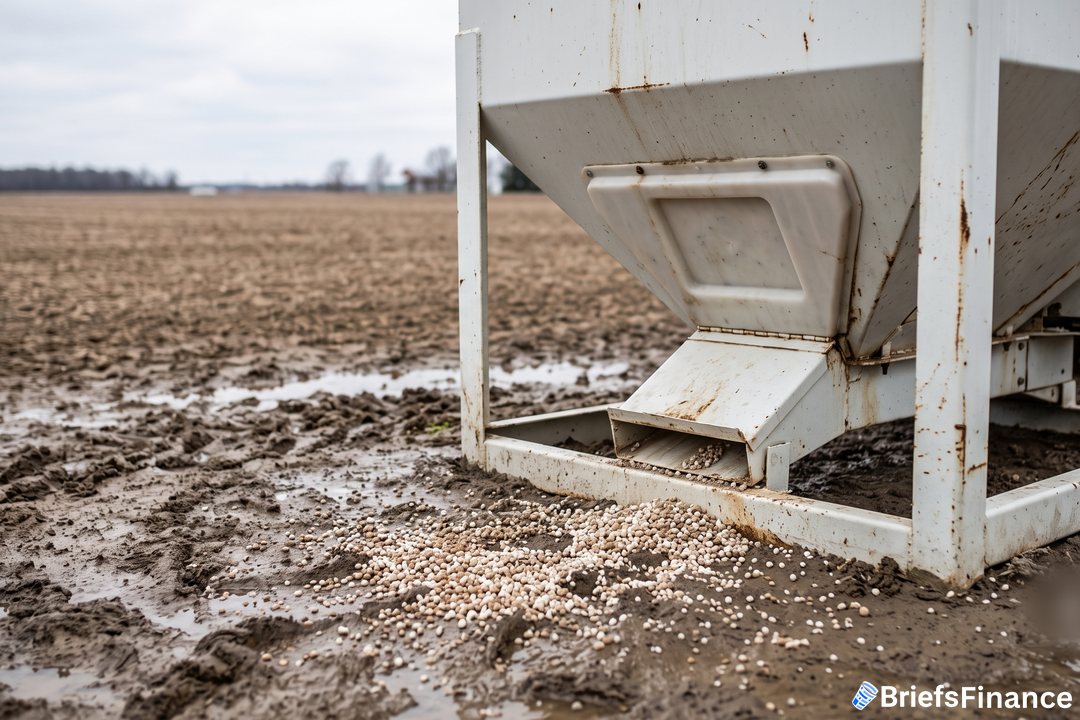
Farmers across the United States face higher expenses for fuel and fertilizer while crop prices remain stagnant. A new survey from the American Farm Bureau Federation indicates that almost six in 10, or 58%, of farmers report worsening financial conditions. The reason: shipping disruptions in the Middle East have closed the Strait of Hormuz, pushing fertilizer prices higher just as spring planting begins.
The survey, conducted from April 3 to April 11, 2026, shows wide regional differences. In the South, 78% of Southern farmers say they can't afford all required fertilizer. In the Midwest, 48 percent said they lacked the funds to obtain the fertilizer needed. Across the Western, Northeast and Southern regions, at least 66% of farmers report the same shortfall.
Lorenda Overman, a farmer in Goldsboro, North Carolina, described the pressure. "We're always battling weather, disease and insects," she said. "Three years we've had record high input prices, and it has just got higher the last six or eight weeks."
Get your free investing masterclass bonus when you join Market Briefs, our free daily newsletter
On her farm, the cost for fertilizer and nitrogen per acre jumped from $139 per acre last year to an unexpected $217 this season.
Many farmers did not pre-book fertilizer ahead of the season. Only 19% of Southern farmers ordered it early, compared with 67% of Midwest farmers. That left late buyers exposed when prices spiked.
Tommy Salisbury, who farms in Oklahoma and serves as a leader in the Farm Bureau's young farmers and ranchers group, described the situation. "That increase that we've talked about on fertilizer happened right before spring planning. It was the worst timing of all," said Salisbury. "We were already budgeted." He added: "We are paying input prices of 2026, but getting crop prices of the '70s and '80s."
The financial strain is not limited to input costs; farmers are also grappling with unpredictable weather patterns and trade policy uncertainties. Many are forced to take out additional loans or dip into savings to cover the gap, raising concerns about long-term sustainability for smaller family farms.
In response, farmers are shifting what they plant. Lorenda Overman said: "We're going to cut back on our acreage of corn and try to plant a crop that's a little less fertilizer and nitrogen dependent, which would be soybeans. We're also going to … spread that fertilizer, a little bit thinner." That means lower yields and less overall production for 2026. For rice, cotton and peanut producers, more than 80% say they cannot afford necessary inputs.
The American Farm Bureau Federation plans to meet with the White House in the coming months to advocate for additional assistance for farmers. Because large areas of the South, Northeast, and West cannot fully fertilize their fields, the Farm Bureau warns that these risks are growing.
Subscribe to Market Briefs, our free daily newsletter, and claim your bonus investing masterclass